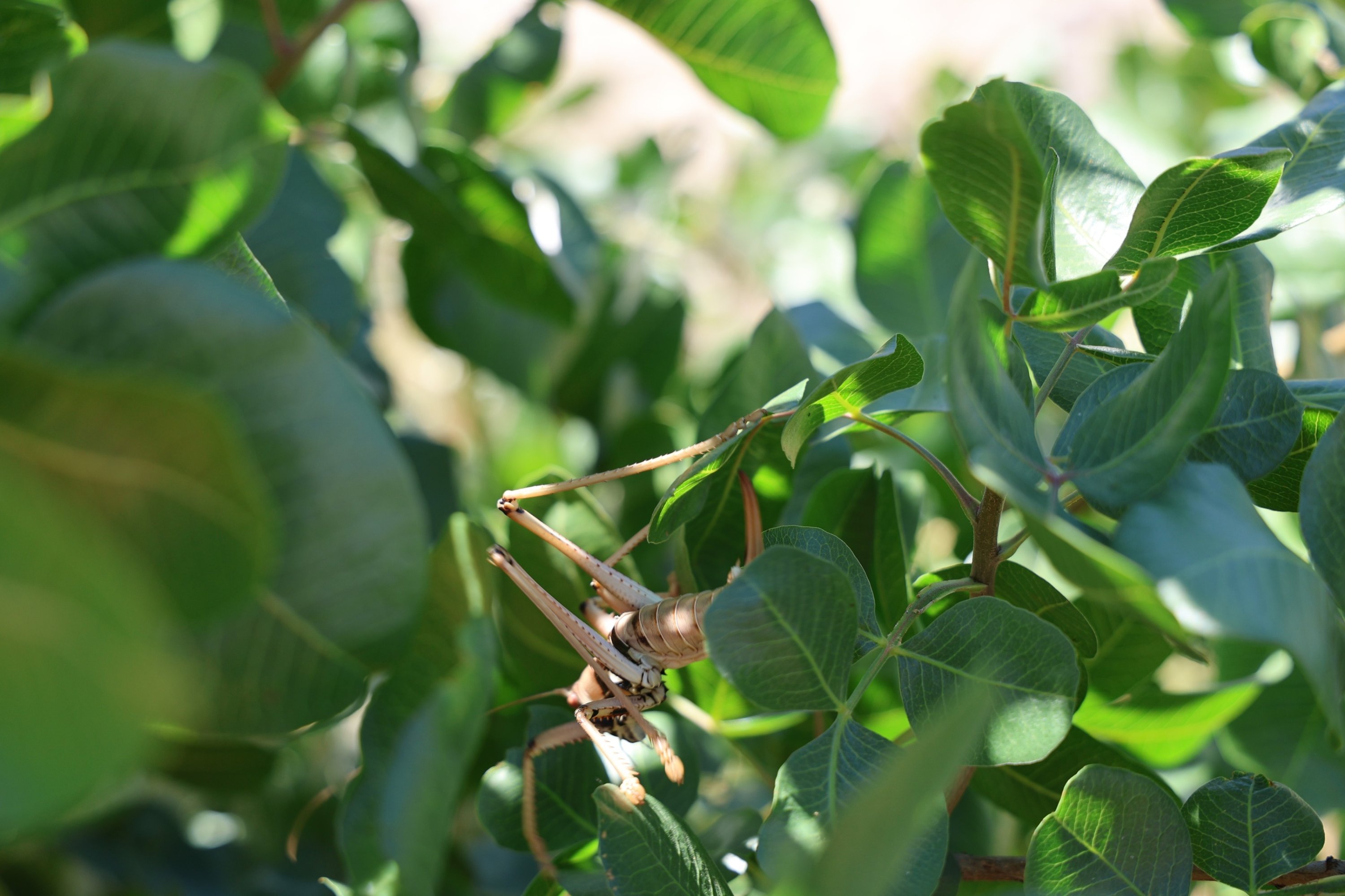
Giant grasshoppers spotted across several provinces in Türkiye's Marmara region have sparked concern among residents, but experts and authorities say there is no evidence of an infestation or threat to agriculture.
The unusually large insects, believed to have entered Türkiye through the Balkans, have recently been reported in Bursa, northwestern Türkiye, after earlier sightings in the neighboring Marmara provinces of Edirne, Istanbul and Kocaeli.
Videos and photographs shared on social media show the insects resting on apartment balconies, garden walls and windows, while some have entered homes and workplaces through open windows, particularly during the evening. One resident even kept a captured specimen in a glass jar and fed it lettuce.
Others have experimented with homemade methods to keep the insects away. One widely shared video shows a resident pouring a mixture of white vinegar and water around a balcony and windows in an attempt to repel the grasshoppers.
Dr. Ergün Bacak, head of the Hunting and Wildlife Program at Istanbul University-Cerrahpaşa's Vocational School of Forestry, said most of the insects seen in Istanbul are white-faced bush crickets, a species that can reach 5 to 6 centimeters (2 to 2.4 inches) in length.
He said the insects' large bodies, long antennae and powerful legs make them appear intimidating but stressed they are not an invasive species and do not pose a threat to people or crops.
"This is not a swarming grasshopper species. At most, 1 or 2 individuals may enter a person's home. Social media has created the perception that there is a widespread grasshopper invasion, but that is not the case," Bacak said.
He added that the insects are active at night and are attracted to artificial lights rather than food, explaining why they often enter homes through open windows. Bacak also noted that the species feeds on plants and other insects, helping maintain ecological balance, and does not spread disease or damage agricultural products.
Despite the growing attention online, the Tekirdağ Provincial Directorate of Agriculture and Forestry said field inspections have found no reports or evidence of a grasshopper infestation or crop damage.
The directorate said provincial and district teams are continuing regular surveys in areas that could serve as grasshopper breeding grounds. If egg-laying sites are identified, authorities will carry out pest control measures under the state's agricultural support program, regardless of land ownership.
Bacak also said the recent rise in sightings is temporary, explaining that warmer weather has brought adult insects out after hatching in late spring and early summer. He noted that populations of some grasshopper species naturally peak every five to six years and predicted the current increase would subside within a few weeks.
Meanwhile, in the southeastern province of Diyarbakır, another large grasshopper species has also drawn attention. The insect, identified as the predatory bush cricket, has been spotted in the rural Kral Yolu area of Çermik district.
Entomologist Ali Satar said the species can grow up to 25 centimeters long and is commonly found in high-altitude areas of Southeastern and Eastern Türkiye.
Satar stressed that the predatory bush cricket is harmless to people and crops and, in fact, benefits agriculture by feeding on harmful insects.
"The species poses no danger to humans or agriculture. On the contrary, it helps control agricultural pests, so it should be protected," he said.
This version adds the new expert's explanation while avoiding repetition and strengthens the article by explaining why the insects are entering homes, why social media exaggerated the situation, and why the increase in sightings is temporary.