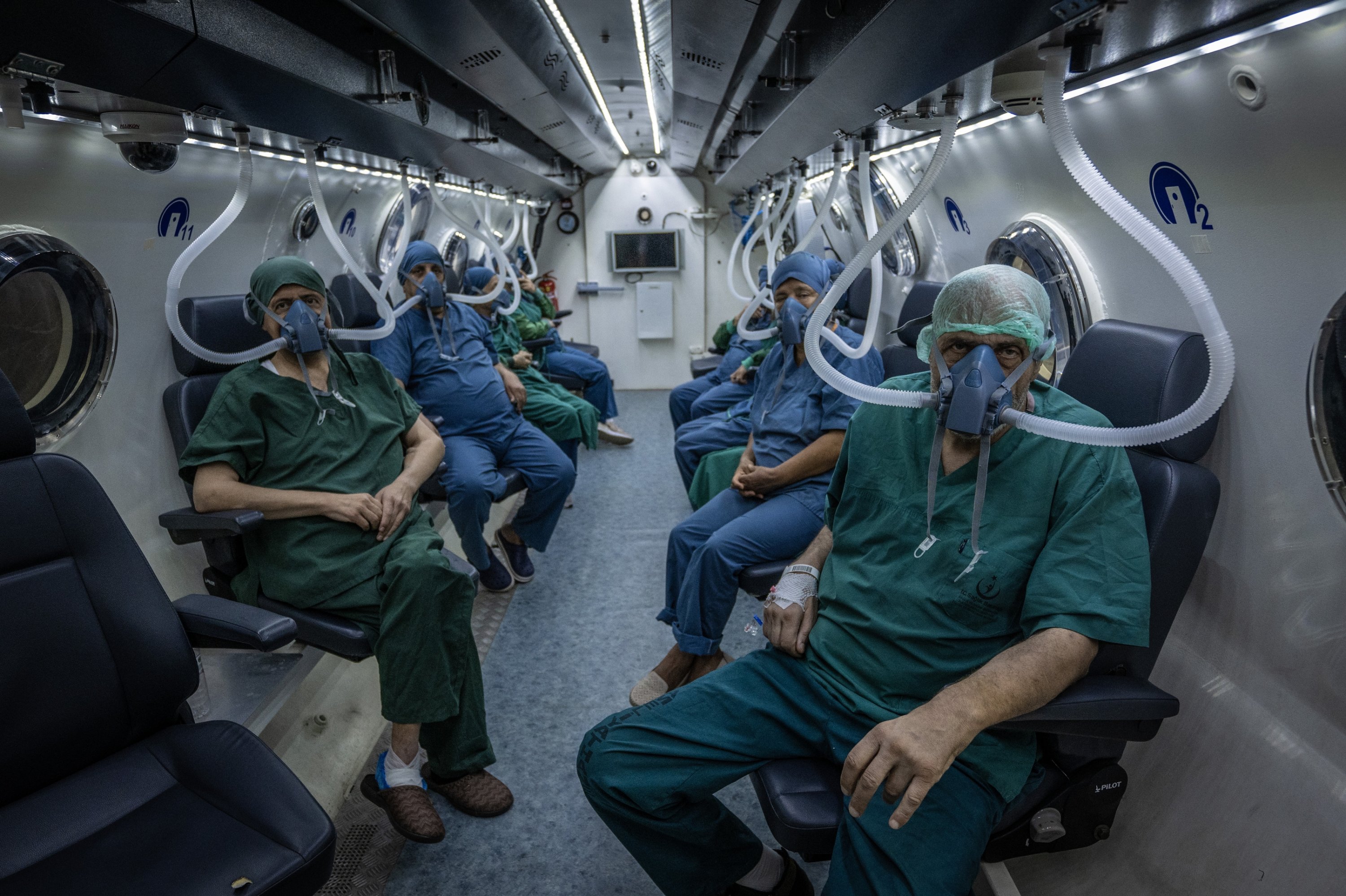
A physician who survived the 1999 Marmara earthquake after spending 17 hours under the rubble of his home is now helping patients at Istanbul’s Sultan Abdülhamid Han Training and Research Hospital recover from crush injuries, carbon monoxide poisoning and diving-related illnesses through hyperbaric oxygen therapy.
Dr. Yavuz Aslan, who was a medical student and living in Gölcük, in Kocaeli Province in northwestern Türkiye, when the Aug. 17, 1999 earthquake struck, was rescued with minor injuries and no permanent damage after his home collapsed. He lost close friends and neighbors in the disaster.
Years later, his experience of the earthquake, together with his interest in diving, influenced his decision to specialize in underwater and hyperbaric medicine.
Today, Aslan works at the hospital’s Underwater Medicine and Hyperbaric Medicine Clinic, where he treats patients suffering from a range of conditions, including crush injuries, carbon monoxide poisoning and diving-related illnesses.
The treatment is also used for acute traumatic ischemia, soft-tissue infections and sudden hearing and vision loss.
Aslan said his experience during the earthquake played an important role in his decision to pursue underwater medicine.
He also said his experience as a diver contributed to his decision to work in the field. “I am also a three-star diver. My diving experience also influenced my decision to choose this department,” he said.
The Hyperbaric Oxygen Therapy Center at Sultan Abdülhamid Han Training and Research Hospital was among the hospital’s first clinics established in 1984.
He said the center was also among the first at the hospital to introduce hyperbaric oxygen therapy. Because the hospital was formerly a military institution, it has also treated and examined naval divers, while diving-related illnesses among Underwater Defense (SAS) commandos have been treated there.
Hyperbaric oxygen therapy is administered inside a fully enclosed pressure chamber. Patients breathe 100% oxygen through a mask while the atmospheric pressure is gradually increased.
Explaining the treatment process, Aslan said patients are given special clothing because of the risk of fire associated with oxygen. They also remove makeup, while female patients are asked to tie their hair back before the chamber is sealed.
“After we close the doors, we begin the dive from the operator section. We conduct the dive with air. We start pumping air inside with a compressor. When we reach approximately 45 feet, or 15 meters underwater, we stop pressurizing. We have patients breathe 100% oxygen through a mask,” he said.
Aslan said people normally live at sea level under approximately one atmosphere of pressure and breathe air containing about 21% oxygen.
“In hyperbaric oxygen therapy, we increase the ambient pressure to approximately 2.5 atmospheres. In this way, they receive 17 to 18 times more oxygen. The treatment lasts approximately two hours,” he said.
Aslan said hyperbaric oxygen therapy can be particularly important for patients suffering from crush injuries following earthquakes.
Such injuries can cause tissue damage and infections and may put patients at risk of losing their limbs. Increasing oxygen delivery to damaged tissues can support healing and help prevent amputation in some cases.
Following the Feb. 6, 2023 earthquakes in southern Türkiye, the clinic treated approximately 60 to 70 patients, particularly children, Aslan said.
Aslan said hyperbaric oxygen therapy is also used to treat carbon monoxide poisoning, which can occur following exposure to stove or natural gas fumes in enclosed spaces.
Carbon monoxide can cause neurological effects, including fainting, impaired vision and speech, loss of consciousness and, in severe cases, death.
“We quickly take patients into the pressure chamber for oxygen therapy and ensure that carbon monoxide is eliminated from the body,” Aslan said.
He explained that the gas, which would normally take 15 to 20 hours to leave the body gradually, can be eliminated much more rapidly through the treatment.
“We eliminate the gas from patients’ bodies in two hours, or even within half an hour. When we bring an unconscious patient into the chamber, they can walk out 2 hours later,” he said.