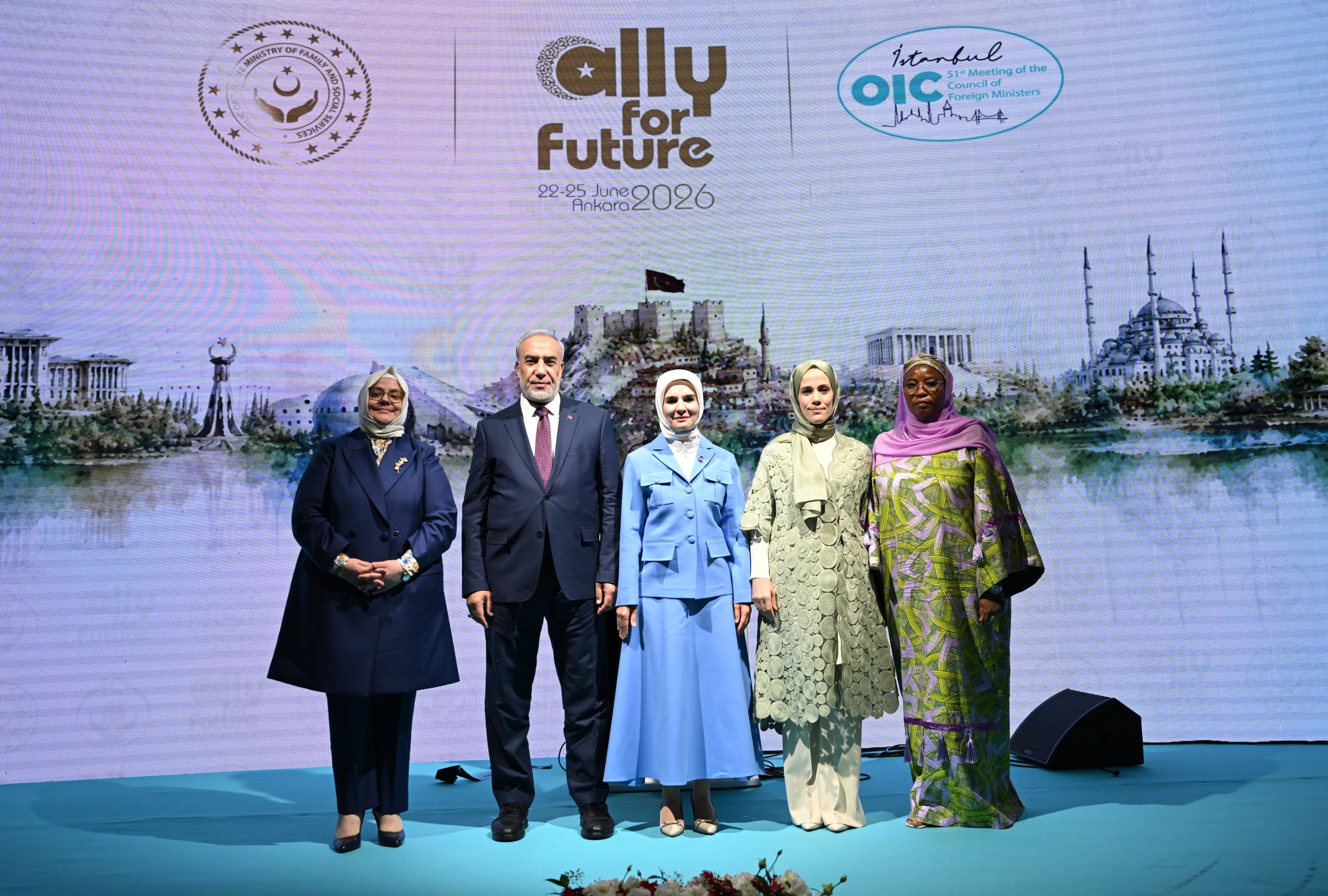
Young Muslim women from 25 countries gathered in Ankara on Monday for the ALLY for Future: Young Muslim Women Leadership Program, where speakers highlighted the importance of leadership, representation and building future solutions rooted in the cultural and intellectual traditions of Muslim societies.
Speaking at the opening session, ALLY for Future founder and Chair of the Board of Trustees of the NUN Education and Culture Foundation Dr. Esra Albayrak called on young Muslim women to play a greater role in shaping future narratives and addressing global challenges, saying women who demonstrate leadership under difficult circumstances are often overlooked in dominant global narratives.
Delivering a speech titled "Women Who Make a Difference: Leadership Examples in the Struggle for Human Rights," Albayrak said Muslim women are frequently portrayed either as victims in need of rescue or as individuals to be blamed, while their ability to act as leaders and agents of change is often ignored.
Referring to the war in Gaza, she criticized narratives that place responsibility on Palestinian women while overlooking the realities they face and the leadership they display during times of crisis.
She also challenged assumptions surrounding Muslim women's choices, particularly regarding the headscarf, saying many discussions fail to recognize women as independent actors capable of making decisions based on their own beliefs and values.
While supporting efforts to protect women's rights and dignity, Albayrak said she opposed attempts to impose a single model of womanhood under the banner of universal values.
The ALLY for Future founder urged participants to draw inspiration from influential women in Islamic history, including Khadija and other prominent figures who played active roles in commerce, scholarship and public life.
"A leader is not the person who receives the most applause or attention," Albayrak said. "A leader is someone who creates meaning, inspires others and transforms the place where they stand."
Addressing young participants, she said the world is currently experiencing a historic transition shaped by the humanitarian crisis in Gaza and the rapid advancement of artificial intelligence.
"The old map is collapsing, and the new map has not yet been drawn," she said. "We have an opportunity to help shape that future."
Addressing the program, Family and Social Services Minister Mahinur Özdemir Göktaş said the gathering serves as an important platform for strengthening women's leadership across the Islamic world and encouraging young Muslim women to take a more active role in decision-making processes.
"I believe this program will contribute to young Muslim women taking a more active role in decision-making processes," Göktaş said. "At the same time, it will provide an important foundation for producing more capable, confident and strategic responses to today's and tomorrow's global challenges."
The minister described women's leadership as a long-standing reality throughout Islamic civilization, reflected in education, family life, charitable institutions, production and governance.
According to Göktaş, women remain essential actors in addressing major global challenges, including artificial intelligence, climate change, migration and poverty.
She argued that artificial intelligence can become a tool for a fairer future when women are represented in the spaces where such technologies are designed and governed, while women also play a critical role in rebuilding societies affected by war and displacement.
Göktaş also strongly condemned hate speech targeting women who wear headscarves.
"Despite this, we still unfortunately encounter hate speech targeting women who wear headscarves," she said. "This is a direct attack on fundamental rights and freedoms, social peace and the culture of living together through targeting women because of their beliefs and clothing. We will never allow this mentality to become normalized."
The minister highlighted what she described as significant progress in women's participation in education, public service and economic life in Türkiye over the past two decades.
She noted that the share of female university students increased from 14% in 2002 to 53% in 2025, while women now account for 53% of academic staff, compared with 36% in 2002.
Women's representation in Parliament has reached 19.8%, while the number of female ambassadors has risen from 14 in 2002 to 82 today, Göktaş said.
She added that women now make up 40% of judges and prosecutors across Türkiye, while female labor force participation has increased to 35% and the female employment rate has reached 31.2%.
Göktaş said the government is working to make these gains permanent through the 2024-2028 Women's Empowerment Strategy Document and Action Plan, while supporting women's advancement in entrepreneurship, technology, artificial intelligence, digital transformation and the green economy.