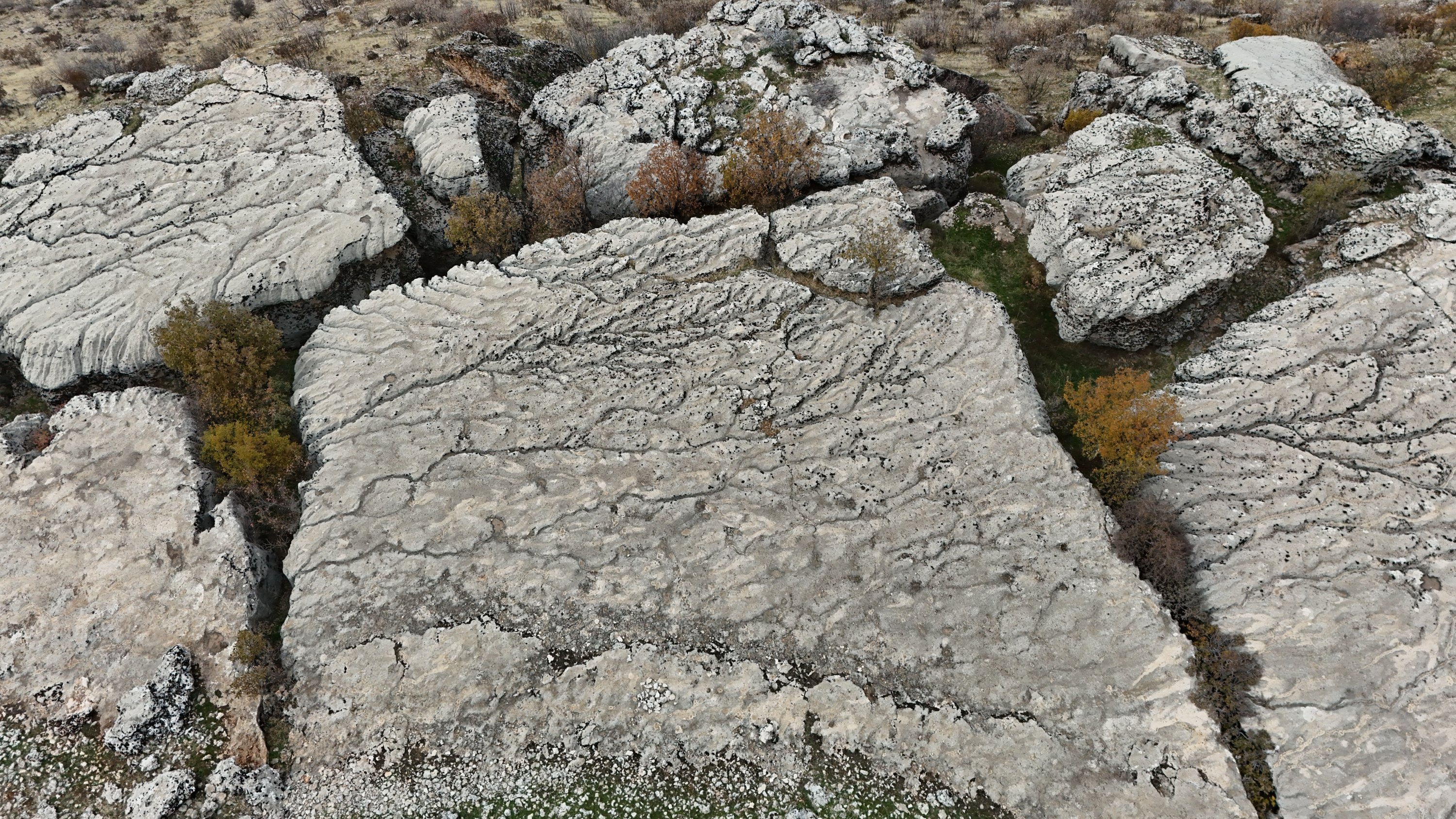
A rare geological formation resembling a miniature version of the Euphrates and Tigris river systems has emerged in the Kocaköy district of Diyarbakır, southeastern Türkiye, after nearly 20,000 years of chemical erosion caused by rainfall, researchers say.
The formation appears on a sedimentary limestone layer about 4 kilometers (2.5 miles) from the district center, where rainwater gradually dissolved the rock surface, creating lapies that mirror lakes, valleys, stream beds and watershed divides similar to those shaped by the two major rivers and their tributaries across the region.
Experts say the contrast between shallow lapies in soil covered areas and deeper, more pronounced formations in exposed sections highlights the long term geological process that shaped the site. The exposed structures offer a detailed, scaled-down model of how water systems carve landscapes over millennia.
Anthropologist Naci Akdemir said the area consists of sedimentary limestone and contains well-defined lapies formed through chemical erosion. He described the formations as a miniature example of peneplanationm the gradual leveling of land surfaces, produced by the Euphrates and Tigris rivers and their branches.
“These structures show miniature rivers, valleys, watershed lines, lakes and meanders shaped by the terrain,” Akdemir said, noting differences in slope between the northern and southern sections that enhance the realism of the landforms. He added that the site could serve as a valuable outdoor classroom for geography education.
Based on their depth and development, Akdemir said the formations likely date back 15,000 to 20,000 years and formed after the retreat of glaciers.