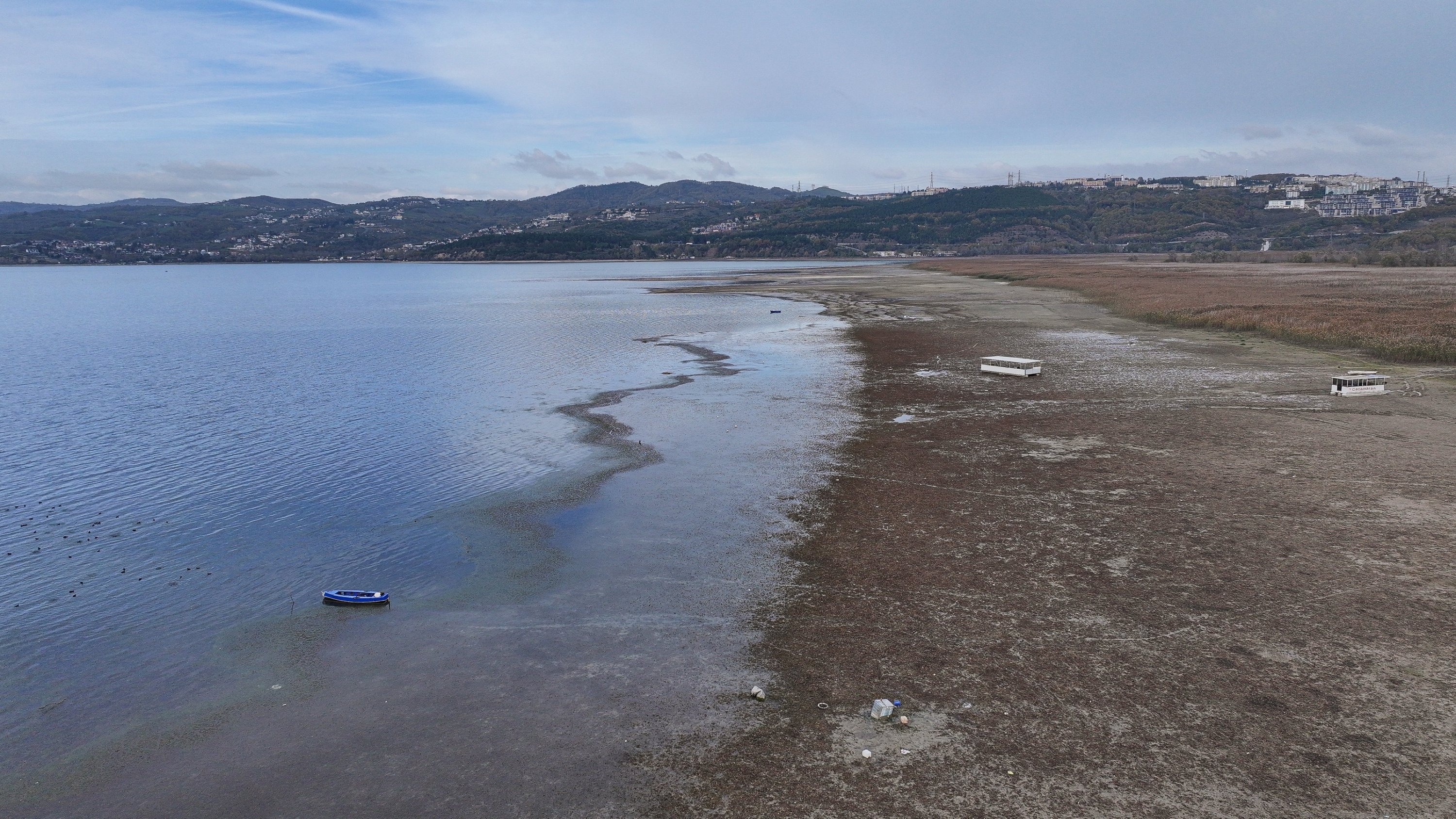
Water quality in Sapanca Lake in northwestern Türkiye has deteriorated to its worst level on record, posing a serious threat to biodiversity and raising concerns over the sustainability of water supplies for two major cities, according to professor Meriç Albay of Istanbul University’s Faculty of Aquatic Sciences.
Speaking to Anadolu Agency (AA) as part of its special file titled “Sapanca Lake Raises the Alarm,” Albay said long-term drought, uncontrolled water withdrawal, rapid urbanization and industrial pressure have pushed the lake’s ecosystem to the brink of collapse.
Albay, a faculty member in the Department of Marine and Inland Water Resources Management, noted that Sapanca Lake is a tectonic lake that has been studied for more than three decades. During this period, researchers have closely monitored water quality, biological changes and the cumulative pressures affecting the lake.
Sapanca Lake measures approximately 16 kilometers (9.94 miles) in length and 6 kilometers in width, with an average depth of 25 to 26 meters (82 to 85 feet) and a maximum depth of 54 meters. However, Albay stressed that these physical characteristics no longer provide resilience against the mounting stress caused by human activity and climate change.
According to Albay, large-scale construction around the lake began in the early 1990s following the opening of a highway passing through the region. This development accelerated tree cutting, increased residential density and reduced natural water flow, particularly from streams feeding the southern part of the lake.
Sapanca Lake is primarily supplied by surface streams and groundwater. However, Albay warned that the proliferation of illegal wells has significantly reduced groundwater reserves, leaving many streams either severely weakened or completely dry.
“If alternative water sources are not developed for Kocaeli and Sakarya and population growth continues at this pace, the lake will inevitably disappear,” Albay said. “Sapanca Lake supplies drinking water to Adapazarı and Kocaeli. It cannot withstand this level of pressure.”
He explained that the lake’s usable water volume currently stands at 120 million cubic meters. Of this amount, 67 million cubic meters are allocated annually to Sakarya and 30 million cubic meters to Izmit. In addition, industrial facilities extract around 4 million cubic meters per year, while another 4 million cubic meters are supplied to bottling plants.
Albay emphasized that existing water resources must be managed more effectively, calling on industrial users to shift toward desalinated seawater. He warned that freshwater reserves are far too limited to be consumed by industry.
Climate change has further exacerbated the situation, Albay said, noting a marked decline in snowfall and snow depth in recent years. As a result, future water availability is expected to decrease even further. Drought, he added, is now affecting Sapanca Lake in the same way it is impacting water resources nationwide.
The lake is fed by 12 streams, eight of which remain active. However, Albay said these streams fail to reach the lake due to extensive domestic and agricultural water use. He added that water withdrawal levels in both the previous year and the current year have been exceptionally high.
“We are paying last year’s bill this year, and we will pay this year’s bill next year,” Albay said. “Unless we experience extraordinary snowfall, which appears unlikely, the situation will worsen. Reducing water withdrawal is the only viable solution. Even with strong rainfall, we could recover at most 20% of the loss.”
Albay warned that the lake’s water level, known as its elevation relative to sea level, has dropped dangerously. The elevation should not fall below 31 meters, he said, yet current measurements indicate levels have declined to between 28 and 28.5 meters.
“This means water should no longer be discharged from the lake through the Çark Stream,” Albay said, describing the current level as “extremely dangerous.”
Monthly monitoring and sampling show a sharp deterioration in nearly all water quality indicators, Albay added. Oxygen levels below a depth of 10 meters have dropped to around 4 milligrams per liter, a critical threshold for aquatic life.
Shoreline retreat has reached hundreds of meters in some areas, while depth loss of 3 to 4 meters has been recorded. Albay said such declines are severe enough to disrupt the lake’s ecosystem and accelerate biodiversity loss.
“Even a few centimeters matter in lakes,” he said. “As water levels fall and pressure increases, the impact of pollutants becomes much more severe.”
Albay also highlighted the growing impact of tourism, tree cutting and dense construction around the lake. He warned that the rapid expansion of summer housing developments has intensified groundwater consumption, diverting water away from the lake toward residential and industrial use.
If excessive water withdrawal continues, Albay cautioned that parts of the lake’s shoreline could turn into mudflats, permanently damaging the ecosystem.
Calling for urgent action, Albay said an immediate shift to comprehensive water management and the preparation of an emergency action plan are essential.
“If water discharge through the Çark Stream is not halted and the lake is not allowed to re-oxygenate and recover, the damage will be irreversible,” he said. “Two major cities now face the risk of water shortages. The area must be declared a first-degree protected site.”
Albay concluded by recalling successful wastewater treatment efforts carried out in the early 2000s by the Sakarya Water and Sewerage Administration (SASKI), noting that similar investments are now urgently needed due to rapid population growth in the basin. “Without decisive intervention,” he warned, “Sapanca Lake is disappearing before our eyes.”