Daily Sabah logo

Politics
Diplomacy Legislation War On Terror EU Affairs Elections News Analysis
TÜRKİYE
Istanbul Education Investigations Minorities Expat Corner Diaspora
World
Mid-East Europe Americas Asia Pacific Africa Syrian Crisis Islamophobia
Business
Automotive Economy Energy Finance Tourism Tech Defense Transportation News Analysis
Lifestyle
Health Environment Travel Food Fashion Science Religion History Feature Expat Corner
Arts
Cinema Music Events Portrait Reviews Performing Arts
Sports
Football Basketball Motorsports Tennis
Opinion
Columns Op-Ed Reader's Corner Editorial
PHOTO GALLERY
JOBS ABOUT US RSS PRIVACY CONTACT US
© Turkuvaz Haberleşme ve Yayıncılık 2025

Daily Sabah - Latest & Breaking News from Turkey | Istanbul

  • Politics
    • Diplomacy
    • Legislation
    • War On Terror
    • EU Affairs
    • Elections
    • News Analysis
  • TÜRKİYE
    • Istanbul
    • Education
    • Investigations
    • Minorities
    • Expat Corner
    • Diaspora
  • World
    • Mid-East
    • Europe
    • Americas
    • Asia Pacific
    • Africa
    • Syrian Crisis
    • Islamophobia
  • Business
    • Automotive
    • Economy
    • Energy
    • Finance
    • Tourism
    • Tech
    • Defense
    • Transportation
    • News Analysis
  • Lifestyle
    • Health
    • Environment
    • Travel
    • Food
    • Fashion
    • Science
    • Religion
    • History
    • Feature
    • Expat Corner
  • Arts
    • Cinema
    • Music
    • Events
    • Portrait
    • Reviews
    • Performing Arts
  • Sports
    • Football
    • Basketball
    • Motorsports
    • Tennis
  • Gallery
  • Opinion
    • Columns
    • Op-Ed
    • Reader's Corner
    • Editorial
  • TV
  • TÜRKİYE
  • Istanbul
  • Education
  • Investigations
  • Minorities
  • Expat Corner
  • Diaspora

Surface fractures across Türkiye quake-zone temporary: Expert

by Daily Sabah with AA

ISTANBUL Feb 17, 2023 - 11:01 am GMT+3
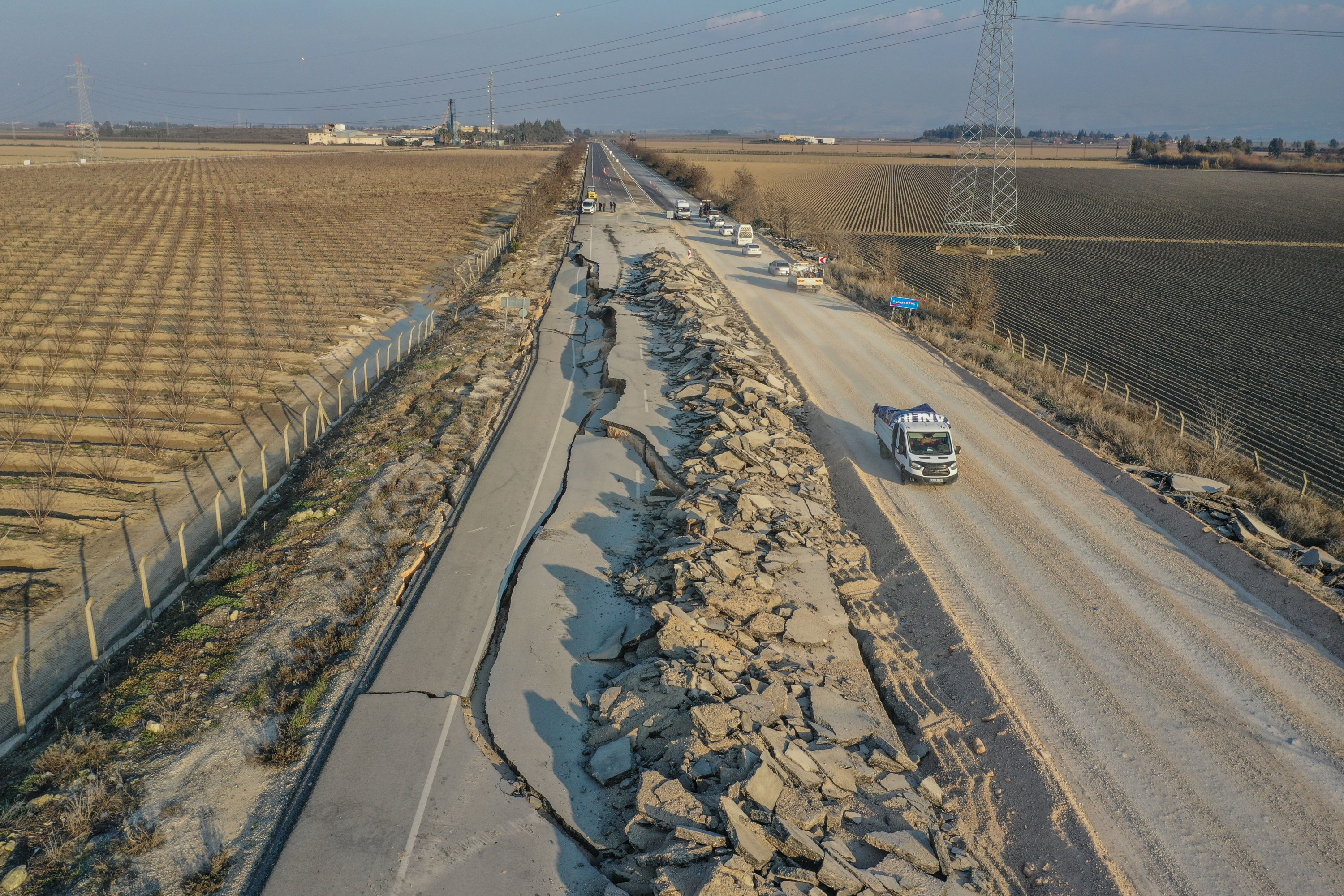
The rifts formed in Demirköprü on the Antakya-Cilvegözü highway after the Kahramanmaraş-centered earthquakes, southeastern Türkiye, Feb. 17, 2023. (AA Photo)
by Daily Sabah with AA Feb 17, 2023 11:01 am

Surface fractures formed on the fault lines in Türkiye's southeast will superficially close after sufficient precipitation erodes the sides over time, an expert studying the ruptures and maps of the area claims

Jagged fractures have been widely observed and raised concerns among the public following the twin earthquakes in Türkiye's southeast, but they will soon disappear, an expert said.

''Surface fractures will disappear after a while with the effect of precipitation, but morphologically, they will continue to exist. In the surface fractures, the fault splinters. We can clearly observe this in the Nurdağı part, in Fevzipaşa. It is linear in the Pazarcık region but splintered in some places. It is the shape of the fault," explained professor Çağlar Özkaymak, director of the Afyon Kocatepe University Earthquake Application and Research Center.

The twin earthquakes that struck Türkiye's Kahramanmaraş Pazarcık and Elbistan provinces within less than 10 hours of each other on Feb. 6 marked the biggest quakes in Türkiye in nearly a century, leaving more than 38,000 dead, according to the latest official figures. The earthquake that directly affected at least 13.5 million people caused major damage to buildings, gas and energy infrastructure while also moving roads, railways and fields due to its strength.

"The first earthquake caused hundreds of kilometers of fractures between Hatay, Adıyaman and Malatya. We mapped them and in our observations, we saw the movements of the Anatolian block. This was caused by the first shock of the earthquake, which is called the surface rupture," Özkaymak told Anadolu Agency (AA).

"In addition, there is a linear fault line between Antakya and Malatya stretching for a distance of about 300 kilometers (186.4 miles). There is also a fault line with widths reaching 50 meters (164.04 feet) in places and in some places, it broke through to the surface," he explained.

Pointing out that geographical changes can be caused by the combination of gravity and the motion of the quake, Özkaymak explained that large boulders can be shaken loose, leading to landslides.

''This can cause large crevices and valleys to form as we saw in Antakya. These are landslides that generally move into a valley. Thousands of similar landslides occur in such powerful earthquakes."

Referring to the suspicion of volcanic activity on Göksun Kuşkayası Mountain in Kahramanmaraş, the professor also explained that with the occurrence of the earthquakes and the aftershocks, the effect was actually created when rocks in high areas fell down along the valley.

''There is an area that looks dark from afar, but when we went inside, we saw that there was no flow of volcanic lava but instead disturbed soil. As stated earlier, this region is not a volcanic area anyway, it's a region of sedimentary rocks. The rocks add to disruption of soil when they fall, making it look like the flow of volcanic activity."

Water levels

Evaluating the increase in the sea level in Iskenderun after the earthquake, Özkaymak also noted that the Earth's crust shook with the earthquake, leading to a fluctuation in the waters in the region. This is a common situation after earthquakes, he said.

Özkaymak also drew attention to the water sources located in the rocks or in the fault lines underground: "Some water sources may be cut off, some may increase in flow, some waters may mix with the hot water coming from underground and get warmer, or the existing hot water may mix with cold water. The chemical properties of the water may change over time."

However, the occurrence of such events is normal. "It will stabilize within a few weeks. It is not something to cause panic. It is a normal situation that is often observed after earthquakes," he added.

"The water levels will rebalance soon," he assured.

On the other hand, speaking about soil liquefaction, Özkaymak said: "If the groundwater level is high after the earthquake, the sandy material that adds to the running water sediments in flat areas, such as the Amik Plain, rises with the decrease of friction and the ground behaves like a swamp. Underground sand comes to the surface with water. Underground water is up to 14 meters from the soil. This is a normal phenomenon that is often observed in areas such as the Amik Plain. Our fault is that we build our cities in alluvial regions, so the first two floors of the buildings are buried in the ground tipped over on their side."

Maintaining that the fractures on the surface were actually the reflection of the fault line, the professor explained that the fracture ''with linear continuity starts from Hatay's Kırıkhan district in the south, goes to Hassa, Islahiye, Nurdağı, Türkoğlu, then moves to Gölbaşı from the south of Kahramanmaraş, and then turns to Adıyaman Çelikhan."

Under the coordination of the Disaster and Emergency Management Authority (AFAD), the team comprising Afyon Kocatepe University Earthquake Application and Research Center Director professor Çağlar Özkaymak, Dokuz Eylül University Earthquake Research and Application Center Director professor Hasan Sözbilir and Osmangazi University Geological Engineering Department professor Volkan Karabacak examined the surface deformations observed in the region after the Kahramanmaraş-centered earthquakes – which are described as the "disaster of the century."

  • shortlink copied
  • Last Update: Feb 17, 2023 5:58 pm
    KEYWORDS
    geologists earthquake shaking gravity fluctuation iskenderun earthquake in türkiye
    The Daily Sabah Newsletter
    Keep up to date with what’s happening in Turkey, it’s region and the world.
    You can unsubscribe at any time. By signing up you are agreeing to our Terms of Use and Privacy Policy. This site is protected by reCAPTCHA and the Google Privacy Policy and Terms of Service apply.
    No Image
    In photos: A look into Prince Philip's lifetime
    PHOTOGALLERY
    • POLITICS
    • Diplomacy
    • Legislation
    • War On Terror
    • EU Affairs
    • News Analysis
    • TÜRKİYE
    • Istanbul
    • Education
    • Investigations
    • Minorities
    • Diaspora
    • World
    • Mid-East
    • Europe
    • Americas
    • Asia Pacific
    • Africa
    • Syrian Crisis
    • İslamophobia
    • Business
    • Automotive
    • Economy
    • Energy
    • Finance
    • Tourism
    • Tech
    • Defense
    • Transportation
    • News Analysis
    • Lifestyle
    • Health
    • Environment
    • Travel
    • Food
    • Fashion
    • Science
    • Religion
    • History
    • Feature
    • Expat Corner
    • Arts
    • Cinema
    • Music
    • Events
    • Portrait
    • Performing Arts
    • Reviews
    • Sports
    • Football
    • Basketball
    • Motorsports
    • Tennis
    • Opinion
    • Columns
    • Op-Ed
    • Reader's Corner
    • Editorial
    • Photo gallery
    • DS TV
    • Jobs
    • privacy
    • about us
    • contact us
    • RSS
    © Turkuvaz Haberleşme ve Yayıncılık 2021