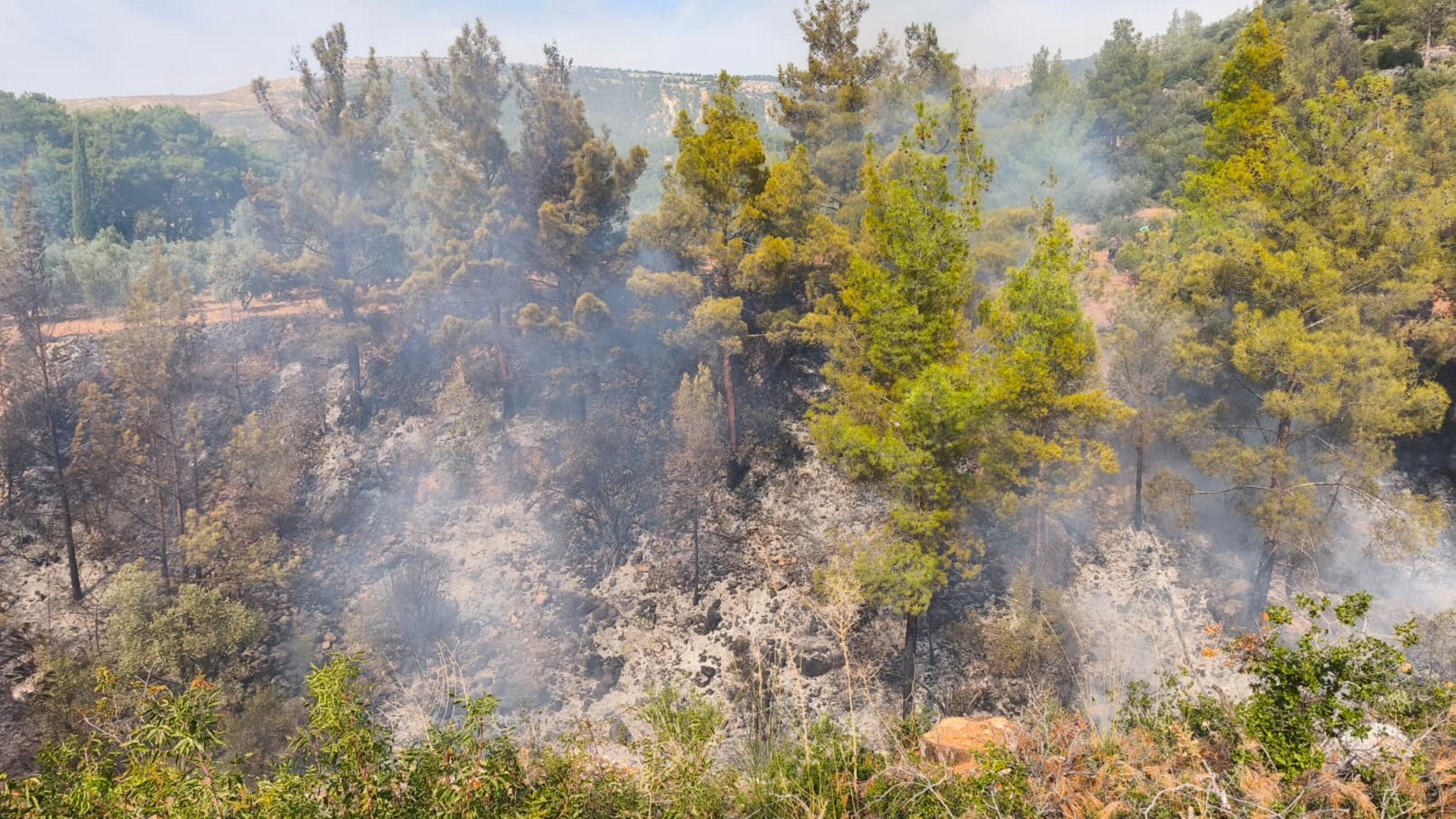
General Director of Forestry Bekir Karacabey said that Türkiye has established itself as a global leader in the fight against forest fires, emphasizing that the country is far ahead of other Mediterranean nations with similar forest and climate conditions in areas such as technology use, fire risk detection, development of decision support systems, unmanned aerial vehicle (UAV) monitoring and early and effective response.
Karacabey underlined that Türkiye’s leadership position in global forest fire management stems from a combination of robust infrastructure and effective use of modern technology. He pointed out that traditional methods and existing technologies were no longer sufficient to combat today’s wildfire challenges, signaling the start of a new era requiring innovative and adaptive approaches.
He explained that over the past decade, Türkiye has undergone a major transformation in detecting, monitoring and extinguishing forest fires. The General Directorate of Forestry (OGM), he said, has accelerated its digitalization process in fire management, actively integrating UAVs into early detection systems, real-time fire line tracking and strategic decision-making.
Karacabey also emphasized that OGM’s aerial fleet has been significantly strengthened. In 2024 alone, Türkiye deployed 27 aircraft, 105 helicopters, 14 UAVs, 1,786 fire trucks, 2,742 first response vehicles and 831 heavy-duty machines in firefighting operations.
With increased use of technology and expansion of operational capacity, fires can now be detected at an early stage and contained rapidly. Karacabey said that the newly developed Fire Decision Support Systems analyze historical fire data, meteorological patterns and geographical factors to identify high-risk zones in advance.
He explained that artificial intelligence-supported systems further enhance firefighting operations by generating fire probability maps, risk analyses and fire behavior models, offering valuable insights to on-ground teams. “These technologies enable fire managers to make faster, data-driven and scientifically grounded decisions. As a result, the average initial response time to forest fires in Türkiye is now just 11 minutes,” he said.
Citing the European Forest Fire Information System (EFFIS) reports, Karacabey stated that Türkiye has the lowest ratio of burned forest area to total forest assets among Mediterranean countries. This success, he said, demonstrates the efficiency and resilience of Türkiye’s fire management system and the effectiveness of its preventive strategies.
Karacabey also highlighted that one of the critical components supporting this success is the fight against forest pests. He explained that OGM adopts entirely eco-friendly and sustainable methods, avoiding chemical interventions and prioritizing natural balance through biological control mechanisms.
“As of the end of October, 55 laboratories produced a total of 930,318 beneficial organisms, which were released into affected forest areas to naturally combat pests. Additionally, 14 anthill relocations were conducted, 20,415 birdhouses were installed, and biological, mechanical and biotechnical control methods were applied across 36,464 hectares,” he said.
He added that these innovations have positioned Türkiye among the world’s top nations in forest fire management. “With its technological infrastructure, operational capacity, and skilled workforce, Türkiye has become a model that many countries aspire to replicate,” he said.
Looking ahead to the 2026 fire season, Karacabey announced plans to further expand Türkiye’s firefighting capacity by adding 165 new fire trucks, 38 heavy-duty machines, and 14 first response vehicles to the OGM’s fleet. He detailed that 58 of the aircraft in use are leased from domestic and international sources, while 88 belong to the General Directorate, the Ministry of National Defense and the Ministry of Interior.
Currently, OGM’s inventory includes 35 aircraft, 9 helicopters (6 for management and three for firefighting), 14 planes (including 2 for management) and 12 UAVs.
Karacabey noted that Türkiye had received 12 of the 20 Airtractor AT-802F amphibious firefighting aircraft ordered in 2023, each capable of carrying 3 tons of water, with the remaining eight aircraft scheduled for delivery by 2027.
He added that under an agreement with Turkish Aerospace Industries (TUSAŞ), the first delivery of eight domestically produced firefighting helicopters is planned for 2028. Türkiye also continues to conduct international tenders for additional aircraft leasing to bolster its aerial firefighting capacity for the 2026 season.
Recalling that 3,797 forest fires occurred in Türkiye last year, damaging 27,485 hectares of forest land, Karacabey said that as of Nov. 4 this year, 3,032 forest fires had affected 81,438 hectares.
He noted that recovery operations begin immediately after each fire, with field inspections, soil analysis and project planning launched without delay. Rehabilitation, regeneration and reforestation activities are implemented across all affected areas to ensure that burned lands are restored within the same year.
“Reforestation typically takes two to three years to complete. The General Directorate of Forestry continues these efforts tirelessly under the principle that every burned area will once again become a forest,” Karacabey concluded.