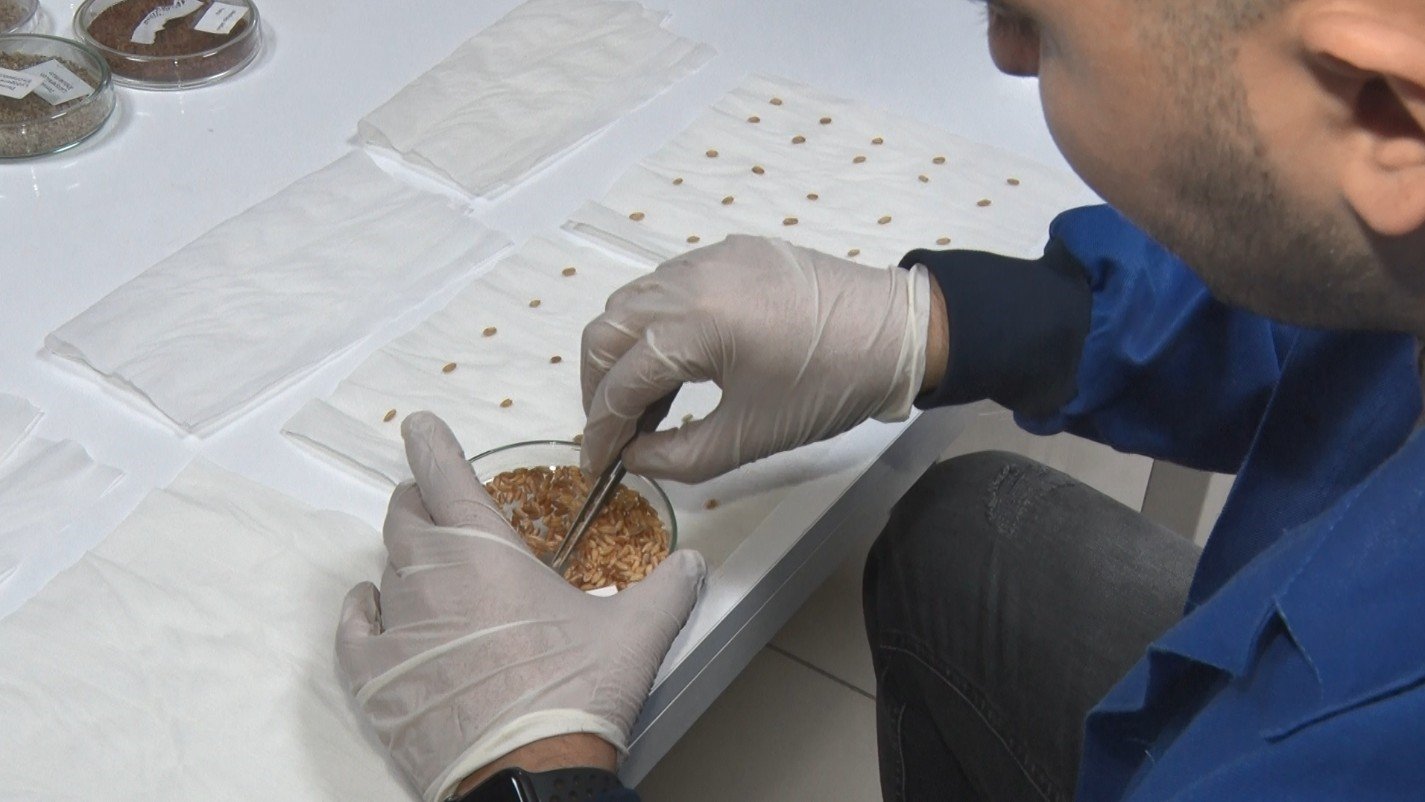
Amid rising regional tensions, particularly involving Iran, attention has again turned to food security, while Türkiye is reinforcing agricultural resilience through national gene banks preserving 122,000 seed varieties within a 400,000-capacity system.
Authorities say this infrastructure is a key pillar of long-term agricultural security, designed to mitigate risks from climate change, conflict, migration, and urbanization, all of which threaten biodiversity and food systems stability.
Within this framework, Türkiye continues to focus on the preservation, classification, and regeneration of its plant genetic resources.
Director General of Agricultural Research and Policies Mustafa Altuğ Atalay on Sunday provided a comprehensive overview of the country’s seed conservation architecture, emphasizing that Türkiye’s gene bank ecosystem is structured to ensure both immediate preservation and long-term genetic continuity.
Atalay highlighted that Türkiye’s biodiversity is actively safeguarded through dedicated gene banks located in Ankara and Izmir in western Türkiye. Within these facilities, seeds undergo detailed processing, including cleaning, drying, and categorization before being stored under tightly controlled environmental conditions.
Depending on biological characteristics and preservation requirements, materials are maintained at different temperature thresholds, including minus 15 degrees Celsius and plus 5 degrees Celsius, ensuring optimal viability over extended periods.
He further emphasized that gene banks are active research infrastructures. “All materials are preserved in a fully controlled system, and they are regularly tested for germination and viability,” he said, pointing to ongoing monitoring processes designed to ensure long-term genetic integrity.
A key component of Türkiye’s biodiversity strategy is the conservation of local seed varieties, which are considered essential for maintaining ecological adaptation and agricultural heritage.
Atalay explained that these seeds are systematically registered, classified according to morphological characteristics, and multiplied through institutions such as the Agricultural Research and Policies General Directorate (TAGEM), the General Directorate of Agricultural Enterprises (TİGEM), and the General Directorate of Plant Production (BÜGEM).
The resulting seed stock is then distributed to farmers via Agricultural Credit Cooperatives, ensuring controlled and traceable circulation within the agricultural system.
Atalay underlined that seed selection must align with regional agro-climatic conditions, noting that productivity and quality depend on cultivating varieties in their appropriate ecological environments. He also emphasized that Türkiye’s agricultural policy framework prioritizes both traditional resilience and modern productivity standards.
One of the most significant expansions in Türkiye’s biodiversity preservation efforts was initiated in 2017 through a public campaign supported by Emine Erdoğan, which encouraged citizens to submit local seed varieties to national gene banks.
Atalay stressed that defining a local variety is a long-term process shaped by generational adaptation. “For a seed to be considered a local variety, 40–50 years is not enough; it must go through generations,” he said, highlighting the role of natural selection in shaping resilience and productivity.
He stated that Türkiye’s gene bank infrastructure is capable of storing up to 400,000 seed samples in total, with 122,000 currently preserved, describing this as a significant genetic reserve for national and regional agricultural resilience.
Citizens also contribute by submitting heirloom seed samples for evaluation, which undergo scientific assessment including germination testing and morphological comparison with existing commercial varieties.
Only seeds demonstrating distinct genetic or agricultural value are added to the national gene bank for long-term preservation.
Atalay highlighted Türkiye’s growing capacity in genetic research, noting a shift beyond physical conservation toward genomic analysis that identifies traits such as drought tolerance, heat resistance, and disease resistance.
He also stated that Türkiye has transitioned from a seed-importing country to a seed-exporting country over the past two decades, with sufficient capacity to meet domestic demand and provide support to other countries if required.
Atalay confirmed that newly collected seed data is digitized into a national database, while genomic mapping is being integrated to strengthen climate- and soil-based agricultural decision-making.
He added that gene banks also function as restoration systems, enabling lost or endangered plant varieties to be regenerated and reintroduced into ecosystems in cases of disaster or ecological degradation.
Finally, Atalay emphasized that seed trade operates under strict global regulatory frameworks and confirmed that genetically modified organism (GMO) cultivation is not practiced in Türkiye and is legally prohibited. He noted that modern breeding techniques are used to improve yield and resistance, while heirloom varieties are preserved to protect biodiversity and agricultural heritage.