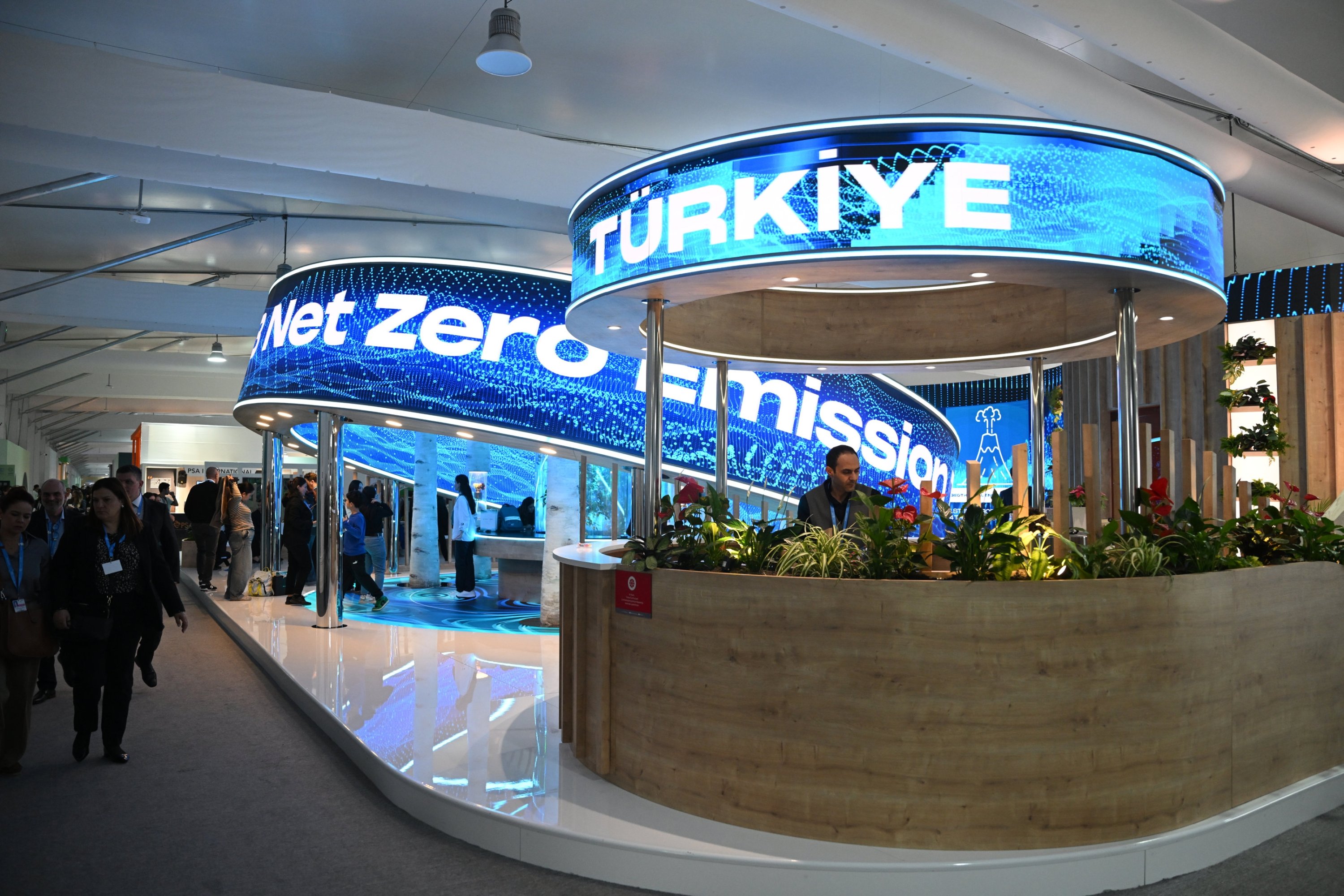
Experts stated that Türkiye has set important and realistic targets in critical areas such as emission reduction, renewable energy, agriculture and waste management with its Long-Term Climate strategy.
Minister of Environment, Urbanization and Climate Change Murat Kurum presented Türkiye's vision for combating climate change at the 29th Conference of the Parties (COP29) of the United Nations Framework Convention on Climate Change (UNFCCC) held in Baku.
Kurum shared that 72% of this year's emissions in Türkiye come from energy, 13% from agriculture and 3% from the waste sector. He also mentioned plans to increase the share of renewable energy in primary energy to 50% and nuclear power to 30%, aiming to make nearly 80% of the energy used nationwide carbon-free. Kurum further added that technological use in agricultural irrigation would be increased and the target was to achieve organic farming on at least 10% of agricultural land. He also highlighted plans to raise the waste recycling rate to 70% and implement the Deposit Management System nationwide by the end of 2025.
Evaluating the energy targets in the roadmap, Oğuzhan Akyener, President of the Turkish Energy Strategies and Policies Research Center (TESPAM), stated that Türkiye is making significant efforts to change its energy balance.
Akyener emphasized that reducing carbon emissions aligns with national energy policies, contributing to economic growth and energy independence. He noted that Türkiye is focusing on nuclear energy, which plays a crucial role in both achieving energy independence and reducing carbon emissions.
He continued, "Achieving a 50% share of renewable energy and a 30% share of nuclear energy in the overall energy mix will be challenging; reaching these targets within the context of electricity balances may be more achievable, with the growing population, economic growth and digitalization, we project that energy demand will increase by twofold and electricity demand by fivefold in the coming century. Therefore, it will be necessary not only to deploy large-scale conventional nuclear power plants but also to introduce modular and micro nuclear power plants."
Akyener added that Türkiye has undergone a significant transformation in the energy sector, with major goals set for 2035. He also highlighted the potential for offshore wind energy, especially in Izmir and the Sea of Marmara, as a valuable opportunity.
He stated, "In Türkiye's coastal areas, particularly in Izmir and the Sea of Marmara, establishing wind power plants near energy production centers offers significant advantages; our projections show that by 2070, the wind energy production capacity in Türkiye's seas will surpass its land-based production."
Comparing Türkiye's targets with those of European countries, Akyener remarked: "Long-term goals are important for macro planning, but they cannot be expected to be achieved to the same degree as forecasted, as unforeseen variables can affect dynamics. Even European countries have only reached success rates of less than 30% for the long term energy transformation targets they set; therefore, if Türkiye achieves 50% success in its energy transformation goals, it will be a significant step, as this is a target that even developed Western countries have not been able to reach."
Professor Yusuf Demir, head of the Department of Agricultural Structures and Irrigation at Ondokuz Mayıs University, listed the primary emission sources in agriculture, including methane from livestock, fertilizers, urea applications, agricultural waste, and rice production.
Demir reminded us that agriculture accounts for about 45 billion cubic meters of water in Türkiye, representing 75% of total water usage. He said, "Approximately 24 million hectares are cultivable agricultural land; of this area, about 8.5 million hectares is considered economically irrigable. However, with new and modern irrigation methods, this area could be increased at least twofold."
Regarding future targets, Demir emphasized the importance of water conservation, limited water usage, and improving irrigation efficiency through modern irrigation methods. He stressed the need to abandon open irrigation systems and ensure water is delivered directly to the plant roots to minimize water loss.
Demir added, regarding the 10% organic farming target, "The European Union has set a target of 25% organic farming by 2030. Türkiye has not yet reached the 5% target set in 2023. However, the 10% target for organic farming by 2053 is realistic and achievable; to achieve this, agricultural restructuring, transitioning to professional agriculture, and updating agricultural development goals are necessary."
Fatih Eren, President of the Association of Recyclers and Recovery Operators (GEKADER), stated that he finds the Long-Term Climate Roadmap targets highly appropriate, noting that Türkiye is already progressing rapidly toward these goals under the Paris Agreement.
Eren pointed out that while waste management makes up a small share of total emissions, an effective recycling and waste reduction strategy is crucial. Referring to data from the Turkish Statistical Institute (TurkStat), he provided the following information:
"In 2020, 127.4 million tons of waste were processed, 78.3 million tons were disposed of, and 49.1 million tons were recovered through recycling methods, contributing to the country's economy. In 2022, there was a 4.5% increase in waste processing to 133.2 million tons, with 81.4 million tons sent to waste disposal facilities. The most significant part of the recycling rate increased by 5.4% to 51.7 million tons compared to two years ago."
Eren mentioned that they are continuing their cooperation efforts for the Deposit Management System, stating, "Although the infrastructure work for the system planned to be implemented in 2025 has not yet been completed, we are ready to share our knowledge and expertise with all our esteemed members in this field."