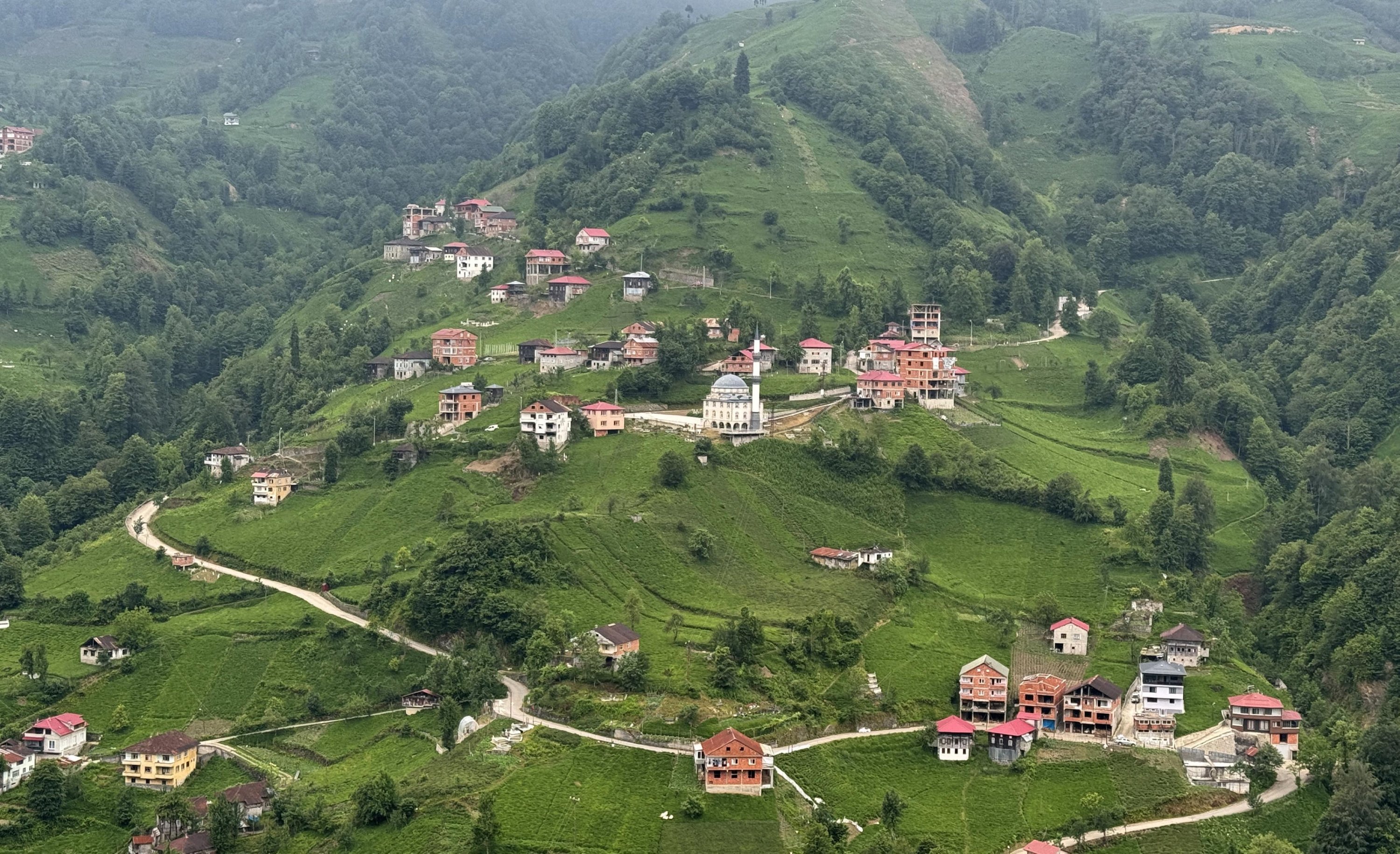
In the Ardeşen district of Rize, northeastern Türkiye, four village mukhtars have jointly decided to adopt digital delivery for wedding invitations in an effort to simplify the distribution process amid challenging geographical conditions.
The village heads of the Yukarıdurak, Kaçkar, Önder and Deremezra villages convened to address the difficulties residents face when delivering physical invitations. After reaching a consensus that digital communication would solve the issue, they made a collective decision with the support of their village councils.
In the official statement, the mukhtars noted the hardship of physically delivering invitations due to the region’s rugged terrain, saying, “To ease this difficulty, a joint decision by the four village administrations states that a person will be considered invited to a wedding if the host calls or sends the invitation through individual WhatsApp messages, SMS or phone calls.”
It was further stated that the invitations would also be shared digitally by the mukhtars on the day of the wedding, and “anyone receiving the digital invitation will no longer be able to use the excuse ‘I wasn’t invited to the wedding.’”
Mehmet Yazıcı, the mukhtar of Kaçkar village, told Anadolu Agency (AA) that residents had been requesting a solution for some time due to the challenges of invitation delivery.
“Settlements here are very scattered. We wanted to take advantage of the conveniences offered by modern technology. Together with three other headmen, we worked on this and made the decision,” he said.
Yazıcı emphasized that anyone still wishing to hand out printed invitations in person is free to do so, but the decision has already received widespread support.
“This decision has now been widely accepted. We've been working on it for about a year. From now on, if someone sends a wedding invitation via WhatsApp, it will be considered a valid invitation. No one will be able to claim, ‘I wasn't invited.’ We, as the four village administrations, will also help centralize contact numbers to assist our residents,” he explained.
Turan Yılmaz, the mukhtar of Önder Village, noted the difficulties caused by the area's remoteness: “Residents were having a hard time distributing invitations. They would say, ‘We go to people’s homes but can’t find them.’ So, we four mukhtars got together to find a solution. We believed this problem could be solved through digital means, and we agreed on this decision.”
Hasan Öztabak, the mukhtar of Yukarıdurak village, highlighted that the new approach would bring considerable relief: “I believe this system will become the norm over time. Those organizing weddings had to visit 500-600 homes. This new method will be a real convenience. I see it as a good start.”
Irfan Kuru, the mukhtar of Deremezra village, expressed hope that the decision could serve as a model for other villages as well.
Mustafa Önder, a 68-year-old resident of Önder village, described the decision as reasonable and timely: “You’d have to deliver envelopes to 500-600 houses. That takes several days. Still, some people complain, ‘Why didn’t you invite me?’ Sometimes you can’t even find the person, or the envelope doesn’t reach them. I think this is a useful solution.”
Mustafa Zeytin, a resident of Yukarıdurak village, also voiced his support for the new practice.