
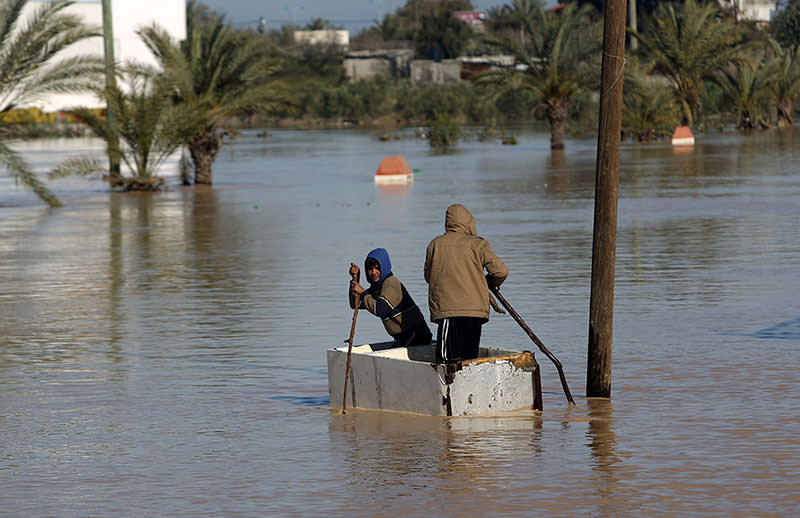
"Opening the levees to the canal has led to the flooding of several Palestinian homes, and we had to quickly evacuate the afflicted citizens," it added. Medical sources told The Anadolu Agency that no casualties have been reported as a result of the flooding.
However, hundreds of Gazans had to leave their homes as at least 80 Palestinian homes have been flooded after water levels in the Gaza Valley (Wadi Gaza) rose to three meters and dozens of families were evacuated. The Gaza Ministry of Interior said in a statement on Sunday that civil defence services had worked alongside teams from the Ministry of Public Works to evacuate families.
The evacuated families were moved to shelters in al-Bureij refugee camp and in al-Zahra neighborhood sponsored by United Nations. "Israel opened water dams, without warning, last night, causing serious damage to Gazan villages near the border. More than 40 homes were flooded and 80 families are currently in shelters as a result. The dam opening would adversely affect local agriculture as the flooded area included Gazan poultry and animal farms. We are appealing to human rights organizations and international rights organizations to intervene to prevent further such action," Brigadier General Said Al-Saudi, chief of the civil defense agency in Gaza told Al-Jazeera.
Gazans also suffer from heavy winter storm descended on parts of the Middle East last week. Heavy rains that started on Thursday have been forecast for the rest of the week and brought a freezing weather to besieged city.
Besides the weather conditions and floods, Gaza still suffers from the effects of Israeli aggression that happened last summer and killed more than 2,000 people. Aid agencies struggling to shelter thousands of Gazans made homeless by war have resorted to building makeshift temporary homes out of metal and wood to evade Israeli restrictions on imports into the territory. Around 150,000 families are still homeless after last year's war between Israel and Hamas, in which Israeli bombardment destroyed thousands of apartment buildings and homes. Israel tightly limits the flow of concrete, cement, iron bars and other materials into Gaza.
That means few homes have been rebuilt despite international pledges of billions for reconstruction. Rather than wait to rebuild permanent homes, some relief agencies have decided to build temporary structures with materials they can get. Israel's restrictions make it a slow and costly process to get hold of the building materials. A bag of cement in Gaza now costs around 100 shekels ($25), four times its usual price.
Besides the weather conditions and floods, Gaza still suffers from the effects of Israeli aggression that happened last summer and killed more than 2,000 people. Aid agencies struggling to shelter thousands of Gazans made homeless by war have resorted to building makeshift temporary homes out of metal and wood to evade Israeli restrictions on imports into the territory. Around 150,000 families are still homeless after last year's war between Israel and Hamas, in which Israeli bombardment destroyed thousands of apartment buildings and homes.
Israel tightly limits the flow of concrete, cement, iron bars and other materials into Gaza. That means few homes have been rebuilt despite international pledges of billions for reconstruction. Rather than wait to rebuild permanent homes, some relief agencies have decided to build temporary structures with materials they can get. Israel's restrictions make it a slow and costly process to get hold of the building materials. A bag of cement in Gaza now costs around 100 shekels ($25), four times its usual price.


