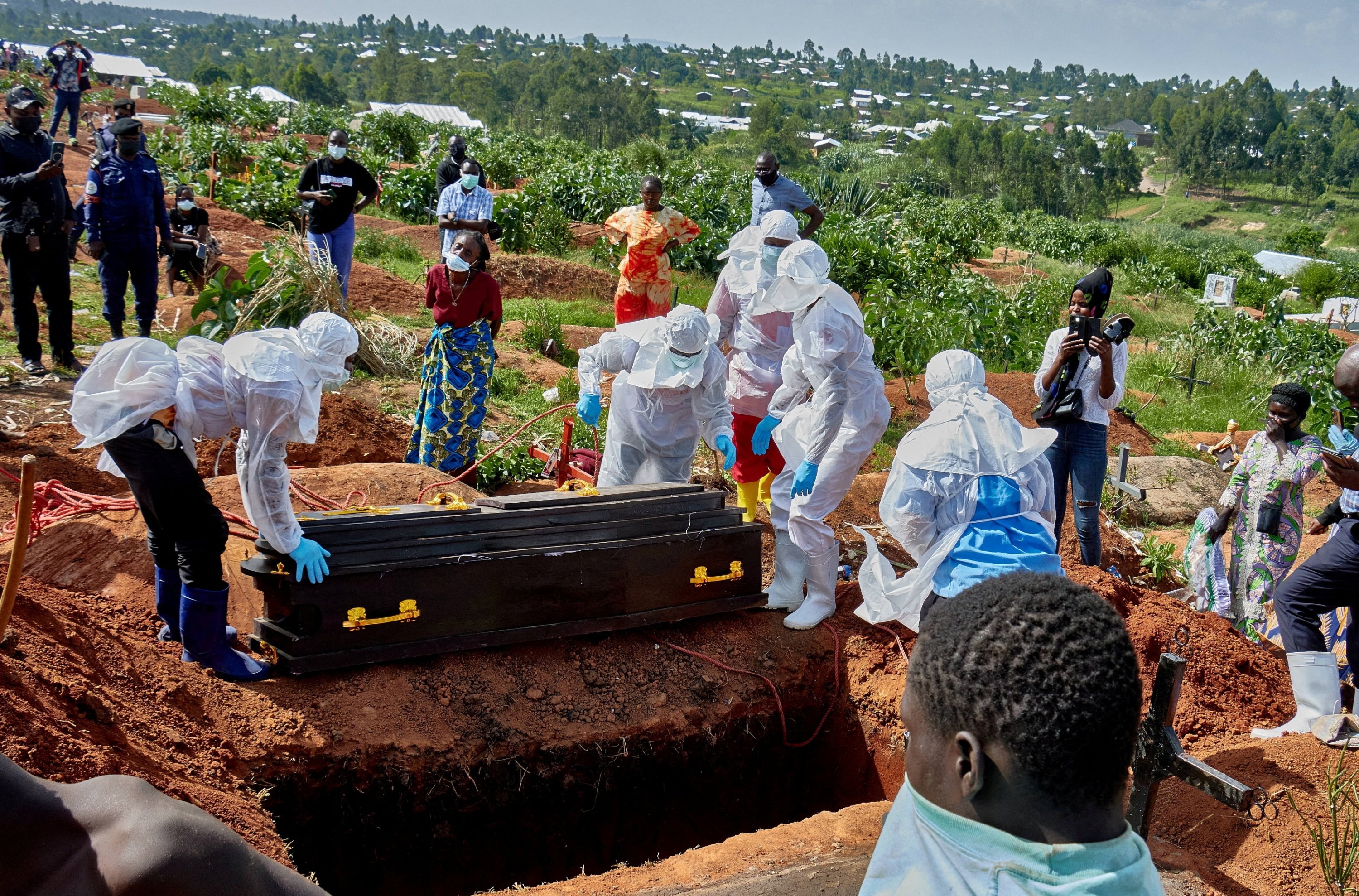
The Democratic Republic of Congo's rapidly spreading Ebola outbreak has become the world's second-largest on record, government data showed Friday, as the virus continues to spread faster than efforts to contain it.
The Communications Ministry said the number of confirmed cases has climbed to 3,532, with 1,556 deaths recorded.
"It is the fastest-spreading Ebola epidemic that we have ever seen," Carl Skau, acting executive director of the U.N. World Food Programme, told Reuters this week. "The world needs to pay much more attention."
Less than three months after the outbreak began, Ebola has claimed five times as many lives as previous outbreaks had at the same stage, according to the Africa Centres for Disease Control and Prevention, the continent's leading public health agency.
The outbreak is caused by the rare Bundibugyo strain of the Ebola virus, for which there is no approved vaccine or treatment.
Health responders are also battling insecurity and attacks on health facilities across eastern Congo, where dozens of armed groups operate, while deep cuts in foreign aid have stretched resources.
The latest outbreak figures indicate that only the 2014-16 West Africa Ebola outbreak was larger, with 28,616 cases and 11,310 deaths recorded across Guinea, Liberia and Sierra Leone, according to the World Health Organization.
Angele Gapio, head of emergencies for the Caritas charity in the northeastern city of Bunia, said awareness campaigns were failing and frontline responders were exhausted and traumatized.
"The disease has now become established in the community," she told Reuters. "People continue to seek treatment from traditional healers, and the chain of transmission continues."
The WHO said earlier this month that the true scale of the outbreak could be up to four times higher than official figures suggest.
Reuters reported this week that surveillance efforts are being strained by shortages of vehicles, understaffing and community mistrust.
Africa CDC said in June it would require $1.4 billion to contain the Ebola outbreak, three times its earlier estimate.
Figures presented this week by Africa CDC and the WHO showed Congo's May-August response plan had secured $213.9 million in pledged funding, short of the planned $242.4 million response.
A U.S. travel ban is also restricting the deployment of aid workers. The Trump administration said earlier this month it was barring American citizens in Congo from traveling to the United States on commercial flights.
Samaritan's Purse, which operates treatment centers and relies on U.S. responders for its mission in Congo, said it would have to scale back operations because of the quarantine order.