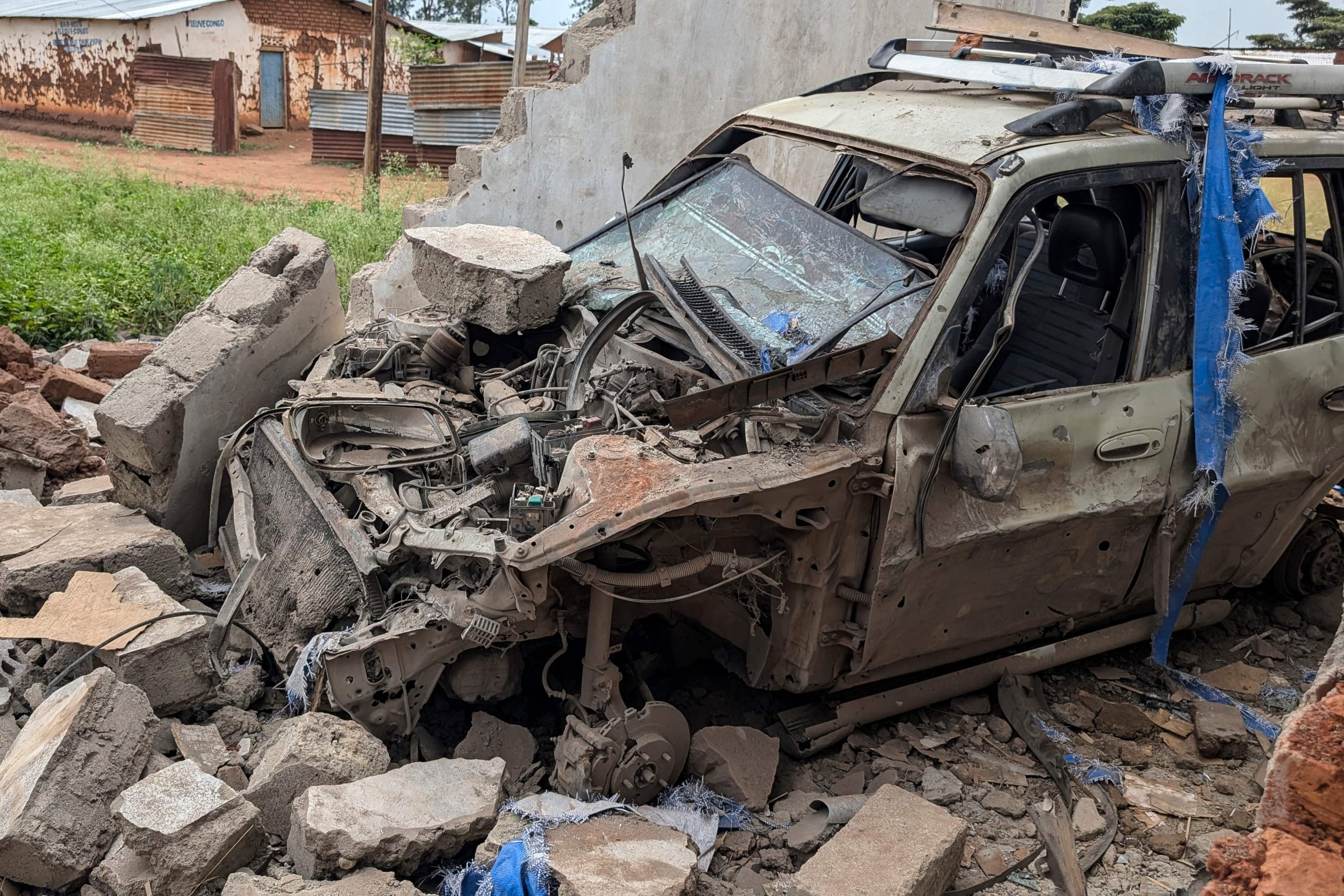
A deadly bomb blast that killed more than 30 people in eastern Congo has again pierced the fragile optimism surrounding a U.S.-brokered peace deal, underscoring how quickly violence can upend diplomatic promises in one of the world’s most volatile conflicts.
The explosion tore through the town of Sange in South Kivu on Sunday evening after Congolese army troops and Wazalendo militiamen – nominal allies against the Rwanda-backed M23 insurgency – turned their guns on each other.
Residents said the clash erupted when FARDC soldiers, returning from the front lines, were ordered not to advance toward Uvira.
Some refused. Shots rang out. Moments later, a blast ripped through the area.
More than 20 others were wounded, and by dawn many families were fleeing toward Burundi, desperate to escape yet another cycle of violence.
“We are tired,” said local resident David Kaserore. “It’s impossible to know who is the enemy anymore.”
The fighting shattered hopes raised just days earlier in Washington, where Congolese President Felix Tshisekedi and Rwanda’s Paul Kagame reaffirmed a “historic” peace deal in the presence of U.S. President Donald Trump.
The agreement – revived from a dormant June pact – was meant to halt a war that has displaced more than 7 million people and drawn in dozens of armed groups competing for territory rich in coltan, gold and other critical minerals.
Instead, Tshisekedi stood before parliament on Monday accusing Rwanda of violating the accord within 24 hours of signing it.
He claimed Rwandan Defence Forces had fired heavy weapons from across the border, calling it “aggression by proxy” aimed at destabilizing Congo and looting its mineral wealth.
Burundi added its own allegations, with Foreign Minister Edouard Bizimana accusing Kigali of launching “kamikaze drone” attacks on civilians and warning that repeated strikes would trigger retaliation.
Rwanda denies backing M23 or carrying out any operations beyond its borders.
M23 itself – not a party to the Washington pact – continues to expand its reach, digging in across North and South Kivu while waging a parallel political project that threatens to redraw eastern Congo’s map.
In September, hundreds of civilians sat in formation at a “re-education” camp near Rutshuru as M23 commander Sultani Makenga lectured them on Congo’s history and the group’s vision for a future federal state.
Videos reviewed by Reuters show the trainees practicing basic weapons handling, chanting in unison and pledging loyalty.
M23’s internal 32-page charter frames the movement as a force meant to restore order and rebuild Congo through discipline, sacrifice and “commitment.”
Behind that ideological push is a sweeping state-within-a-state: new rebel-appointed governors and mayors, taxes on coltan mines, rebel-issued visas at border posts, arbitration courts for land disputes, and the recruitment of thousands of new fighters.
U.N. and diplomatic sources estimate M23’s military force has grown from roughly 5,000 fighters early this year to more than 14,000, bolstered by defectors and recruits trained at bases in Chanzu and Rumangabo.
The group now controls territory stretching from Uganda’s border south toward Burundi – an area home to as many as 9 million people.
Analysts say the rebel administration is becoming more entrenched and harder to dislodge, despite international pressure.
“M23 is holding out for long-term power,” said Jason Stearns, a former U.N. expert. “They’re not preparing to implement peace deals – they’re preparing to govern.”
Eastern Congo has been shaped by violence since the aftermath of Rwanda’s 1994 genocide, when Hutu militias fled into Congo and Rwanda sent troops in pursuit.
The resulting wars drew in nine neighboring states and killed millions.
Today’s M23, dominated by ethnic Tutsis, traces its name to a 2009 peace agreement Kinshasa never fully implemented.
The group briefly seized Goma in 2012 before being forced into exile; this time, it appears determined not to withdraw.
Much of its strength, U.N. investigators say, comes from Rwandan support – a charge Kigali steadfastly denies.
Cameras and recruits interviewed by Reuters reported Rwandan trainers at M23 camps, along with advanced weapons not commonly found in local stockpiles.
Residents living under M23 rule describe improved security but a system of tight control, strict discipline and fear.
Journalists and activists are fleeing the region, with hundreds seeking U.N. protection.
Some who attended rebel training recount severe punishments and brainwashing-style conditioning. “Destroy, Build, Confidence” was the motto, according to one recruit.
The conflict’s stakes are immense.
M23 now holds at least 45 mining sites in North and South Kivu, including the Rubaya coltan mine – one of the world’s most valuable.
U.N. experts say the ore is taxed by the rebels and smuggled through Rwanda to Asia, generating an estimated $800,000 a month.
Land, too, is a combustible issue. Tens of thousands displaced years ago say their property has been seized, some by newcomers from Rwanda. A U.N. panel says M23 has “dismantled” state institutions and replaced them with its own authority, laying the groundwork for demographic change.
Both M23 and government troops have faced accusations of killing civilians – allegations both sides deny.
As Qatar-hosted peace talks in Doha inch forward, M23 continues to entrench itself and expand its governance.
Diplomats warn that if negotiations collapse, eastern Congo could inch closer to an irreversible fragmentation – a “federalism or worse” scenario that could lock the region into permanent conflict.
The U.S. insists the Washington accord must be implemented immediately, saying it is monitoring “areas where actions on the ground do not yet align with commitments.”
But with rebel forces advancing, militias splintering, and civilians fleeing explosions like Sunday’s blast in Sange, the chasm between diplomatic signatures and battlefield realities is widening fast.