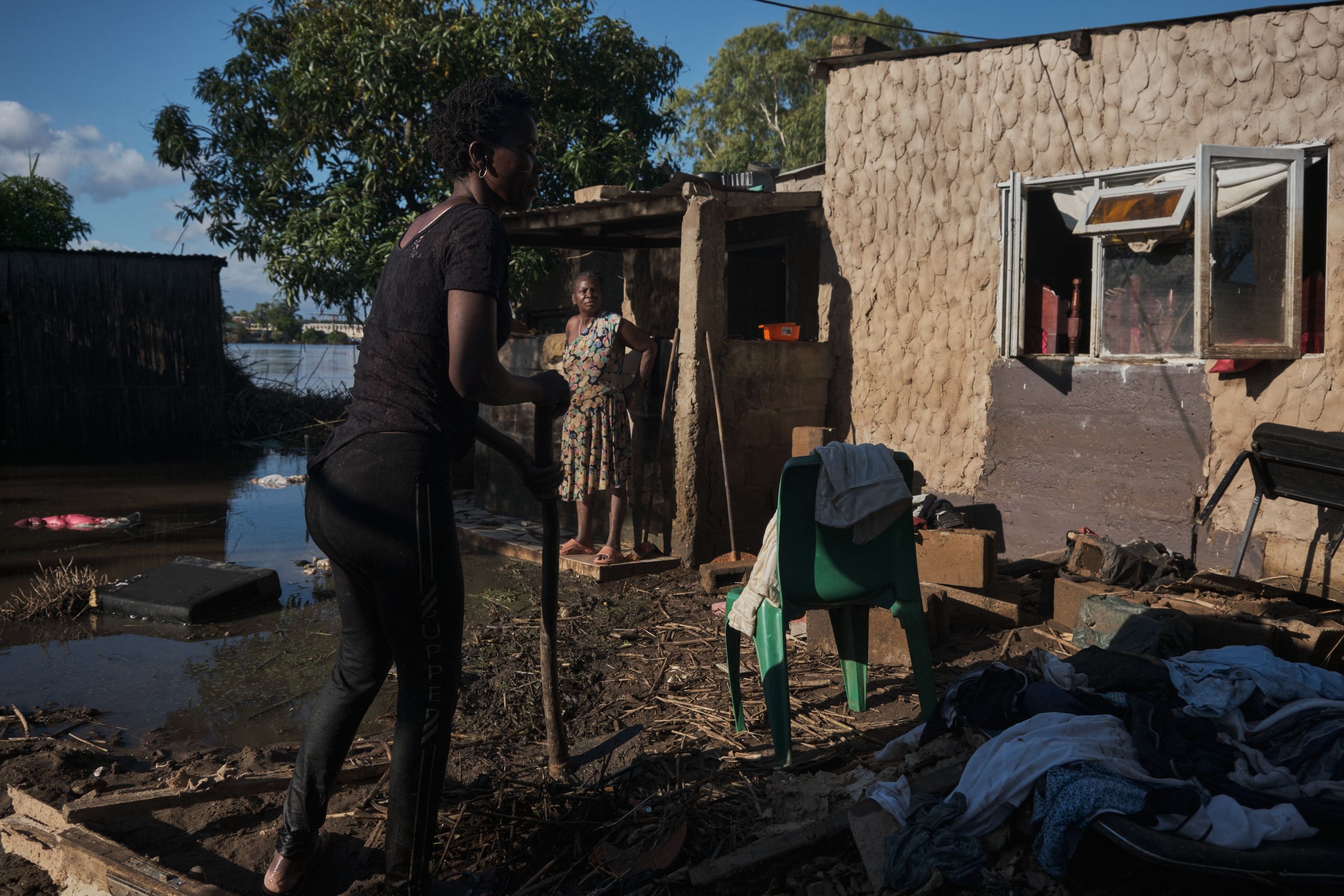
Erica Raimundo Mimbir gave birth to her first child on a school desk, the only dry surface she could find after spending days trapped in her flooded home in southern Mozambique.
“I wanted to die because of the pain and the conditions,” the 17-year-old told Agence France-Presse (AFP) in a village in Maputo province.
She was evacuated by boat the following day and found refuge with relatives, joining an estimated 650,000 Mozambicans the United Nations says have been affected by torrential rains since December.
“I don’t think I’ll go back home. I’ve never experienced anything like this,” Mimbir said, recalling how rising waters forced her to sleep upright, leaning against a wall.
Cradling her daughter, Rosita, born prematurely Jan. 19 and weighing just 1.5 kilograms (3.3 pounds), she described the ordeal simply: “It was very painful.”
The baby was named after Rosita Salvador, whose mother famously gave birth in a tree while fleeing catastrophic floods that struck Mozambique in 2000.
Salvador, who died this month after a long illness, became a symbol of resilience during the disaster, which killed about 800 people.
The southern African country’s latest bout of flooding has claimed nearly 140 lives since Oct. 1, according to the National Institute for Disaster Risk Management.
About 100,000 people are sheltering in 99 temporary accommodation centers, according to the U.N. Office for the Coordination of Humanitarian Affairs.
In the province’s 3 de Fevereiro village in Manhica district, a low-slung school has been turned into one such emergency shelter.
About 500 people sleep on mats in its 11 classrooms, their clothes draped over blackboards and window bars as they take stock of what the floods swept away and how close many came to losing their lives.
Among them is Elsa Paulino, a 36-year-old mother of five who was cut off from her home after taking her two youngest children to a funeral outside her village.
By the time she returned, the road had vanished under rising water.
“The car I was traveling in almost overturned because of the fury of the waters,” she told AFP.
Her other three children were still at home. “I was desperate.”
Paulino eventually arranged for them to be evacuated by bus to relatives in neighboring Gaza province, also badly affected by flooding.
But washed-out roads mean her children have still not been able to join her.
“Right now I know my children are safe, but my mother’s heart isn’t at peace,” she said.
Across the region, floods have ripped through critical infrastructure, roads, bridges, power lines and water systems, slowing aid deliveries and isolating entire communities.
The N1 highway linking Maputo to the north remains cut. About 325,000 head of livestock have died, and 285,000 hectares (704,250 acres) of farmland have been damaged, according to OCHA.
The latest flooding is among the worst Mozambique has seen in years, with officials warning the death toll could rise as more heavy rains loom and a nationwide red alert remains in force.
For Salvador Maengane, a 67-year-old farmer sheltering in 3 de Fevereiro, the losses are total.
“All my farmland was flooded,” he said. He was due to harvest maize and vegetables in March and sugarcane in May.
“Everything was lost and I have nothing to sell. All my family’s livelihood is gone,” he said, his thin frame hunched with exhaustion.
Maengane, who farms five hectares in Xinavane farther north, said that in previous rainy seasons he could still salvage part of his crop.
“This is the first time I have seen a tragedy of this magnitude,” he said.