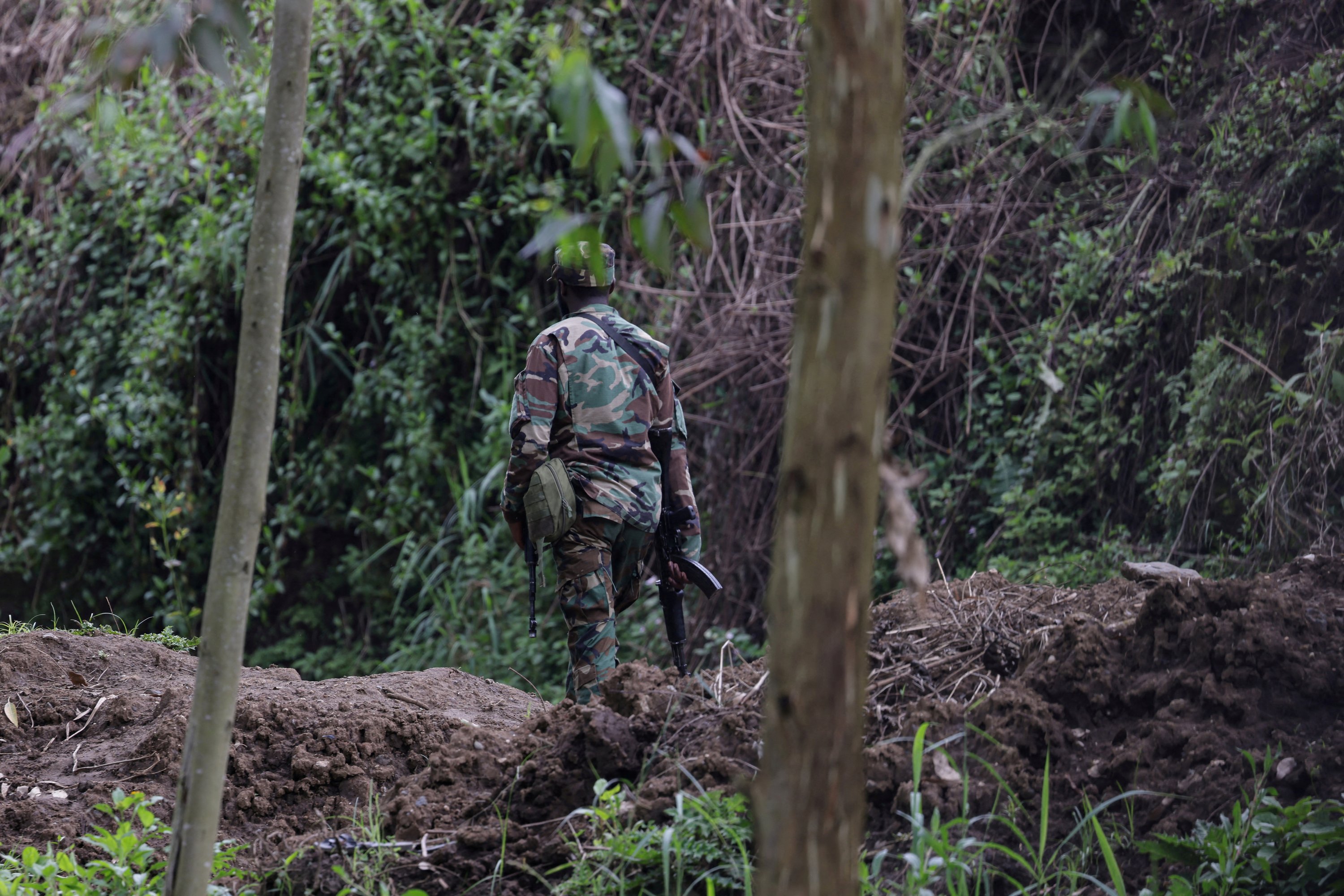
The Congolese army on Tuesday accused the Rwanda-backed M23 militia of launching “multiple attacks” on its positions in the east, where days of clashes have put a U.S.-brokered cease-fire in jeopardy.
Eastern Democratic Republic of Congo – a mineral-rich region bordering Rwanda but scarred by more than 30 years of violence from nonstate armed groups – has been the epicenter of renewed fighting.
The M23, which resumed its insurgency in late 2021, has seized large swaths of territory with Rwandan support, deepening a humanitarian crisis. The conflict flared again early this year when the rebels captured the strategic cities of Goma and Bukavu, installing their own administrations.
The Congolese government and the M23 signed a declaration of principles on July 19 in Qatar that included a “permanent cease-fire” aimed at halting the conflict.
It followed a separate peace deal between the Congolese and Rwandan governments signed in Washington the previous month.
But violence has continued on the ground, with fighting intensifying since Friday around the town of Mulamba in South Kivu province, where the front line had been relatively stable since March.
The M23 attacked positions held by pro-Kinshasa militia and army forces and pushed them back several kilometers, local and security sources said.
The “almost daily” attacks constitute an “intentional and manifest violation” of the Washington peace deal and the declaration of principles agreed to in Doha, Congolese army spokesman Sylvain Ekenge said in a statement.
The army said it was ready to respond “to all provocations from this coalition, accustomed to violating agreements.”
M23 spokesman Lawrence Kanyuka said in a post on X on Monday that the DRC government was continuing “offensive military maneuvers aimed at full-scale war.”
After a lull in the morning, fighting resumed in Mulamba on Tuesday afternoon, according to local sources.
Both sides had rushed reinforcements to the territory on Sunday, the sources added.
Any breakthrough by the M23 in the mountainous region would give the armed group control of numerous mining sites, most of them gold and run by Chinese businesses.
Neither side has provided a toll from the clashes.
Dozens of cease-fires and truces have been brokered and broken in recent years without bringing a lasting end to the conflict.
At the beginning of August, U.N. human rights chief Volker Turk accused the M23 of killing at least 319 civilians in July, insisting the fighters were “backed by members” of the Rwandan army.
Rwanda on Monday called the U.N.’s accusations that its army had helped kill civilians “unacceptable.”
Kigali has consistently denied providing the M23 with military support.
A report from U.N. experts in July, however, found that Rwanda’s army played a “critical” role in the M23’s conquest of Goma and Bukavu, the capitals of North and South Kivu provinces, respectively.
More than 2 million people have fled the violence in both provinces since the beginning of 2025, according to a late July report from the U.N. Office for the Coordination of Humanitarian Affairs.
Rwanda has long maintained that it faces an existential threat from the FDLR, a militia founded in eastern Congo by ethnic Hutu leaders involved in the 1994 Rwandan genocide of Tutsis.