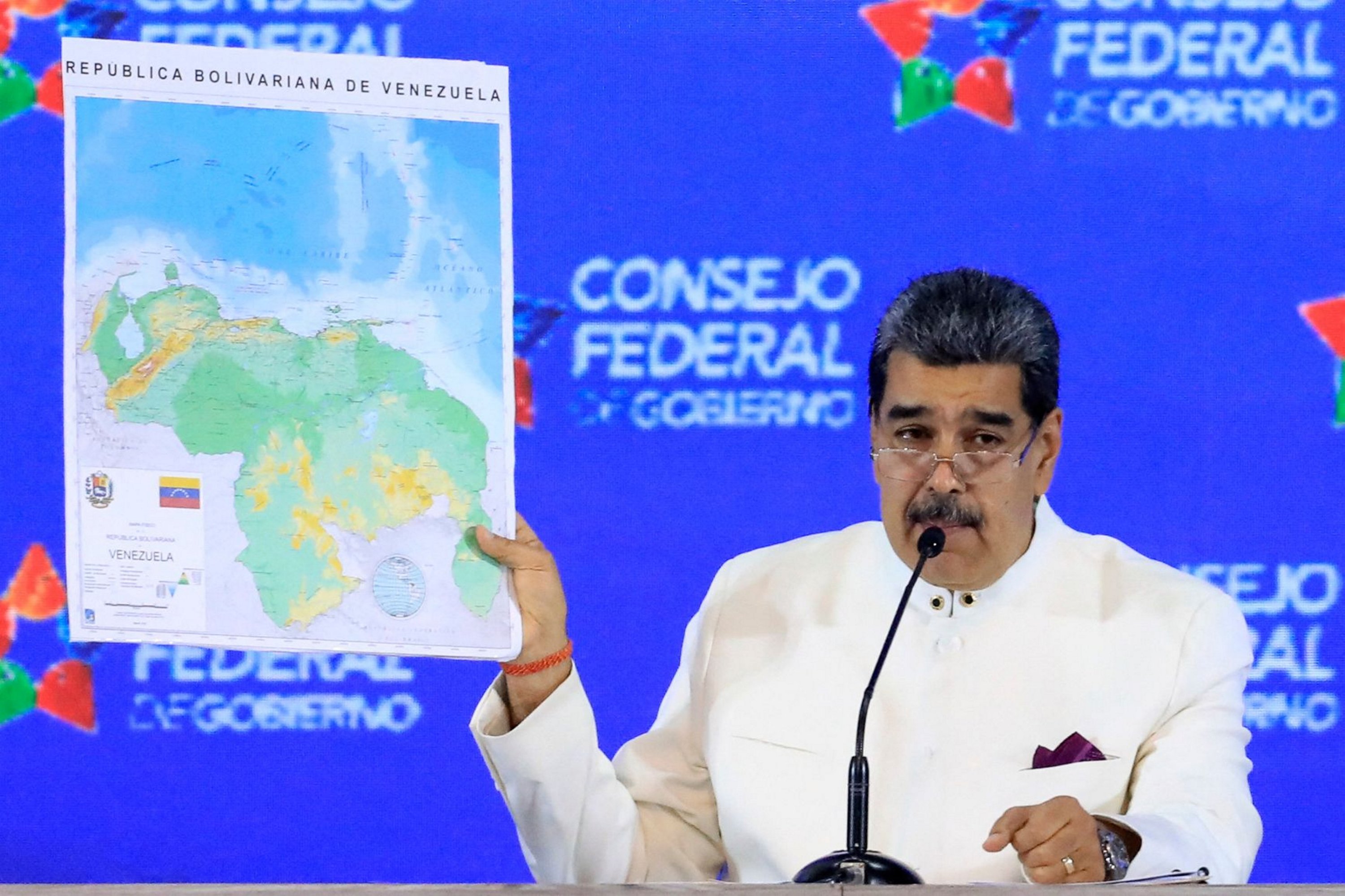
Bilateral relations between Venezuela and Guyana were strained amid rising tensions over a Caracas-proposed bill to create a Venezuelan province in a disputed oil-rich region.
Venezuela's President Nicolas Maduro proposed at a government meeting that a bill be sent to the National Assembly for the creation of a "Guyana Esequiba" province in a region Guyana has administered for over a century.
He also said oil, gas and mining licenses must be issued immediately.
Guyanese President Irfaan Ali called Maduro's statements a "direct threat" against his country and rejected the measures announced by the Venezuelan leader.
On Sunday, Venezuela held a controversial non-binding referendum on the region's fate that yielded an overwhelming 95% "yes" vote for Caracas' designs on Essequibo, or Esequiba as it is known in Venezuela.
Maduro gave an ultimatum to oil companies working under concessions given by Guyana to withdraw their operations within three months.
He also said a town bordering the disputed area, Tumeremo, would become the headquarters of Venezuelan efforts to defend its interests there, adding authorities would conduct a census and begin issuing identity cards without giving details of how that would occur.
Earlier Tuesday, Guyana said it would approach the U.N. Security Council for help if Venezuela makes any moves following the referendum, which Guyana had sought to stop with an urgent application to the International Court of Justice (ICJ) in The Hague.
Guyana's Attorney General Anil Nandlall told AFP "any action or any attempt to take any action pursuant to the referendum will necessitate a resort to the U.N. Security Council as an injured party."
He said Guyana would invoke Articles 41 and 42 of the U.N. Charter which can authorize sanctions or military action to maintain or restore international peace and security.
"In terms of military, it (the UNSC) can authorize the use of armed forces by member states to assist in the enforcement" of ICJ orders, Nandlall said.
China, a close ally of Venezuela and its main creditor, said Wednesday that both countries were "good friends" of Beijing and it supported the resolving of their border issues.
Beijing "has consistently supported Venezuela and Guyana in properly resolving questions about border delineations," Foreign Ministry spokesperson Wang Wenbin said in a statement.
"This accords with the interests of the two countries' peoples, and is also conducive to stability, cooperation and development in Latin America and the Caribbean region."
Guyana has administered Essequibo for more than 100 years. The region makes up more than two-thirds of its territory and is home to 125,000 of Guyana's 800,000 citizens.
Litigation is pending before the ICJ over where the borders should lie.
Guyana, a former British and Dutch colony, insists the frontiers were determined by an arbitration panel in 1899.
But Venezuela – which does not accept the ICJ's jurisdiction in the matter – claims the Essequibo River to the region's east forms a natural border and had historically been recognized as such.
The dispute has intensified since ExxonMobil discovered oil in Essequibo in 2015.
Caracas called Sunday's referendum after Guyana started auctioning off oil blocks in Essequibo in August.
Guyana had asked the ICJ to block the vote, which it considered an existential threat.
On Friday, the court urged Caracas to take no action that might affect the disputed territory but did not grant Georgetown's request for urgent intervention.
Instead, it ruled that Venezuela "shall refrain from taking any action which would modify the situation that currently prevails in the territory in dispute."
On Sunday, Guyana's Ali warned that if Venezuela ignored the court order, "it will be a great injustice to the people of Venezuela because ultimately that path would lead to the suffering of the people of Venezuela."
Voters were asked to respond to five questions in the referendum, including whether Venezuela should reject the 1899 arbitration decision as well as the ICJ's jurisdiction.
They were also asked whether Venezuelan citizenship should be granted to the people – currently Guyanese – of a new "Guyana Esequiba State."