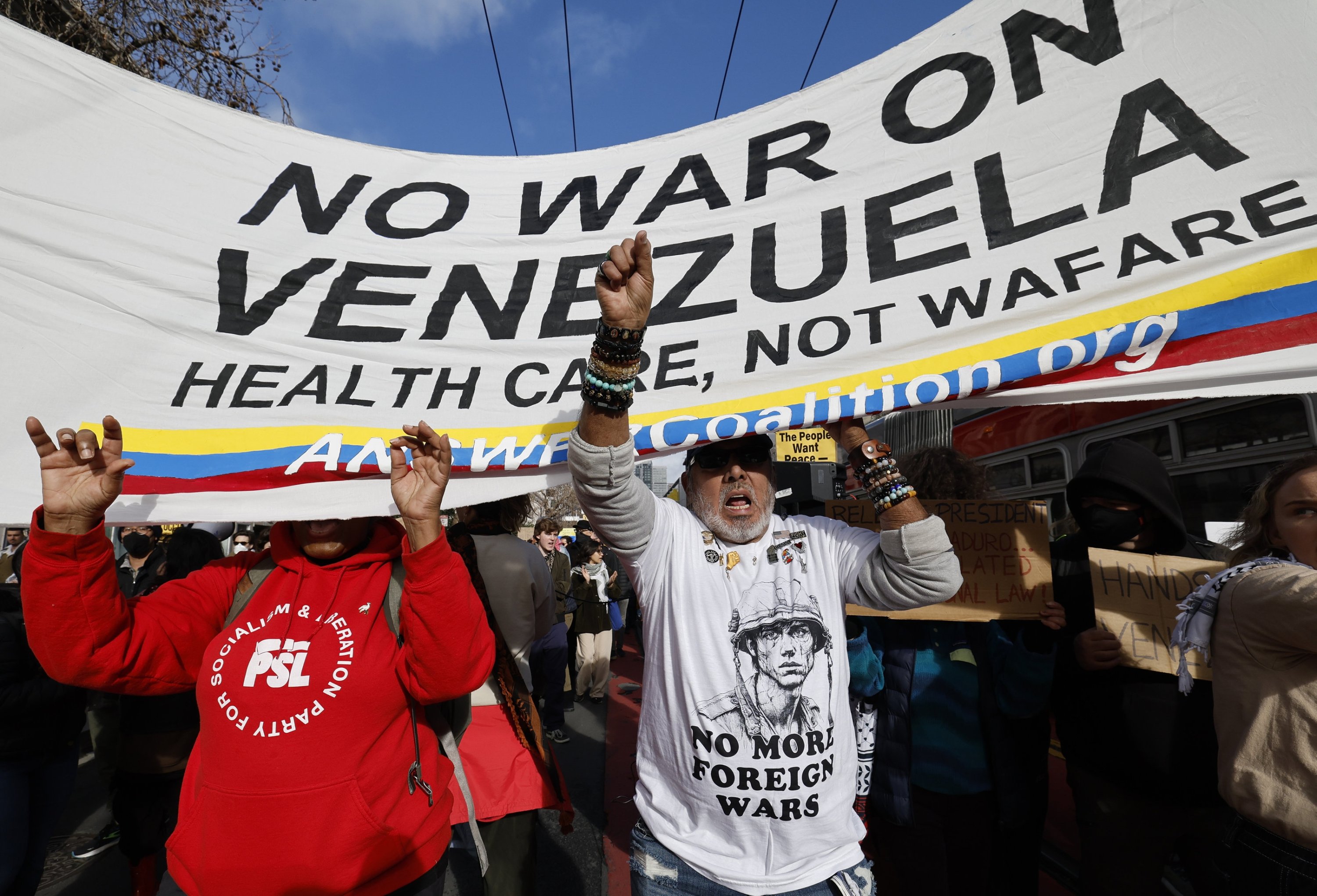
The U.S. military operation that seized Venezuelan President Nicolas Maduro on Saturday triggered international alarm, drawing expressions of concern from both Washington’s allies and its adversaries, as well as from supporters of Caracas.
President Donald Trump said that the U.S. would "run" Venezuela and tap its huge oil reserves and posted a picture of Maduro in custody on a U.S. naval ship wearing a blindfold and handcuffs.
Maduro and his wife were flown by helicopter to New York City, where they face drug-trafficking and weapons charges.
They were seized by U.S. special forces during a pre-dawn attack in which airstrikes pounded sites in and around the Venezuelan capital Caracas late Saturday.
Countries such as China, Russia, and Iran, which have longstanding ties with Maduro's government, were quick to condemn the operation but their alarm was also shared by Washington's allies, including France and the EU.
China made calls Sunday for Maduro to be "immediately released" after saying it "strongly condemns" the U.S. operation in Venezuela.
China's Foreign Affairs Ministry said in a statement that the U.S. is in "clear violation of international law, basic norms in international relations, and the purposes and principles of the U.N. Charter."
Russia also condemned the action, saying that "the United States committed an act of armed aggression against Venezuela. This is deeply concerning and condemnable."
"The pretexts used to justify such actions are unfounded. Ideological animosity has prevailed over business pragmatism and the willingness to build relationships based on trust and predictability," the Russian Foreign Ministry said.
"In the current situation, it is important, first and foremost, to prevent further escalation and to focus on finding a way out of the situation through dialogue," it added.
Iran, which Trump bombed last year, said it "strongly condemns the U.S. military attack on Venezuela and a flagrant violation of the country's national sovereignty and territorial integrity."
Tehran also called on the U.N. Security Council to "act immediately to halt the unlawful aggression" and hold those responsible accountable.
Mexico, which Trump has also threatened with military force over drug trafficking, strongly condemned the U.S. military action in Venezuela, saying it "seriously jeopardizes regional stability."
Colombian President Gustavo Petro – whose country neighbors Venezuela – called the U..S action an "assault on the sovereignty" of Latin America, which would lead to a humanitarian crisis.
Brazilian President Luiz Inacio Lula da Silva slammed the US attacks as a "serious affront" to Venezuela's sovereignty.
"The bombings on Venezuelan territory and the capture of its president cross an unacceptable line. These acts represent a grave affront to Venezuela's sovereignty and yet another extremely dangerous precedent for the entire international community," he added.
"Attacking countries in flagrant violation of international law is the first step toward a world of violence, chaos, and instability, where the law of the strongest prevails over multilateralism."
Cuba, a strong ally of Venezuela, denounced "state terrorism against the brave Venezuelan people."
Prime Minister Pedro Sanchez said the intervention "violates international law and pushes the region toward a horizon of uncertainty and militarism."
France said the U.S. operation undermined international law and no solution to Venezuela's crisis can be imposed externally.
President Emmanuel Macron called for 2004 presidential candidate Edmundo Gonzalez Urrutia to lead a political transition.
Chancellor Friedrich Merz said that Maduro had "led his country to ruin," but called the U.S. action legally "complex."
The EU more generally expressed concern at the developments and urged respect for international law, even as it noted that Maduro "lacks legitimacy."
EU candidate country North Macedonia, along with fellow Balkan nations Albania and Kosovo, backed Washington, however.
"We stand with the United States and the Venezuelan people for freedom and democracy," North Macedonia FM Timco Mucunski said on X.
Prime Minister Keir Starmer said the U.K. will discuss the "evolving situation" in Venezuela with U.S. counterparts while noting Britain will "shed no tears" about the demise of Maduro's "regime."
In a rare expression of support for the US operation by a major European country, far-right Italian Prime Minister Giorgia Meloni – a Trump ally – argued the U.S. military action in Venezuela was "legitimate" and "defensive."
Israel also hailed the operation, saying Washington acted as the "leader of the free world."
Ukraine – dependent on U.S. support in its war against invading Russia – did not address the legality of a big country like America using military force against a much smaller one like Venezuela.
Foreign minister Andriy Sybiga instead focused on Maduro's lack of legitimacy and the Venezuelan government's repression, while backing "democracy, human rights, and the interests of Venezuelans."
South Africa, which Trump accuses of alleged discrimination – and even "genocide" – of minority white Afrikaners, said: "Unlawful, unilateral force of this nature undermines the stability of the international order and the principle of equality among nations."
U.N. Secretary-General Antonio Guterres was "deeply alarmed" by the U.S. strikes, with his spokesman quoting him as saying it could "constitute a dangerous precedent."
Greek Prime Minister Kyriakos Mitsotakis claimed on X that Maduro "presided over a brutal and repressive dictatorship that brought about unimaginable suffering on the Venezuelan people."
"The end of his regime offers new hope for the country. This is not the time to comment on the legality of the recent actions," he said.