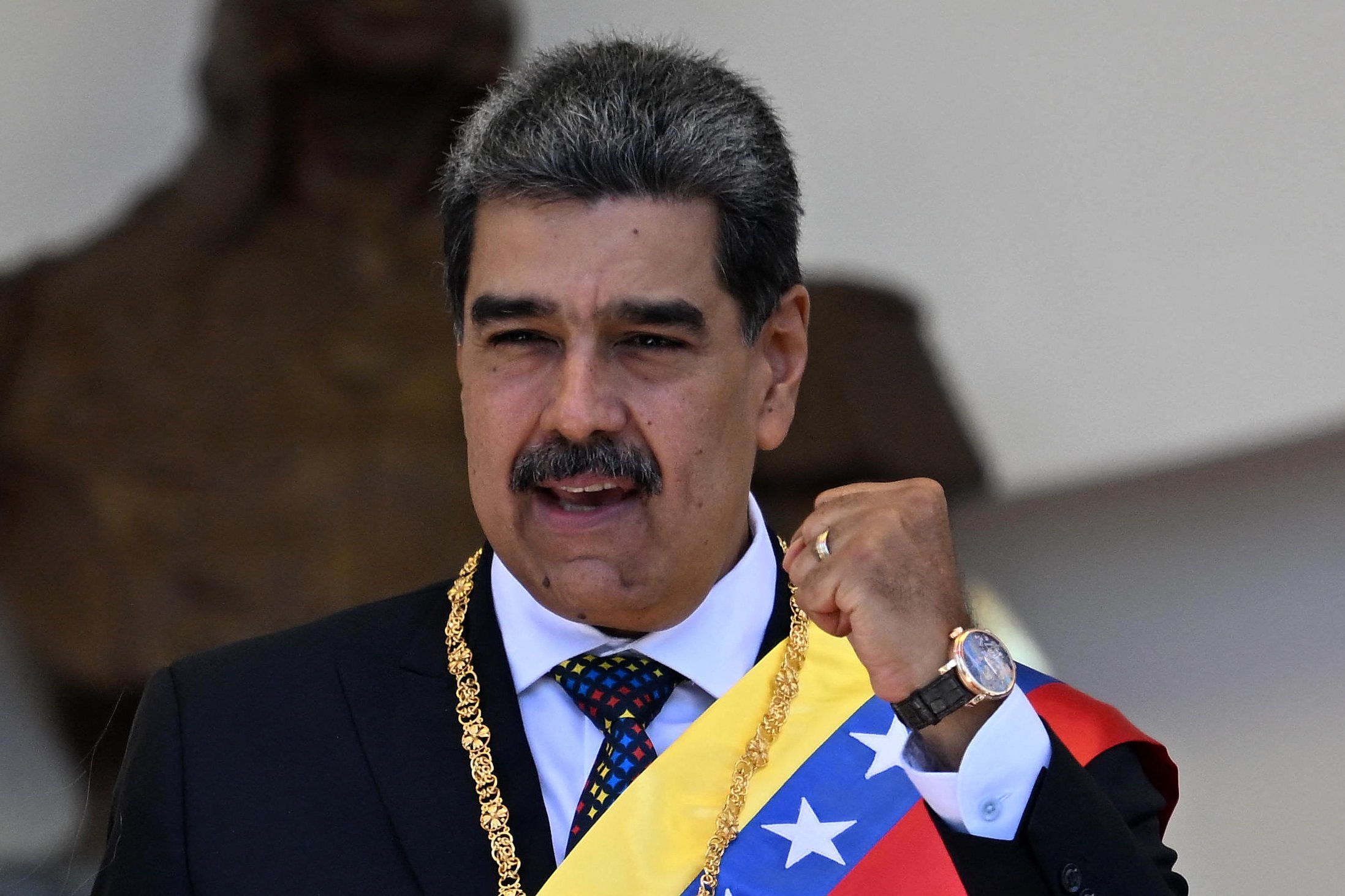
Former Venezuelan President Nicolas Maduro is set to appear Monday in a Manhattan federal courtroom on sweeping narco-terrorism charges, days after a surprise U.S. military raid in Caracas upended Venezuela’s political order and ignited global debate over Washington’s most aggressive intervention in Latin America in decades.
Maduro, 63, and his wife, Cilia Flores, were flown to the United States and jailed in Brooklyn following their weekend capture by American forces. Both are scheduled to appear at noon before U.S. District Judge Alvin K. Hellerstein.
It remained unclear whether either had secured legal counsel or intended to enter pleas.
The arrest marks a dramatic escalation in Washington’s long-running effort to isolate Maduro, whom the United States has refused to recognize as Venezuela’s legitimate leader since his disputed 2018 reelection.
It also represents the most controversial U.S. action in the region since the 1989 invasion of Panama.
Prosecutors allege that Maduro ran a state-sponsored criminal enterprise that transformed Venezuela into a central hub of global cocaine trafficking, working hand in hand with some of the world’s most violent drug syndicates and U.S.-designated terrorist organizations.
A newly unsealed indictment accuses him of serving as the kingpin of a cartel composed of senior Venezuelan political and military officials who conspired for decades to flood the United States with thousands of tons of cocaine.
The alleged network partnered with Mexico’s Sinaloa and Zetas cartels, Colombia’s FARC guerrillas, and Venezuela’s Tren de Aragua gang, prosecutors said. “As Venezuela’s president and de facto ruler, Maduro allowed cocaine-fueled corruption to flourish for his own benefit, the benefit of his regime, and the benefit of his family,” the indictment states.
Maduro faces charges including narco-terrorism conspiracy, cocaine importation, and possession of machine guns and destructive devices, counts that carry potential sentences of decades to life in prison if convicted.
U.S. authorities say Maduro’s involvement in drug trafficking dates back to his first election to Venezuela’s National Assembly in 2000 and continued through his tenure as foreign minister and later as Hugo Chavez’s handpicked successor in 2013.
While serving as foreign minister, prosecutors allege, Maduro sold diplomatic passports to traffickers and arranged diplomatic cover for flights carrying drug proceeds from Mexico to Venezuela.
From 2004 to 2015, prosecutors say Maduro and Flores relied on state-backed criminal gangs to traffic cocaine seized by Venezuelan authorities, while ordering kidnappings, beatings and murders to protect their operations and enforce debts.
As president, Maduro allegedly directed smuggling routes, deployed the military to shield shipments, harbored violent traffickers and used presidential facilities to move drugs.
One example cited in the indictment describes Maduro ordering top aides, just months after taking office, to establish new smuggling routes after French authorities uncovered an existing pipeline, then arresting low-level military officials to divert suspicion.
Legal experts caution that securing a conviction will hinge on proving Maduro’s direct involvement rather than command responsibility, a challenge if prosecutors cannot pierce layers of insulation around his decision-making.
Maduro ruled Venezuela for more than 12 years with an iron grip, presiding over economic collapse, hyperinflation and one of the world’s largest migration crises.
His capture followed a months-long pressure campaign by U.S. President Donald Trump, who authorized naval seizures of sanctioned Venezuelan oil shipments and strikes on vessels accused of transporting drugs.
The legality of the raid has drawn sharp criticism from international law scholars and foreign governments. U.N. Secretary-General Antonio Guterres called it a “dangerous precedent,” and Russia and China, key backers of Caracas, condemned the operation.
The U.N. Security Council scheduled an emergency meeting Monday to address the crisis.
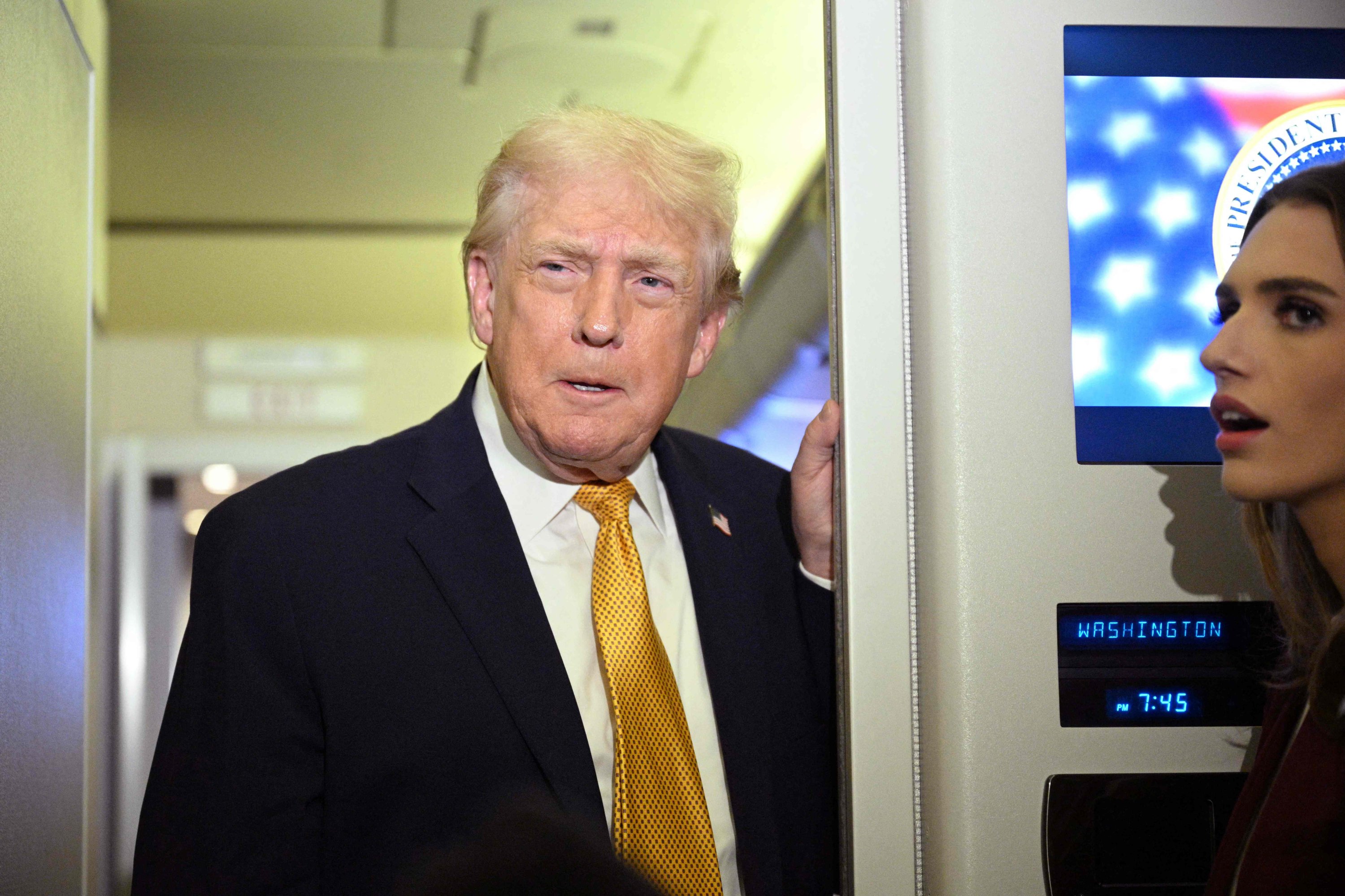
Trump, meanwhile, left the door open to further military action. Speaking aboard Air Force One, he warned of additional strikes if Venezuela failed to cooperate on drug enforcement and reopening its oil sector, and floated the possibility of action beyond Venezuela’s borders. “We’re taking back what they stole,” Trump said. “We’re in charge.”
Global oil prices edged higher as markets weighed the risk of broader instability, even as Asian stock markets rose.
Despite Maduro’s detention, his government remains in control in Caracas.
Vice President Delcy Rodriguez has assumed interim leadership, rejecting Trump’s claims that she is willing to work with Washington and insisting Maduro remains Venezuela’s president.
Rodriguez, who also serves as oil minister, is widely viewed as the most pragmatic figure in the ruling circle.
Maduro has denied all wrongdoing, and any trial is likely months away. Trump has dismissed opposition leader Maria Corina Machado as a viable successor, despite international observers saying her ally, Edmundo Gonzalez, overwhelmingly won last year’s disputed vote.
Beyond Venezuela, the seizure has unsettled Washington itself.
Democrats say they were misled about the administration’s intentions, and Secretary of State Marco Rubio was scheduled to brief lawmakers amid growing unease over the precedent set by capturing a foreign head of state.
Once among Latin America’s wealthiest nations, Venezuela has seen its economy collapse over two decades, driving roughly one in five citizens abroad.
Analysts warn that Maduro’s removal, far from restoring stability, could deepen uncertainty in a country already on the brink.