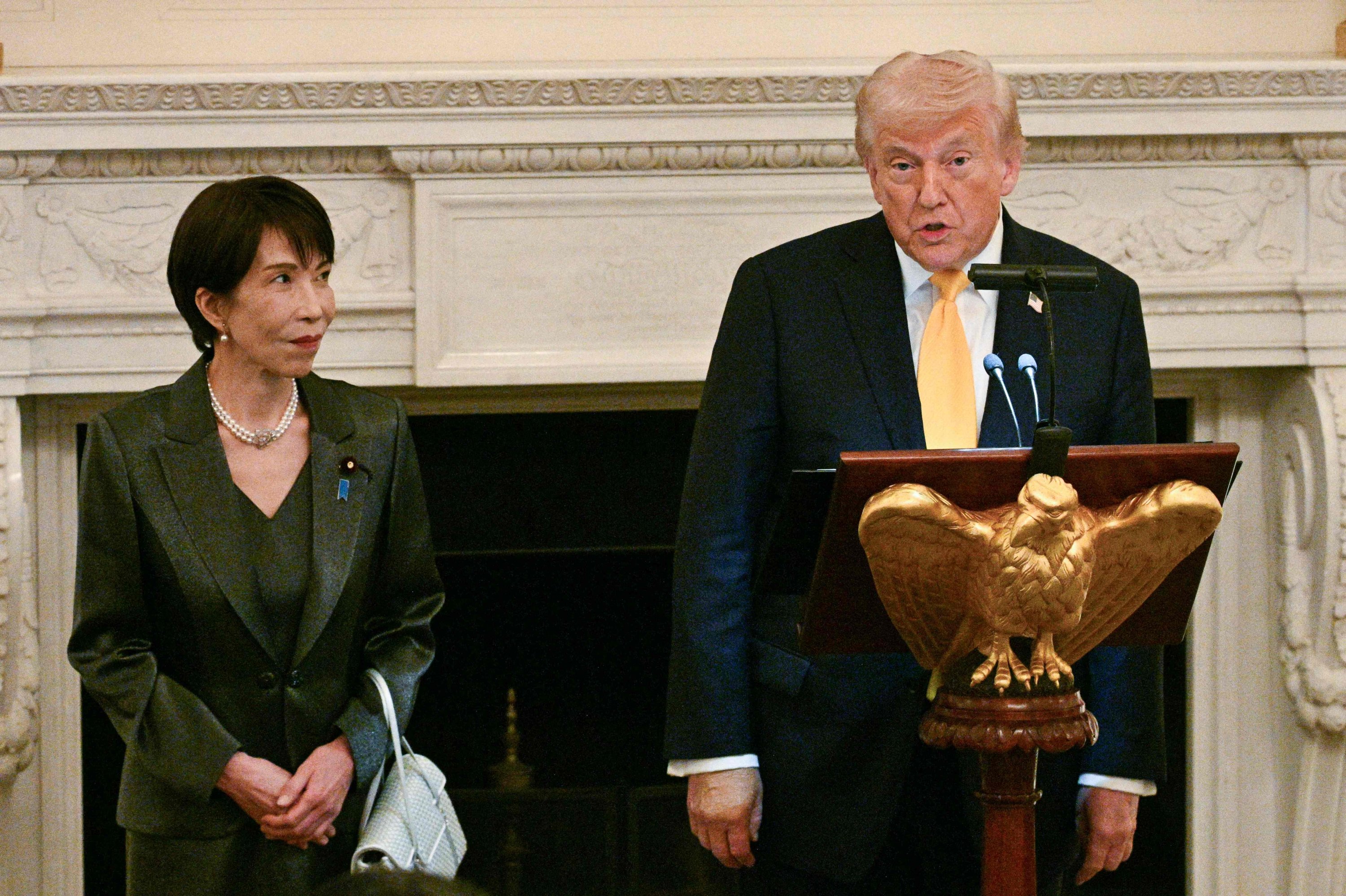
President Donald Trump stirred historical tensions Thursday, drawing a direct parallel between U.S. strikes on Iran and Japan’s 1941 attack on Pearl Harbor, leaving Japanese Prime Minister Sanae Takaichi in a visibly delicate position during a White House meeting.
Asked why the U.S. had not informed allies before launching military action against Tehran, Trump leaned toward Takaichi and quipped, “We wanted surprise. Who knows better about surprise than Japan? Why didn’t you tell me about Pearl Harbor?”
The remark drew a fleeting grimace from Takaichi, who shifted in her seat as reporters captured the moment, underscoring the fraught symbolism of the attack that killed 2,390 Americans and propelled the U.S. into World War II.
Trump used the meeting to defend the war he initiated against Iran, framing it as a strategic necessity.
The president emphasized that much of Japan’s oil supply passes through the Strait of Hormuz, one of the world’s most critical chokepoints for energy transport, and said this gave Tokyo a reason to support U.S. efforts.
“I expect Japan to step up, you know, because we have that kind of relationship,” he said, citing U.S. troop deployments and defense spending in the country.
Takaichi, Japan’s first female prime minister and a protege of Shinzo Abe, responded carefully. She reaffirmed Japan’s opposition to Iran’s nuclear ambitions and described the “very severe security environment” worldwide.
Speaking through an interpreter, she praised Trump’s capacity to achieve peace, signaling a commitment to alliance ties without directly committing Japan to military action in the Middle East.
Public moments were interlaced with visible tension. As Trump fielded repeated questions about Japan’s role in the Iran war, Takaichi checked her watch, a subtle sign of the tightrope she navigates between alliance obligations and constitutional limits.
Japan’s post-World War II constitution restricts military action to self-defense, meaning any involvement in U.S.-led operations against Iran would require unprecedented political justification and could face domestic scrutiny.
Analysts suggest Japan could contribute in limited ways, such as minesweeping or anti-piracy naval missions, but the prospect of full participation remains politically fraught.
The meeting also coincided with broader international concerns.
Earlier Thursday, leaders from Japan and five European countries issued a joint statement demanding Iran cease attacks on the Strait of Hormuz, signaling willingness to help protect commercial shipping routes.
Despite the show of solidarity, Trump indicated he expected Japan to go further, though he offered no concrete steps.
Beyond the Middle East, the discussions touched on regional security, energy cooperation, and China.
Japan has been accelerating military buildup on islands near the East China Sea in response to China’s growing assertiveness, particularly around Taiwan.
Analysts warn that shifting U.S. troops to the Middle East could weaken deterrence in East Asia at a moment of heightened tension, complicating Takaichi’s diplomatic balancing act.
The White House visit also included discussions on economic cooperation. Officials said Trump and Takaichi are expected to announce a $40 billion deal for advanced small modular nuclear reactors in Tennessee and Alabama, involving U.S.-based GE Vernova Inc. and Japan’s Hitachi Ltd.
The project aims to expand U.S. power generation and stabilize electricity prices.
Kurt Campbell, former U.S. deputy secretary of state and chair of The Asia Group, noted that Takaichi must navigate multiple objectives: projecting Japan as a partner in the Middle East while ensuring the U.S. remains committed to the Indo-Pacific and Taiwanese security. “She’s aiming to come out as a partner, but without committing beyond what Japanese law and politics allow,” Campbell said.
The meeting was initially intended to precede Takaichi’s trip to China, but Iran’s conflict and Trump’s demands for allied involvement in the Middle East delayed those plans.