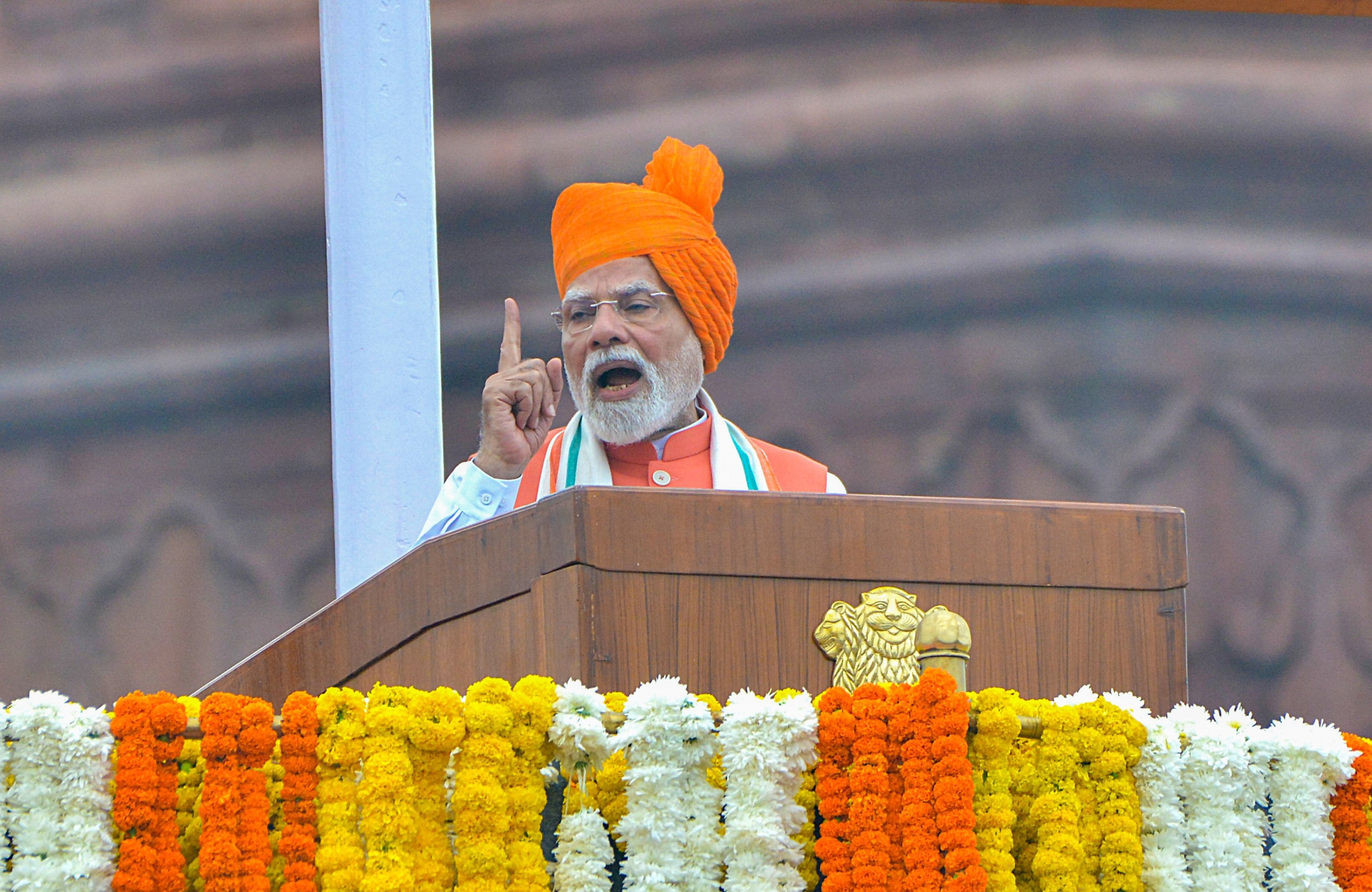
Indian Prime Minister Narendra Modi warned Pakistan on Friday that India will respond decisively to any future attacks, as the country celebrated its 78th Independence Day.
Speaking from the historic Red Fort in New Delhi, Modi said India has established a "new normal" that makes no distinction between "terrorists" and those who support them. He vowed that India would no longer tolerate what he called Islamabad’s "nuclear blackmail."
"For a long time, nuclear blackmail had been going on, but this blackmail will not be tolerated now," Modi said.
The warning comes three months after India and Pakistan, both nuclear-armed rivals, fought their worst clashes in decades during four days of intense fighting.
There was no immediate response from Pakistan, which has previously dismissed India’s statements on nuclear threats as provocative and inflammatory.
However, Pakistani Prime Minister Shehbaz Sharif on Thursday announced the creation of a new "Army Rocket Force Command" to bolster the country’s defense capabilities. Sharif made the announcement during Independence Day celebrations but gave no further details.
India celebrates Independence Day one day after Pakistan. The two countries emerged from the bloody partition of British India in 1947, which sparked some of the worst communal violence in modern history, leaving hundreds of thousands dead and displacing around 12 million people.
India and Pakistan exchanged tit-for-tat military strikes in May that brought them to the brink of war. The fighting followed an April massacre in Indian-administered Kashmir in which gunmen killed 26 people, mostly Hindu tourists.
India blamed Pakistan-backed forces. Pakistan denied responsibility and called for a neutral investigation.
Days later, India launched strikes on Pakistan, claiming it had hit nine "terrorist infrastructure" sites.
"Terror infrastructure was turned to rubble," Modi said in his Friday speech.
Pakistan responded with waves of drones, as well as missile and artillery fire. Dozens of people were killed on both sides until a ceasefire was reached May 10 following U.S. mediation.
Pakistan claimed it shot down six Indian aircraft during the clashes, including a French-made Rafale fighter. India acknowledged some losses but did not provide details.
Last week, India’s air force chief publicly claimed that India shot down five Pakistani fighter jets and one other military aircraft. Pakistan rejected the claim, calling for independent verification of both sides’ aircraft inventories.
During his speech, Modi also hinted that India would continue its unilateral suspension of the Indus Water Treaty. The treaty, suspended by India after the April massacre, governs the sharing of the Indus River, which flows about 2,897 kilometers (1,800 miles) through South Asia and is vital to both countries.
"Rivers from India were irrigating the lands of enemies while my country’s farmers and land faced a deficiency of water," Modi said. "India has now decided that blood and water will not flow together."
Pakistan has said any effort by India to stop or divert the river would be considered an "act of war."
Modi did not directly mention U.S. President Donald Trump’s tariffs on India in his Independence Day speech but said he would not compromise on the agriculture sector, a main sticking point in trade negotiations with the U.S.
Earlier this month, Trump imposed a 25% penalty on India in addition to 25% tariffs for buying oil and weapons from Russia. India has resisted U.S. pressure to open its markets for some farm products, as Modi’s government does not want to anger farmers, a powerful voting bloc.
"India will not compromise on interest of farmers," he said.
Modi also claimed India’s demographics were being altered through illegal migration and announced a "high-powered demographic mission" to address the issue, without giving further details.
"No nation in the world can hand over itself to infiltrators," he said.
Modi’s ruling Hindu nationalist Bharatiya Janata Party has repeatedly described the influx of illegal immigrants from Bangladesh as a "national security crisis," claiming unchecked Muslim migration is causing a demographic shift in India.
In recent months, Indian authorities have conducted what they call a verification drive to identify immigrants lacking legal status. Many people, mostly Muslims, have been detained or expelled to neighboring Bangladesh.