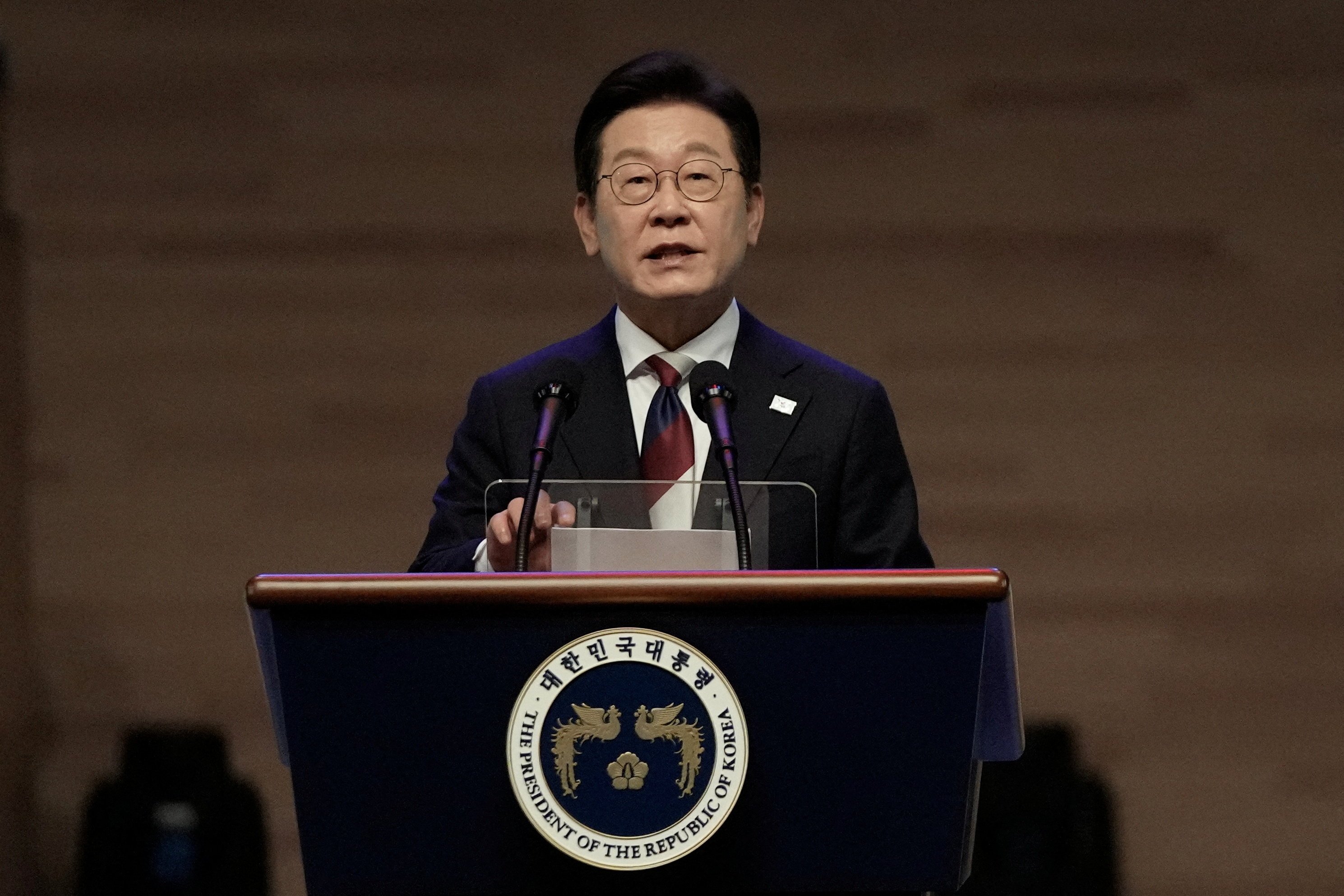
South Korea’s new liberal president, Lee Jae-myung, said Friday he plans to revive a 2018 military agreement with North Korea designed to ease border tensions, calling on Pyongyang to respond to Seoul’s efforts to rebuild trust and restart dialogue.
Lee spoke on the 80th anniversary of Korea’s liberation from Japanese colonial rule, delivering his overture amid rising tensions over North Korean leader Kim Jong Un’s nuclear ambitions and Pyongyang’s deepening ties with Russia amid the war in Ukraine.
The 2018 agreement, forged during a brief diplomatic thaw under former President Moon Jae-in, established buffer zones on land and sea and no-fly zones above the border to prevent clashes.
South Korea’s previous conservative government suspended the deal in 2024, citing tensions over North Korea’s launches of trash-laden balloons toward the South, and resumed frontline military activities and propaganda campaigns. The step came after North Korea had already declared it would no longer abide by the agreement.
“To prevent accidental clashes between South and North Korea and to build military trust, we will take proactive, gradual steps to restore the (2018) Sept. 19 military agreement,” Lee said in a televised speech.
Lee said his government affirms “our respect for the North’s current system” and that the wealthier South “will not pursue any form of unification by absorption and has no intention of engaging in hostile acts.”
He also said South Korea remains committed to an international push to denuclearize North Korea and urged Pyongyang to resume dialogue with Washington and Seoul. Amid a prolonged diplomatic stalemate, Kim’s government has made clear it has no intention of giving up the weapons it sees as its strongest guarantee of survival and would reject any future talks on denuclearization.
“Denuclearization is a complex and difficult task that cannot be resolved quickly,” Lee said. “However, inter-Korean and U.S.-North Korea dialogue, as well as international cooperation, will help us approach a peaceful resolution.”
Japan’s defeat in World War II liberated Korea from colonial rule, but the peninsula was then divided into a U.S.-backed, capitalist South and a Soviet-supported, socialist North – a separation cemented by the devastating 1950-53 Korean War.
Lee, whose speech came days before he plans to travel to Japan for a summit with Prime Minister Shigeru Ishiba, took a conciliatory tone toward Tokyo, calling for the two U.S. allies to overcome grievances rooted in Japan’s brutal colonial rule and develop future-oriented ties. He noted that some historical issues remain unresolved and urged the government in Tokyo to “squarely face up to our painful history and strive to maintain trust between our two countries.”
Lee’s meeting with Ishiba will come just before he flies to Washington for a meeting with U.S. President Donald Trump over trade and defense issues, a sequence that underscores how Trump’s push to reset global trade and U.S. security commitments is drawing the often-feuding neighbors closer.
Ishiba, eager to improve ties with Seoul, has acknowledged Japan’s wartime aggression and shown more empathy toward Asian victims than his recent predecessors.
Lee, who took office after winning an early election in June following the ouster of his conservative predecessor Yoon Suk-yeol over a brief imposition of martial law in December, has taken steps to repair ties with the North, including the removal of South Korean frontline loudspeakers that Yoon’s government had used to blast anti-North Korean propaganda and K-pop across the border.
It is unclear whether North Korea would respond to Lee’s overture. Expressing anger over Yoon’s hardline policies and expanded South Korean-U.S. military exercises, Kim last year declared that North Korea was abandoning long-standing goals of peaceful unification with South Korea and rewrote the North’s constitution to mark the South as a permanent enemy.
Lee’s speech came a day after Kim’s powerful sister mocked his government for clinging to hopes of renewed diplomacy and falsely claiming the North had removed its own frontline speakers as a reciprocal gesture toward the South.
Kim Yo-jong also reiterated previous North Korean statements that it has no immediate interest in reviving long-stalled negotiations with Washington and Seoul, citing an upcoming joint military exercise between the allies as proof of their continued hostility.
Analysts say North Korea sees no urgency to resume diplomacy with South Korea or the United States, remaining focused on its alignment with Russia. Since Russia’s 2022 invasion of Ukraine, Pyongyang has made Moscow the priority of its foreign policy, sending thousands of troops and large quantities of military equipment, including artillery and missiles, to support the war.
In his own speech marking Korea’s liberation Thursday, Kim Jong Un praised the “infinite might” of the country’s ties with Russia at an event in Pyongyang attended by a Russian government delegation. His speech, published by North Korean state media on Friday, made no mention of Washington or Seoul.