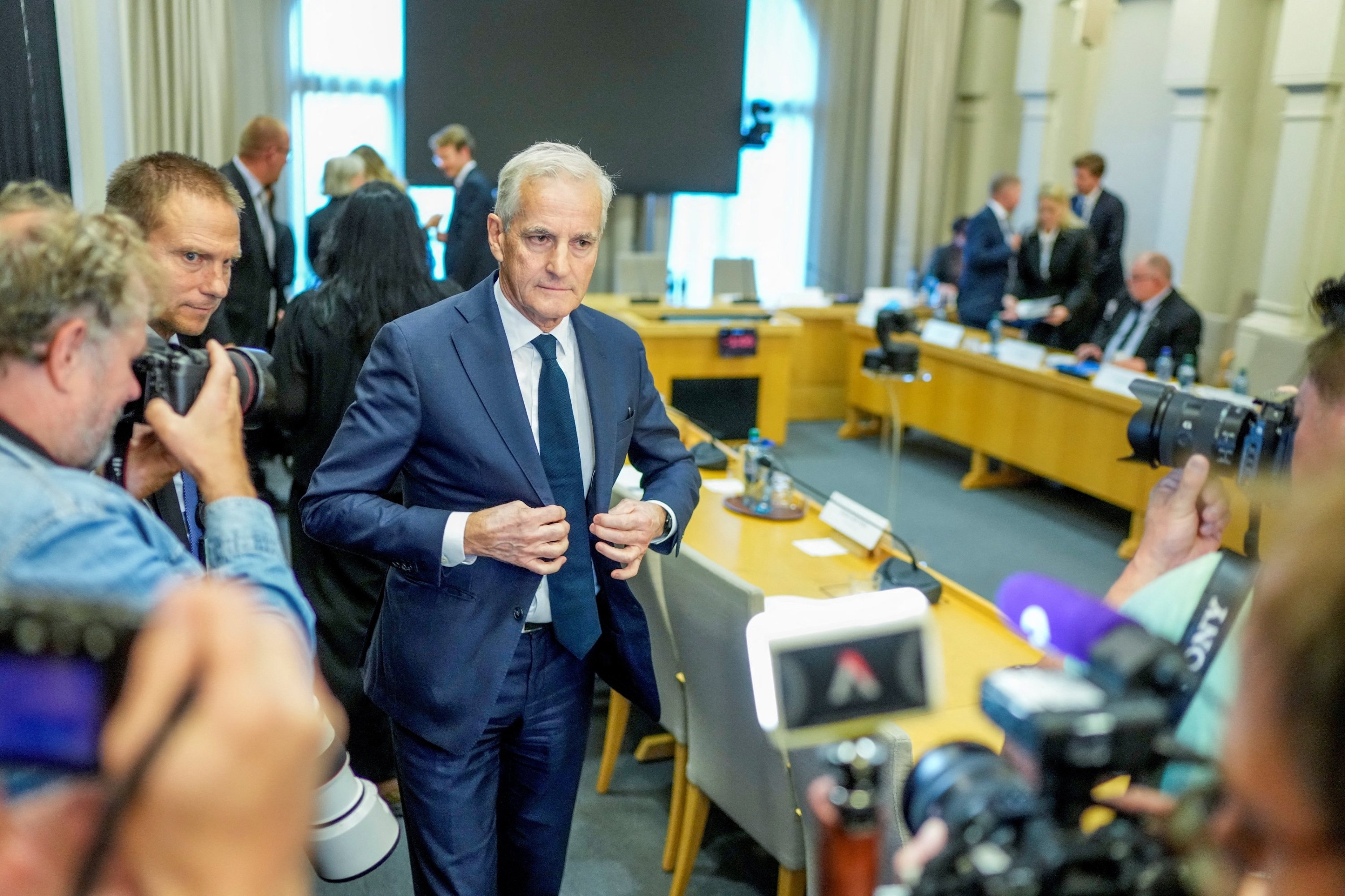
Norway’s parliament opened public hearings Wednesday into links between late U.S. sex offender Jeffrey Epstein and Norwegian politicians and diplomats, as revelations surrounding the disgraced financier continue to reverberate through the country’s political establishment.
U.S. President Donald Trump's Department of Justice in January released millions of Epstein-related documents, revealing connections to politicians, royals and the ultra-rich around the world.
Norway, home of the Nobel Peace Prize and often a fulcrum of international diplomacy, has seen a major fallout, triggering parliamentary inquiries and police investigations.
The government must explain what it is doing to restore trust in the foreign service, said Jonas Andersen Sayed, the leader of the hearing at parliament's Committee on Scrutiny and Constitutional Affairs.
"There are many people who have demonstrated very poor judgment," Andersen Sayed told Reuters of those who had friendships with Epstein.
The committee has summoned 11 current and former foreign ministers and development ministers, including Prime Minister Jonas Gahr Stoere, who was foreign minister from 2005 to 2012.
Stoere reiterated that he had never had any relation to Epstein and said that problems were due to a few individuals not a systemic problem with the foreign ministry.
Issues identified had either been addressed or were being addressed, he said, citing, for instance, updated rules over conflicts of interest for decision-makers.
"Updated and comprehensive rules are necessary, but even the best system provides no complete guarantee against errors being made, whether intentional or unintentional," Stoere said. "No system involving people can guarantee against the misuse of trust."
However, as far as he was aware, Epstein had exercised no influence on Norway's foreign policy, development aid policy "or any other choices we had taken", Stoere added.
Boerge Brende, a former foreign minister who resigned from the position of president and CEO of the World Economic Forum after revelations of his friendly relations with Epstein, also testified on Wednesday.
He told the hearing he met Epstein only after he was foreign minister. "Our contacts were limited to three dinners and exchanges via email and SMS," he said.
"Regarding his abuse, had I known what I know today, I would never have been in contact with him, but I should have researched him more. I take responsibility for that."
Brende apologised for lying to Norwegian daily Aftenposten in November 2025 when the paper asked him whether he had met Epstein and he said he had not. "I am sorry I was not honest at first," he said.
Erik Solheim, a former international development minister, welcomed the probe but said it should not send a signal to diplomats to play it safe in future, particularly when talking to parties involved in wars.
Oslo regularly talks to groups that others boycott, such as Hamas or the Muslim Brotherhood. "We must take care of our peace diplomacy, do more of it," Solheim told the committee.
Though not appearing before parliament, a number of other prominent Norwegians with ties to Epstein, including former premier Thorbjoern Jagland, former minister Terje Roed-Larsen and ex-diplomat Mona Juul, are under police investigation on corruption accusations. All three have denied wrongdoing.
Roed-Larsen has apologised for his close relationship with Epstein, which included a personal loan from the financier, and in 2020 stepped down as CEO of the New York-based International Peace Institute, a think tank.
Queen Mette-Marit, wife of King Haakon, has apologised for her friendship with Epstein, but is also not subject to the hearing.
In parallel, parliament has appointed an external commission of academics and legal experts to probe "matters and issues brought to light" by the files, with an aim of "improving the integrity and transparency of Norwegian authorities."
The rare investigative commission, covering more than 30 years of Norwegian diplomatic history, is due to deliver its findings in early 2028.