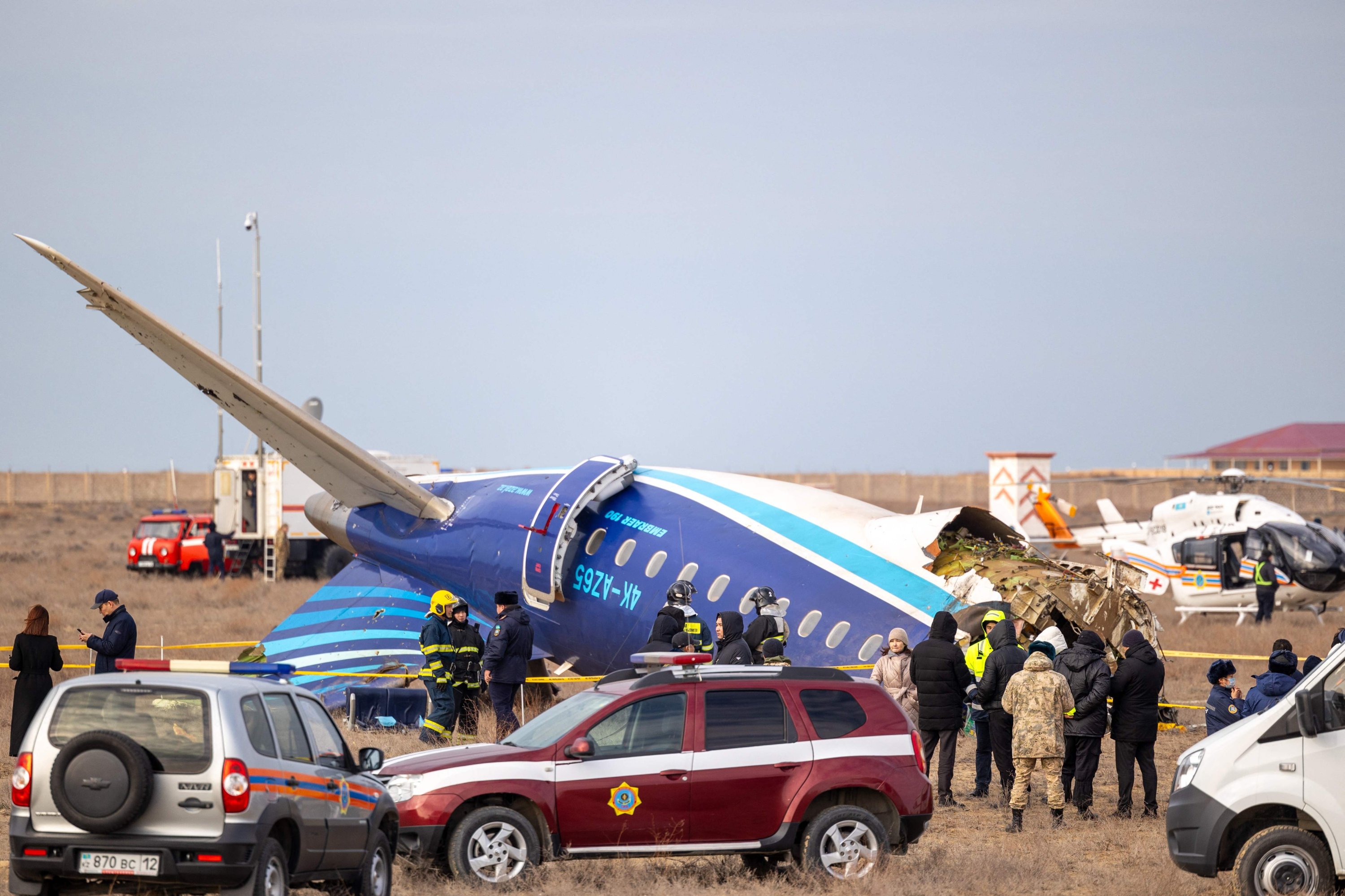
President Vladimir Putin on Thursday told Azerbaijan's leader Ilham Aliyev that Russia's air defense were to blame for downing an Azerbaijani jetliner in December that killed 38 people, his first admission of responsibility for the crash in an effort to ease tensions between the neighbors.
Putin said the missiles fired by Russian air defenses to target a Ukrainian drone exploded near the Azerbaijan Airlines plane flying from Baku as it was preparing to land in Grozny, the regional capital of the Russian republic of Chechnya, on Dec. 25, 2024. Ukrainian drones have regularly struck deep inside Russia.
At a meeting in Tajikistan's capital of Dushanbe, where both leaders were attending a summit of the former Soviet nations, Putin again offered his apologies to Aliyev, pledged to hold those responsible accountable and provide compensation to those affected.
Video footage showed Putin and Aliyev shaking hands and smiling before a bilateral meeting.
Azerbaijani authorities had said the Embraer 190 jet was hit accidentally by Russian fire, then tried to land in western Kazakhstan, where it crashed and killed 38 of 67 people aboard.
Days after the crash, Putin apologized to Aliyev for what he called a "tragic incident," but stopped short of acknowledging responsibility. Aliyev, meanwhile, criticized Moscow for trying to "hush up" the incident.
The controversy over the crash has roiled the previously warm ties between Moscow and Baku. Their relations were further destabilized by deaths of ethnic Azerbaijanis rounded up by police in a Russian city in June and a series of arrests of Russians in Azerbaijan.
Speaking to Aliyev on Thursday, Putin said the two missiles "did not hit the plane directly; if that had happened, it would have crashed on the spot, but they exploded, perhaps as a self-destruction measure, a few meters away, about 10 meters (33 feet)."
"And so the damage was caused, mainly not by the warheads, but most likely by the debris from the missiles themselves. That is why the pilot perceived it as a collision with a flock of birds, which he reported to Russian air traffic controllers, and all this is recorded in the so-called 'black boxes,'" Putin added.
After the incident occurred, the Embraer jet had flown, badly damaged, another 280 miles (450 km) across the Caspian Sea. Putin cautioned on Thursday that it would "probably take some more time" to fully investigate the crash's causes.
A preliminary report published on a Kazakh government website in February found that the plane suffered external damage and was riddled with holes in its fuselage.
"The Russian side will obviously do everything to provide compensation and give legal assessment to all responsible officials' action," said Putin.
"Of course, these words related to this tragedy, aimed at supporting – morally supporting – the families do not solve the main problem: We can't bring back to life those who died as a result of the tragedy," he added.
He voiced hope for overcoming the strain between the countries and fully rebuilding the ties.
"I hope that our cooperation not only will be restored, but continue in the spirit of our relations, the spirit of our alliance," he said.
Aliyev, for his part, thanked Putin for investigating the cause of the plane's downing. "I would like to thank you for keeping the situation under your personal control," he said.
The Azerbaijani leader said they had a chance to discuss a "broad and positive" bilateral agenda, voicing hope that "the messages we are sending today to our societies will meet a positive response."