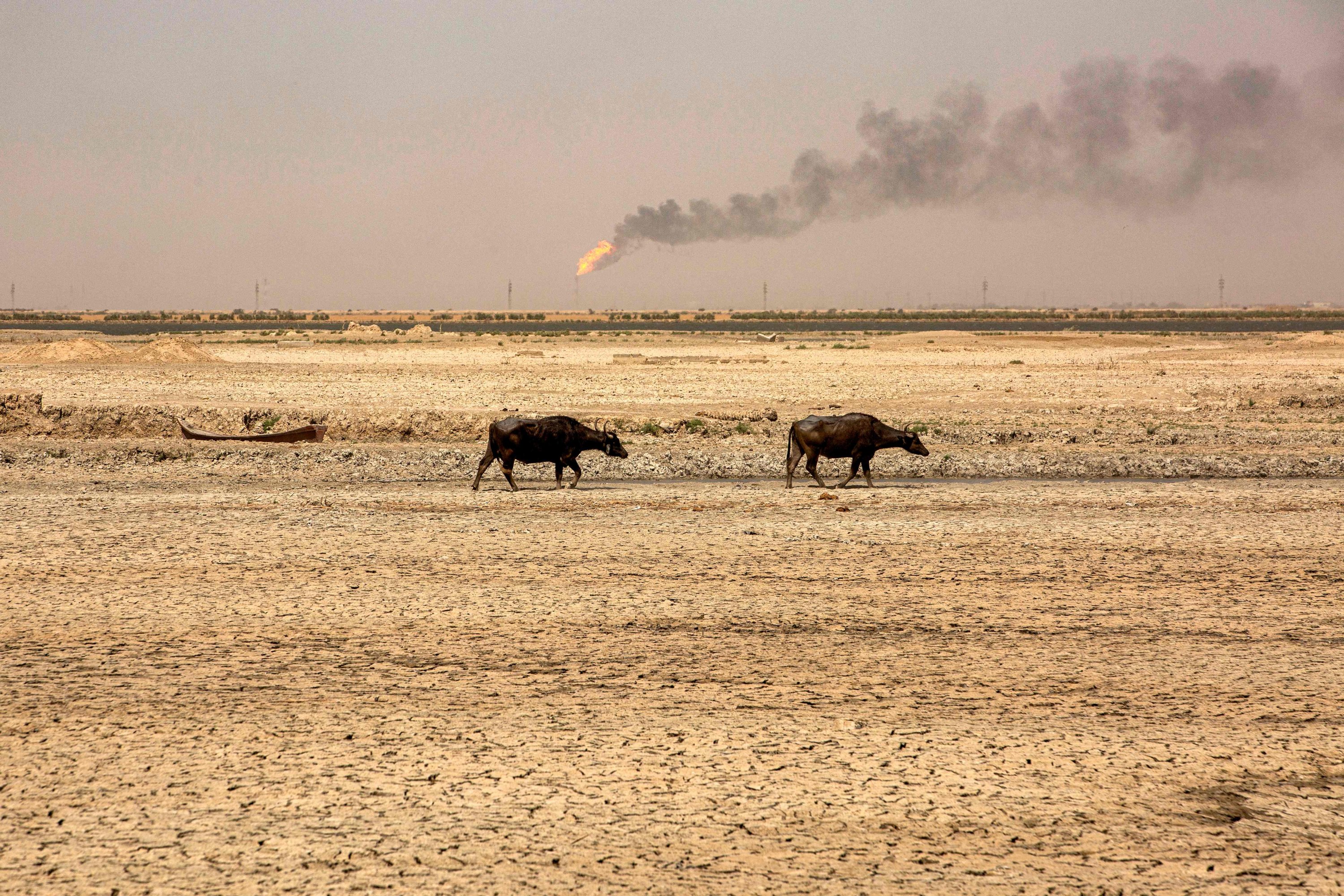
The climate crisis is threatening to displace millions of people in the Middle East as little rainfall, aggressive heatwaves and worsening drought put the world's most water-stressed region on edge.
Hussein Abu Saddam, head of the farmers' syndicate in Egypt which is hosting the COP27 global climate summit in November, told AFP he is already witnessing a climate-induced exodus from the countryside.
Agriculture in Egypt – "one of the aridest countries in the world" – has grown even less profitable because of new climate-linked hazards such as "the appearance of new parasites," he said.
"Young people from rural areas are migrating abroad or to big cities to work in industry."
According to the U.N. refugee agency (UNHCR), "roughly 90% of refugees come from countries that are the most vulnerable and least ready to adapt to the impacts of climate change."
"If people can't farm, if people can't work, if people can't find food, they have few alternatives to displacement," Amy Pope, deputy director of the International Organization for Migration (IOM), told the Agence France-Presse (AFP).
In 2021, natural disasters forced "nearly 3 million people" to leave their homes in Africa and the Middle East, she said.
"And the situation is only going to get worse."
By 2060, Egypt's already stretched agricultural sector could shrink by as much as 47%, researchers predict.
In addition to "the decline in agricultural production," rural-urban migration is also fed by "the attractiveness of urban life, the city and services that are available there," according to Florian Bonnefoi, a research fellow at the Centre for Economic, Legal and Social Study and Documentation (CEDEJ) in Cairo.
Globally, the World Bank estimates that by 2050, if nothing is done to prevent it, there will be 216 million people internally displaced by climate change, including 19.3 million in North Africa.
Some 7% of people in North Africa – where densely populated coastlines are among the world's most threatened by rising waters – live less than 5 meters (16 feet) above sea level, according to the European Institute of the Mediterranean (IEMed).
As coastlines are affected, populations will naturally converge on big cities: Cairo, Algiers, Tunis, Tripoli, the Casablanca-Rabat area and Tangier.
But these "hotbeds of climate migration," the World Bank warns, are themselves vulnerable to rising waters.
In the Egyptian city of Alexandria, for example, 2 million people – nearly a third of its inhabitants – could be displaced and 214,000 jobs lost if the sea level rises by half a meter.
Climate-induced urban migration can "increase the pressure on natural resources," according to economist Assem Abu Hatab, "thus leading to social tensions and violent conflict" in a region where agriculture currently accounts for 22% of employment.
Already in Sudan, tribal clashes over access to water and land leave hundreds dead every year. In just two days in October, at least 200 people died when violence erupted in the southern Blue Nile state.
According to UNICEF, of the 17 most water-scarce countries in the world, 11 are in the Middle East or North Africa.
In Iraq, 20% of the country's freshwater could disappear if the world warms by "one additional degree" and rainfall decreases a further 10%, according to the World Bank.
A third of agricultural land could be deprived of irrigation, creating acute shortages for the country's population of 42 million.
Jordan, one of the world's driest countries, had to double its water imports from Israel in 2021, and the blockaded Gaza Strip has for years suffered chronic water shortages.
The international community has committed – first in Copenhagen and then in Paris – "to help developing countries adapt to the impact of climate change," including by supporting "different mechanisms for farming and water management," according to Pope.
In order to help communities "find other jobs and thus other sources of income" and stem climate migration, these financial commitments must now be kept.