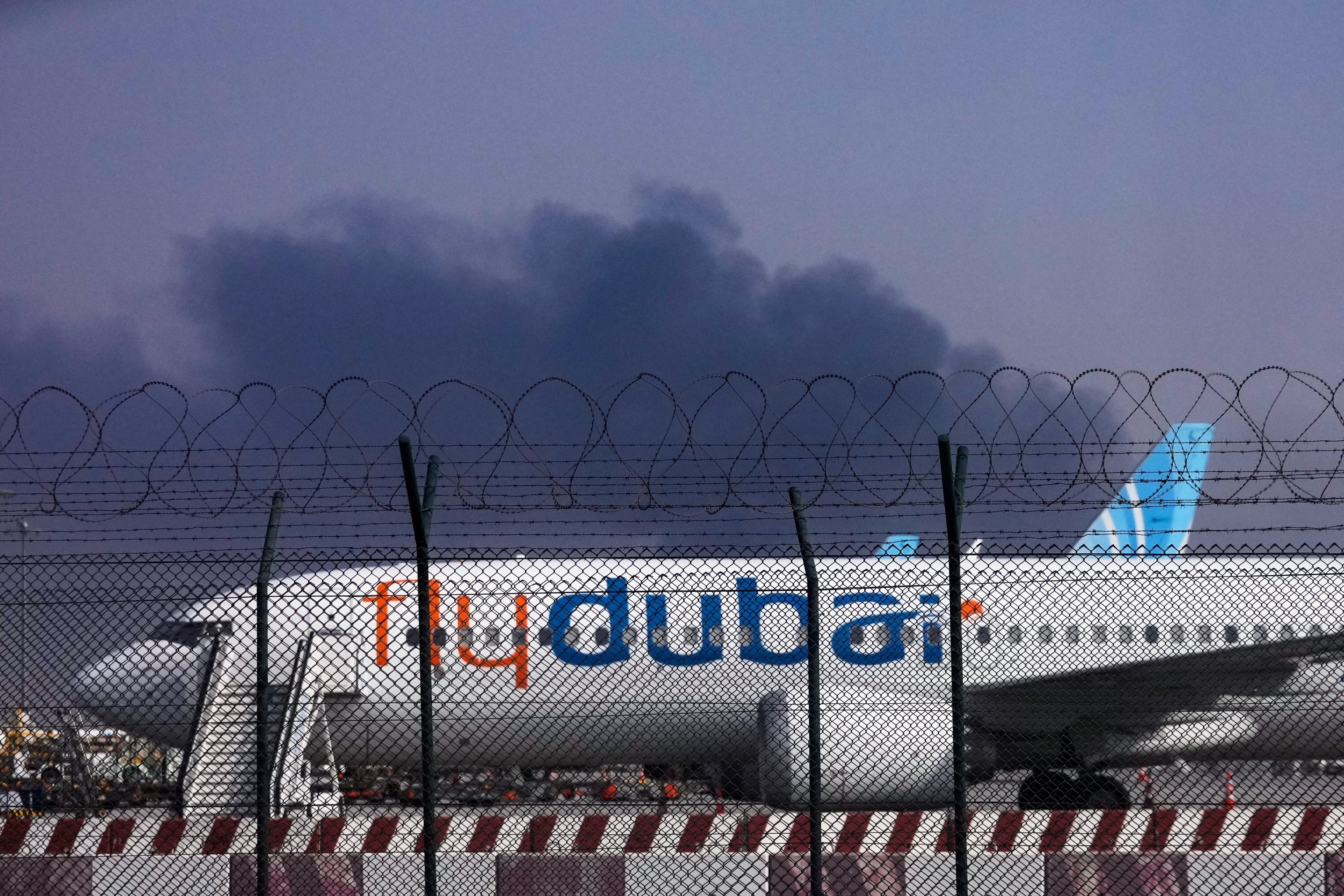
A Flydubai flight carrying more than 170 passengers from Dubai to Tel Aviv diverted to Saudi Arabia on Wednesday after transmitting emergency transponder codes, including one associated with a possible hijacking, triggering an Israeli military response before authorities determined the incident was not believed to involve a hijacking.
Flight FZ1073, operated by a Boeing 737 MAX 8, was traveling toward Ben Gurion Airport when it transmitted the international emergency code 7700 and briefly switched to code 7500, which is used to indicate unlawful interference or a possible hijacking.
The aircraft subsequently changed course, descended sharply and headed toward Saudi Arabia, according to flight-tracking data and Israeli media reports. It eventually landed safely at Tabuk Airport.
The unusual flight path and emergency signals prompted Israeli authorities to treat the situation as a potential security threat.
Israeli media reported that the Air Force scrambled fighter jets after the alert, while Prime Minister Benjamin Netanyahu and Defense Minister Israel Katz held an urgent security consultation with senior defense officials.
The Israeli military also carried out a situation assessment involving the Air Force and other security agencies as authorities sought to determine what had happened aboard the aircraft.
A security source cited by Ynet said there was no confirmed information that the aircraft had been hijacked and that the pilot had activated a distress signal.
The Prime Minister's Office later said the diversion to Saudi Arabia was not believed to have been the result of a hijacking.
The aircraft departed Dubai International Airport early Wednesday on its scheduled service to Tel Aviv. It was carrying roughly 174 passengers, according to reports, including about 27 children.
During the flight, the aircraft transmitted the 7700 general emergency code before briefly transmitting 7500, the code associated with unlawful interference.
The 7500 signal immediately raised the possibility of a hijacking, particularly because the aircraft was headed toward Israel, where security authorities have remained on high alert amid the wider regional security situation.
Flight-tracking data showed the aircraft changing direction and descending to a much lower altitude than its normal cruising level before continuing toward Saudi Arabia. Reports said the aircraft descended to around 15,000 feet.
The combination of the emergency signals, course reversal, descent and temporary concerns over communications intensified the response.
Israeli media initially reported that contact with the aircraft had been lost, although subsequent reports indicated that it was continuing toward Saudi Arabia and was expected to land at Tabuk.
The aircraft eventually landed safely.
The alert prompted an immediate military response in Israel, with fighter jets scrambled as authorities assessed whether the aircraft posed a security threat.
Netanyahu and Katz convened an emergency consultation, while senior military officials assessed the situation with the Air Force.
Other Israeli security bodies were also reported to have been involved in assessing the incident.
Some Israeli reports said departures from Ben Gurion Airport were temporarily affected while the situation was being evaluated.
The response reflected the seriousness with which aviation authorities treat a 7500 transmission. The code is designed to alert air traffic control and relevant security agencies to a possible unlawful interference situation.
However, the transmission alone does not establish that a hijacking has taken place.
As the situation developed, Israeli reports indicated that the incident was not believed to have been caused by a hijacking or an external security threat.
Reports cited by Israeli media suggested that a physical altercation between the pilots may have prompted the emergency signals and the subsequent diversion.
That account remained subject to further verification, however, and detailed official information from flydubai or UAE aviation authorities was not immediately available in the initial coverage.
The Israeli Prime Minister's Office confirmed the broader assessment that the diversion was not believed to have been a hijacking incident.
The aircraft's safe landing in Tabuk brought the immediate security alert to an end.
The incident nevertheless demonstrated how quickly an aviation emergency can escalate when an aircraft transmits a hijacking-related code, particularly on a route involving Israel.
The flight was ultimately diverted well before reaching its planned destination at Ben Gurion Airport.
Rather than continuing toward Israel, the aircraft headed for Tabuk in northwestern Saudi Arabia, where it landed safely after the emergency.
Israeli authorities subsequently scaled back their response after determining that there was no confirmed hijacking threat.
The exact circumstances inside the cockpit, including what prompted the emergency transmissions and the aircraft's abrupt change in course and altitude, remained under review.
The incident also highlighted the sensitivity of commercial aviation routes between the United Arab Emirates and Israel, which were established following the normalization of relations under the Abraham Accords.