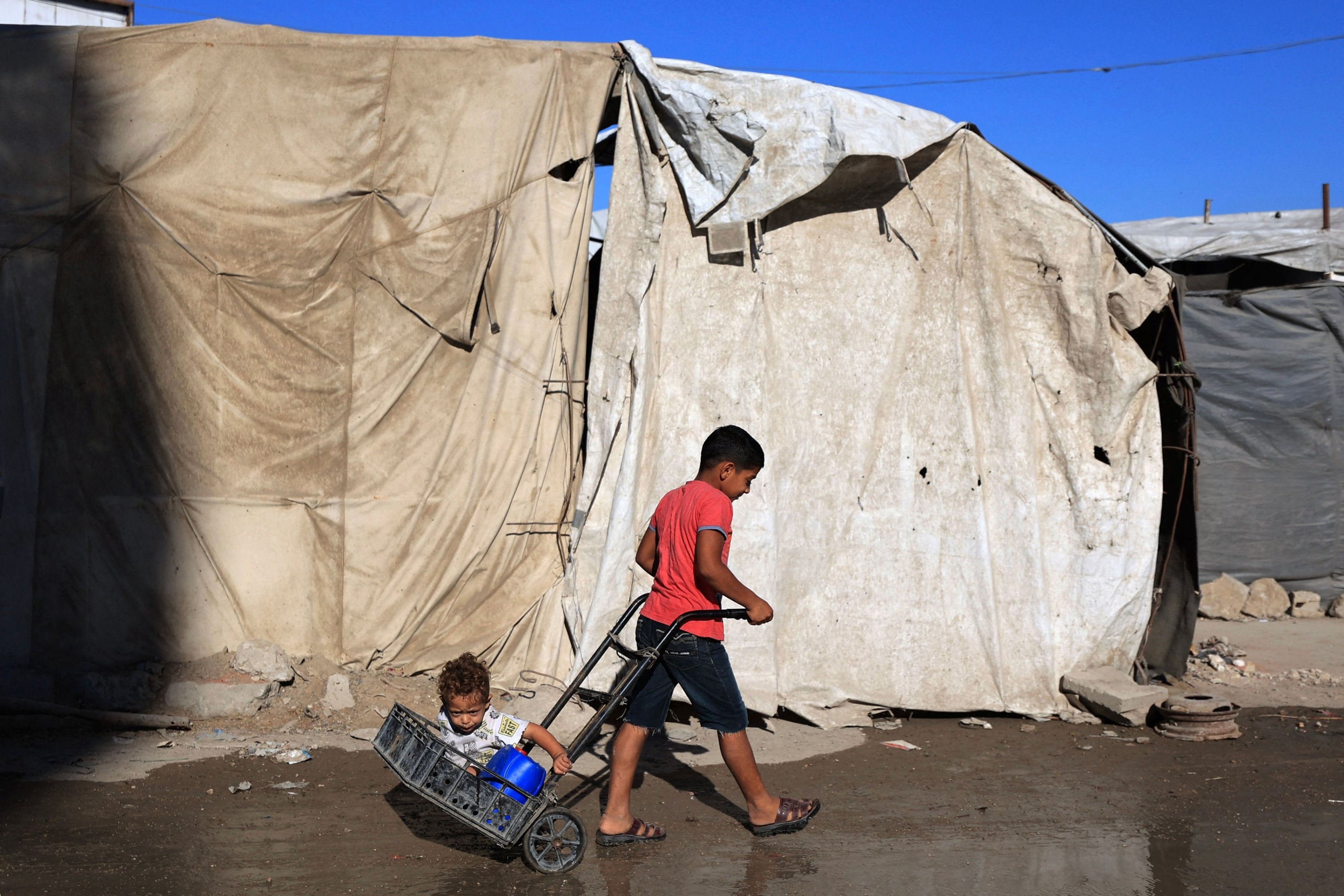
Repeated displacement during three years of Israel’s genocidal war on Gaza has left shelters across the enclave increasingly damaged, while restrictions and funding shortages are undermining efforts to prepare for winter, a senior U.N. migration official said late Friday.
Karl Baker, the International Organization for Migration’s (IOM) regional crisis coordinator for the Gaza response, said some Palestinians have been displaced as many as eight times, with each forced move further damaging or destroying tents and other makeshift shelters.
“When they move, all those goods that they currently have or did have either get destroyed, or they have to seek new shelter,” Baker told U.N. News.
Even basic materials such as tarpaulins need to be replaced roughly every six months, but humanitarian agencies have been unable to bring replacements into Gaza at the required scale, he said.
Baker said agencies now need to move beyond temporary solutions toward more durable transitional shelters.
Materials needed for stronger roofing, concrete floors and more substantial walls, however, are subject to Israel’s “dual-use” restrictions, which are imposed over security concerns.
“After three years of war, we do need to improve the level of shelter which is inside, and move further away from temporary and more toward transitional type of shelter,” he said.
Baker said IOM remains in constant contact with Israeli authorities, but some durable materials continue to be denied entry over security concerns.
He also cited funding shortages and disruptions to international shipping as obstacles, saying IOM relies on suppliers in countries including China, India and Pakistan.
Although funding has begun to arrive, it remains insufficient to meet the needs of an estimated 1.8 million to 1.9 million people requiring shelter assistance, he added.
Baker said only around 30% of Gaza is currently accessible to most of the population, forcing displaced Palestinians into increasingly crowded and often flood-prone areas.
“The 30% in which they currently live is a very large displacement camp,” he said.
With winter rains already beginning, humanitarian organizations are working to address flood-prone areas and deploy water pumps. Baker warned, however, that getting displaced Palestinians through the winter would be the biggest challenge.
Earlier this month, IOM said available and incoming shelter supplies covered only 17% of Gaza’s winter needs, while more than half of tents and makeshift shelters were in poor condition.
A cease-fire has been in effect since Oct. 10, 2025, but Israeli attacks and restrictions on the entry of humanitarian aid and shelter supplies have continued.