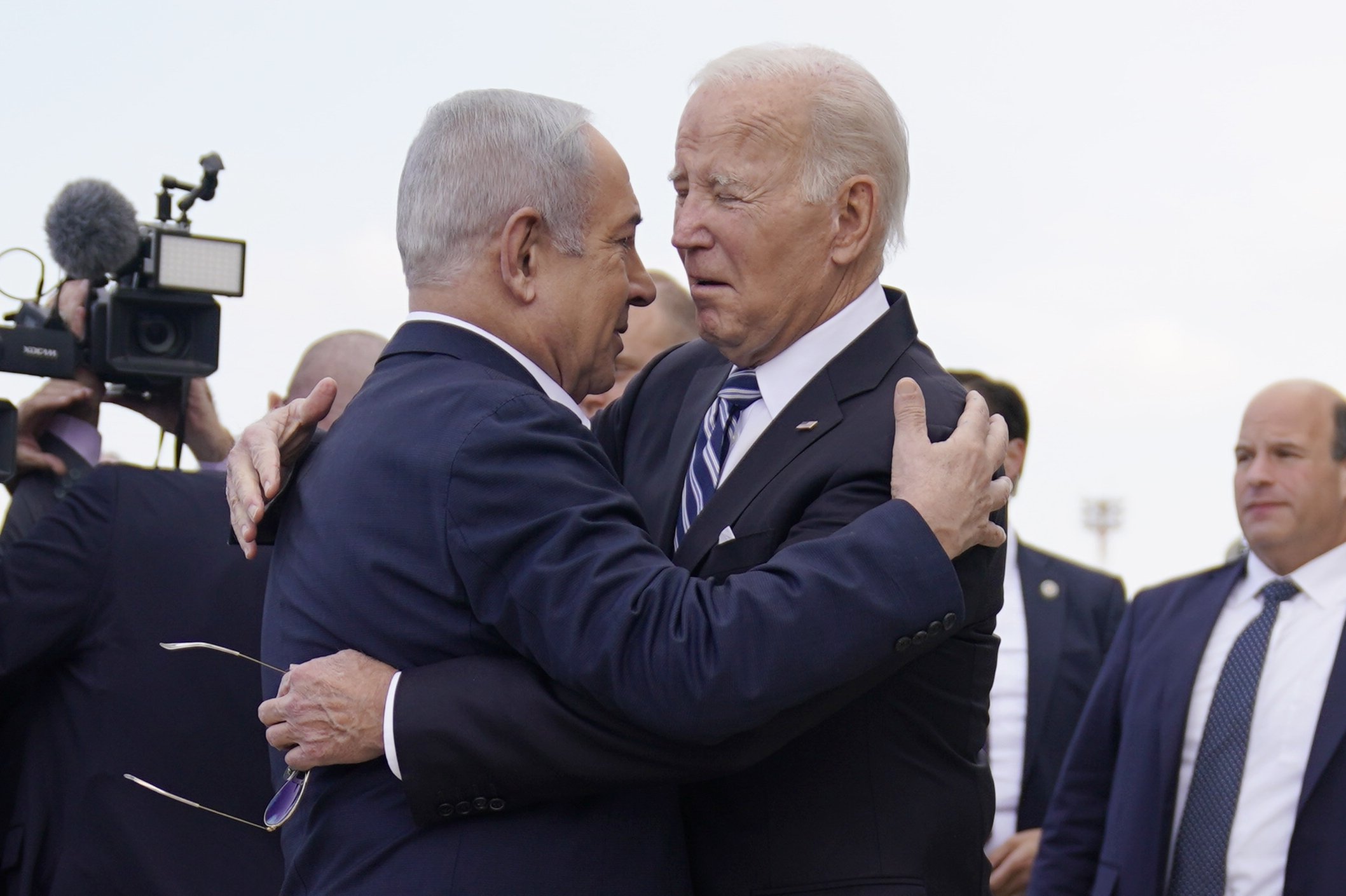
Growing differences between President Joe Biden and Israeli Prime Minister Benjamin Netanyahu over the former's Gaza approach have raised questions on whether the U.S. might restrict military aid
Strains between Biden and Netanyahu have added momentum to discussions within the U.S. administration about how it could use its leverage to convince Israel to not carry out a ground offensive in the south of the enclave, facilitate humanitarian relief and avoid further heavy Palestinian civilian casualties, U.S. officials say.
Biden's greatest source of leverage is the U.S. supply of weapons. He has resisted using it, despite Netanyahu’s defiant response to Washington’s entreaties and increased calls from some of the president’s fellow Democrats.
But with Biden showing mounting signs of frustration with Netanyahu, U.S. officials have not ruled out a possible shift in policy that could include putting conditions on military aid if Israel carries out its threatened invasion of Rafah in southern Gaza.
Biden’s 2024 re-election bid has complicated his efforts to craft a strategy. Aides recognize that he needs to avoid giving Republicans an issue to seize on with pro-Israel voters, while also halting the erosion of support from some progressive Democrats dismayed by his strong backing for Israel.
Any decision by Biden, who has called himself a "Zionist," to get tough with Israel would run counter to his decades-old history as an ardent supporter of the country.
"No matter how you cut it, Biden is in a bind on how to deal with this crisis," said Aaron David Miller, a former Middle East negotiator for Republican and Democratic administrations.
There are no indications that any decisions have been made about restrictions on weapons supplies in the event of a Rafah invasion, which Biden has warned must not happen without an Israeli plan for protecting civilians there. More than half of Gaza’s population is sheltering in the Rafah area.
Biden may have hinted at his thinking in an MSNBC interview over the weekend when, after insisting a Rafah invasion would be a "red line," he said the defense of Israel is "critical" and there is no way "I’m going to cut off all weapons so that they don’t have the Iron Dome (missile defense system) to protect them."
Biden did not explicitly make such assurances about offensive weapons, adding to speculation in media reports that such arms could be included if he were to impose conditions on Israel, which relies heavily on U.S.-made equipment.
Any restrictions on offensive weapons could put Israel at greater risk if all-out war breaks out with Lebanese Hezbollah on its northern border or Iran, which backs both Hamas and Hezbollah, enters the conflict.
Asked about potential limits on weapons, U.S. national security adviser Jake Sullivan told reporters Tuesday he would not engage in "hypotheticals" and that news reports about Biden's thinking on the issue were "uninformed speculation."
Dismissing Biden’s strident criticism to MSNBC in which he spoke of red lines and said Netanyahu was "hurting Israel more than helping," the Israeli premier has vowed to press forward with the military campaign in Rafah, the last part of the Gaza Strip where Israeli forces have not carried out a ground offensive.
"You know what the red line is? That Oct. 7 doesn’t happen again," Netanyahu, who is known as Bibi and has had a long and often tense relationship with Biden, told Politico on Sunday.
Israel has made clear to the U.S. that it is prepared to withstand the international condemnation it had expected to face over its overwhelming military response to the Oct. 7 Hamas incursion, according to a person in Washington familiar with the matter.
Israel accuses Hamas of using human shields.
While U.S. officials have said there is no sign of an imminent assault on Rafah, Biden and his aides have issued repeated warnings about the need for Israel's restraint there. European Union countries have said an attack would be "catastrophic."
Public messaging from the United States has sharpened since the deaths of more than 100 Palestinians earlier this month as they rushed to get food from an aid convoy in northern Gaza.
Irked over the slow pace of aid that Israel was allowing in by land, the Biden administration last week began airdrops of humanitarian supplies and announced plans to build a floating aid dock off the Gaza coast.
Washington has seen Israel slowly cooperating on humanitarian aid, but one U.S. official said progress had been incremental, adding: "It's pulling teeth on every little piece."
There have been closed-door conversations at the U.S. State Department on whether the U.S. should limit military aid to Israel, a second U.S. official said, but the idea has not received support from the senior leadership.
Most analysts said that given Biden's election-year considerations, he would be expected to tread very carefully in deciding whether to pressure Netanyahu by using weapons-related leverage or pulling back on U.S. diplomatic shielding of Israel at the United Nations Security Council.
The likely Republican presidential nominee, former President Donald Trump, would pounce on such moves as threats to Israel’s security.
The safer option for Biden would be to keep up his strategy of gradually distancing himself from Netanyahu, whose own approval ratings have plummeted among Israelis while continuing his outreach to the Israeli people, where the U.S. president is popular.
The administration’s recent welcome to Washington of Israeli war cabinet member Benny Gantz, a centrist politician who U.S. officials hope will someday replace Netanyahu, was widely seen as a snub to the right-wing prime minister, who has yet to be invited to the Biden White House.
"Biden is performing a political amputation – cutting off Bibi to save the patient State of Israel," said Laura Blumenfeld, a Middle East analyst at the Johns Hopkins School for Advanced International Studies in Washington.