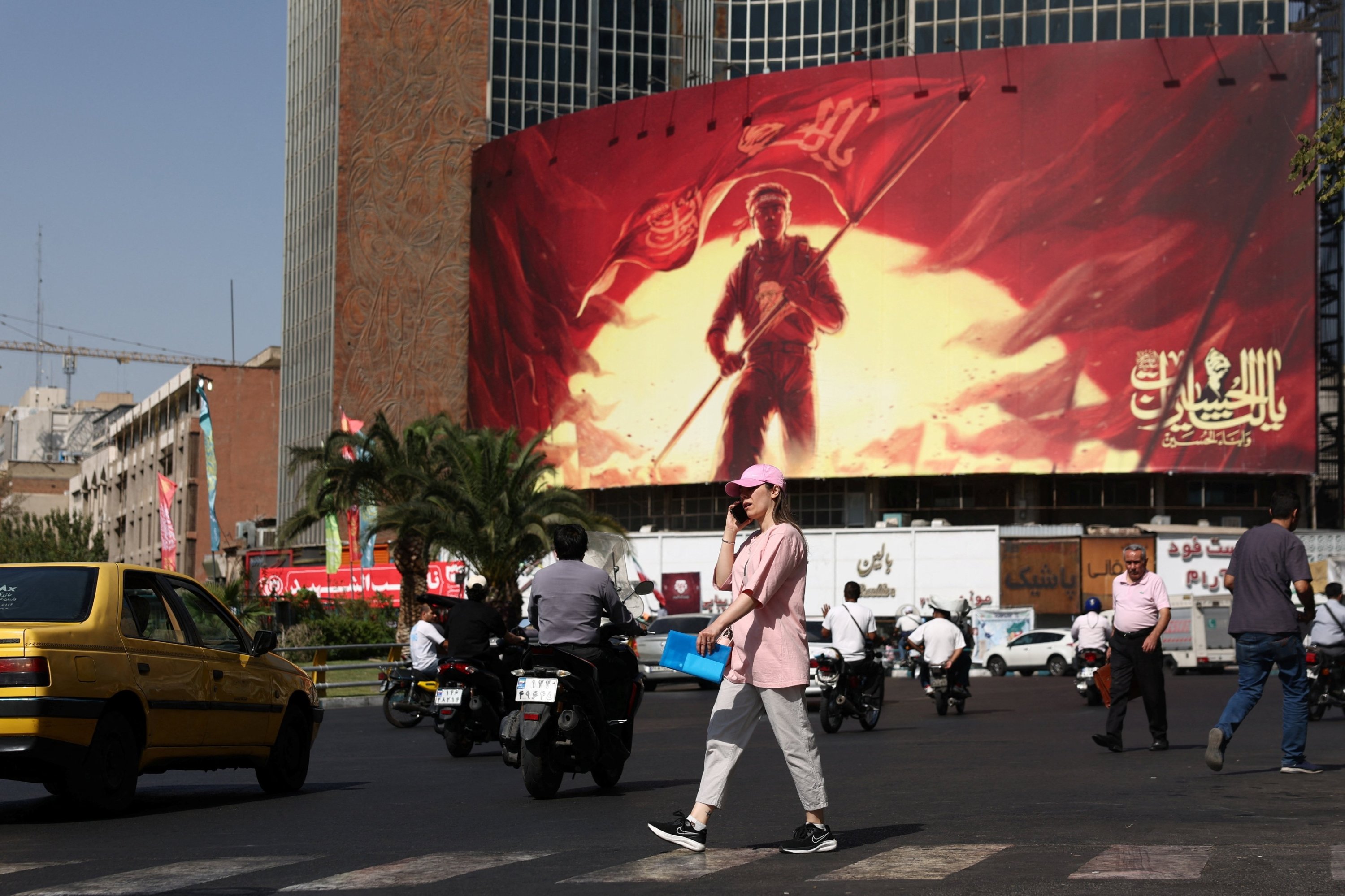
Iran said Sunday it will step up efforts to address problems caused by U.S. sanctions that have battered its economy, while a senior Iranian official warned that any further attack would draw a “painful response.”
Six months after U.S. and Israeli strikes against Iran, the conflict appears to have reached a stalemate. A preliminary cease-fire agreement reached in June has unraveled, while diplomatic efforts to revive negotiations and restore a path toward peace have made little progress.
After a pause in military action through much of July, tit-for-tat attacks have resumed. U.S. Central Command said Saturday that it struck three Iranian tankers after Iran’s Islamic Revolutionary Guard Corps launched ballistic missiles at two U.S. Navy ships.
Following the attacks, Iranian Parliament Speaker Mohammad Baqer Qalibaf said Sunday that the United States should understand that “the rules of the game” in the war against Iran have changed before it is too late.
Qalibaf’s warning came as Tehran faced mounting economic pressure from U.S. sanctions, which have severely restricted Iran’s access to international markets and deepened the challenges confronting its economy.
“From now on, any attack against Iran’s interests and security will receive a faster, heavier and more painful response,” he said in a speech published on his Telegram channel.
Tehran has shown it still retains the capability to attack U.S. interests in neighboring countries and to disrupt oil flows through the Strait of Hormuz, through which about one-fifth of the world’s oil supplies flowed before the conflict.
However, the U.S. campaign to throttle Iran’s economy by blockading its oil exports and stopping sanctions evasion is becoming increasingly difficult to withstand, three senior Iranian sources said.
In his speech Sunday, Qalibaf added that alongside the military front, Iran’s main battle was now over production and people’s livelihoods.
He cited sharp currency fluctuations, inflation, unemployment and market management as major challenges, adding that Iranians could tolerate hardship but not mismanagement or inaction and expected the government to act quickly.
Iran’s Economy Minister Ali Madanizadeh said Tehran planned to respond to U.S. economic pressure with reforms and rejected the idea that sanctions would cause it to change course, according to state media Sunday.
“They speak of economic pressure and isolation, of breaking off financial ties, and they think that by pressuring the economy of a country they can change the decisions of its people,” Madanizadeh said.
“I have to clarify one point: The responsibility for reforming Iran’s economy is with its government and people, not with the U.S. Treasury.”
Separately, Economy Ministry Deputy Morteza Zamanian said Sunday that the ministry’s “Economic War Headquarters” was stepping up efforts to resolve problems caused by the war, according to the semi-official Tasnim news agency.
Iran is the third-largest producer in the Organization of the Petroleum Exporting Countries and exported 90% of its crude through its Kharg Island export hub before the war. Flows have been disrupted since a U.S. blockade of Iranian oil exports began in mid-April.
On Aug. 31, Trump issued a one-line social media post accompanied by an AI-generated video depicting Kharg Island being “blown to smithereens.” Iranian authorities have vowed a strong response if Kharg is attacked.
In an interview aired on state TV Sunday, Iran’s oil minister, Mohsen Paknejad, said the island had been hit about 550 times in previous months but continued to operate.
Iran has also imposed a blockade on the Strait of Hormuz, creating an issue for U.S. President Donald Trump by pushing up fuel prices globally ahead of the November midterm elections.
On Saturday, U.S. Central Command said it struck three Iranian vessels, including one off the coast of Kharg Island, after Iran’s Islamic Revolutionary Guard Corps launched ballistic missiles at two U.S. Navy ships.
“Let the message to the IRGC be clear: If you shoot at two of our ships, we will impose an even higher economic cost, taking out three of yours,” said Adm. Brad Cooper, head of U.S. Central Command, which oversees U.S. military operations in the Middle East.
The IRGC responded by threatening intensified strikes against U.S. military vessels in the region and later said it had targeted the three tankers as well as three U.S.-linked vessels in other areas.
“Do not be deceived by the ‘terrorist’ U.S. military and refrain from any suspicious movement aimed at passing through unauthorized waterways,” the IRGC Navy said in a statement carried on Iranian state TV. “Otherwise, you will be targeted.”
Tasnim, the semi-official Iranian news agency, reported that four U.S. missiles hit a tanker in the area of Kharg’s anchorage. Tasnim quoted local sources as saying there were no casualties and the tanker’s crew was being evacuated.
No American personnel were harmed, Central Command said.
On Sunday, Tasnim reported that the IRGC had shot down a U.S. surveillance balloon over Erbil in northern Iraq, describing it as part of a broader effort to eliminate U.S. aerial surveillance and early-warning systems in the region.