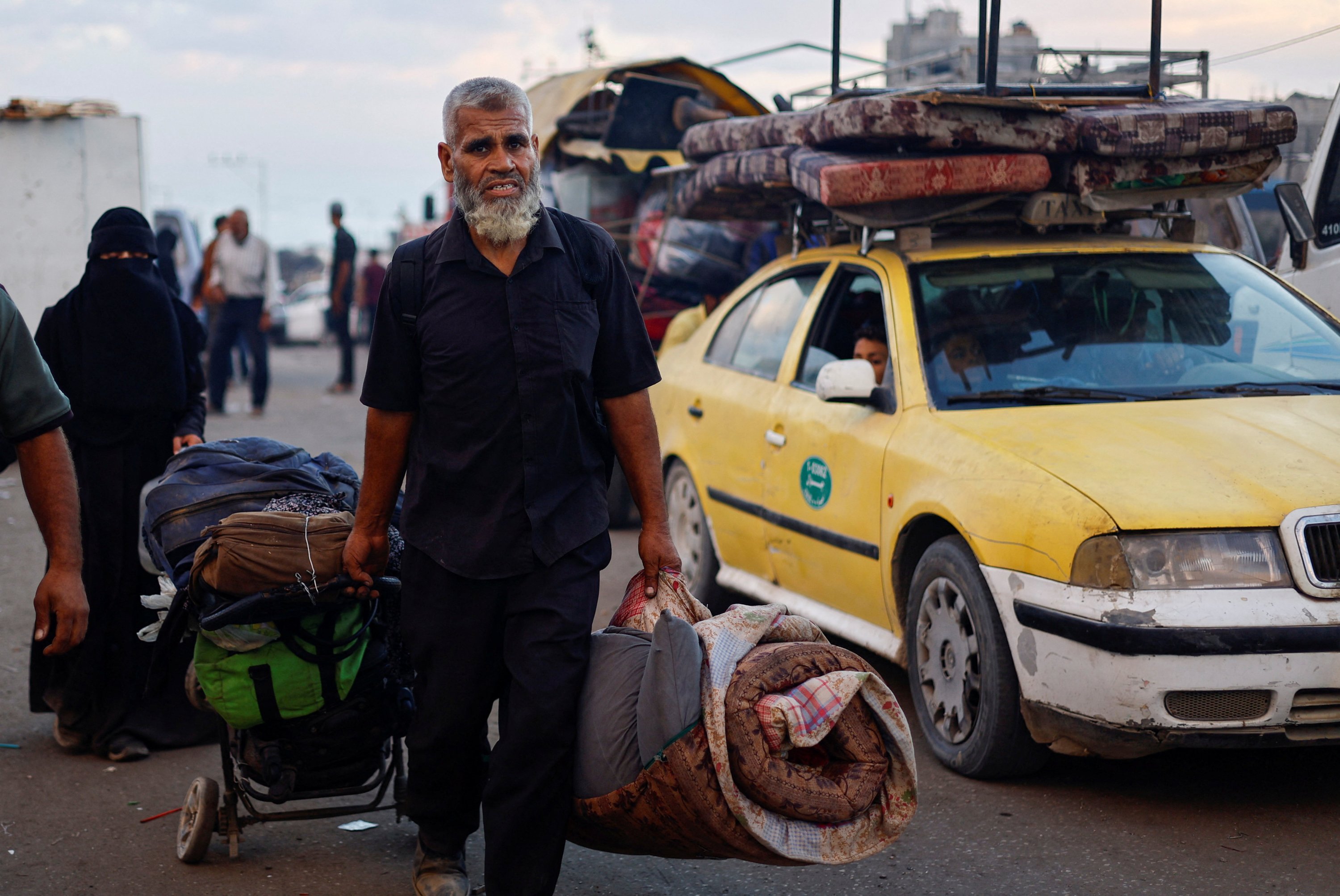
Israel shut down a key evacuation corridor on Friday and vowed to unleash “unprecedented force” on Gaza City, deepening a military offensive that has already left the territory in ruins and triggered global condemnation.
The closure of Salah al-Din Road, Gaza’s main north-south artery, came after a 48-hour window in which residents were urged to flee.
The Israeli army’s Arabic-language spokesman, Avichay Adraee, told civilians their only chance to move south was along the Al-Rashid coastal road, urging them to “take this opportunity and join the hundreds of thousands” who have already escaped the enclave’s largest city.
But with the war grinding into its second year and famine gripping much of Gaza, the call to evacuate has become nearly impossible for many families.
Transport costs have soared beyond $1,000 in some cases, while constant shelling has made the journey itself a gamble with death.
Israeli tanks and warplanes pounded Gaza City and surrounding neighborhoods on Thursday and Friday, sending thick columns of smoke into the sky and triggering a new wave of panic among civilians.
Streams of families were seen fleeing on foot, in battered vehicles, and even on donkey carts, belongings strapped precariously on top.
“There is artillery fire, air strikes, quadcopter and drone gunfire. The bombing never stops,” said Aya Ahmed, 32, sheltering with 13 relatives in Gaza City. “They want us to evacuate south – but where will we live? There are no tents, no transport, no money.”
For those who cannot leave, every day is a battle for survival. “We have lost everything – our homes, our safety,” said displaced father Sami Baroud, 35. “How can I evacuate when I can’t even afford the journey?”
The bombardments have left Gaza’s health system in tatters.
Al-Shifa Hospital said it received 20 bodies on Friday alone, while other facilities reported dozens more killed in strikes across the strip.
Gaza’s civil defense agency, operating under Hamas, said more than 60 people had died the day before.
In Khan Younis, two children were killed when Israeli shelling hit a displacement tent.
In Deir al-Balah and Nuseirat, strikes tore through civilian gatherings, leaving several dead.
Rafah saw yet another tragedy when Palestinians waiting for food aid were shot at near the Shakoush area, an incident that underscored Palestinians’ claims that Israel’s unilateral “humanitarian aid points” have become deadly traps.
“The military incursion and evacuation orders in northern Gaza are driving new waves of displacement, forcing traumatized families into an ever-shrinking area unfit for human dignity,” World Health Organization chief Tedros Adhanom Ghebreyesus warned. “Hospitals, already overwhelmed, are on the brink of collapse.”
The escalation comes as a blistering United Nations investigation accused Israel of committing genocide in Gaza, saying Prime Minister Benjamin Netanyahu and senior officials had incited the crime.
Israel rejected the findings as “distorted and false,” but Navi Pillay, who led the probe, said she saw “clear similarities” to the 1994 Rwandan genocide and hoped Israeli leaders would one day face trial.
Spain announced it would open its own inquiry into human rights violations to support the International Criminal Court, which has already sought arrest warrants for senior Israeli officials over alleged war crimes.
At the same time, several Western governments, including France and Britain, are preparing to recognize a Palestinian state during next week’s UN summit – a diplomatic move that reflects the growing global unease with the devastation in Gaza.
The human toll is etched into the voices of those fleeing.
Shadi Jawad, 47, described his family’s desperate trek out of Gaza City: “Crowds everywhere, the sound of explosions, women and men crying and screaming. At one point, as our belongings fell off our truck after a flat tire, I prayed, ‘God, send a missile to take us out and relieve us.’”
For others, leaving is not even an option. “My seven children and I are still in tents after our home was bombed,” said Umm Mohammed al-Hattab, 49. “The bombing hasn’t stopped. My children are terrified, and I don’t know what to do.”
The genocide was triggered by Hamas’ Oct. 7, 2023 incursion on Israel, which killed 1,219 people and saw 251 hostages taken.
Nearly two years later, 47 remain in Gaza.
Families of the captives continue to protest in Israel, accusing Netanyahu of endangering their loved ones. “My boy is dying over there,” said Ofir Braslavski, whose son Rom is held in Gaza. “Instead of bringing him back, you have done the exact opposite.”
Israel’s retaliatory campaign has killed at least 65,141 Palestinians, most of them women and children, according to Gaza’s health ministry figures deemed credible by the UN.
Famine has claimed hundreds more lives, including 147 children.