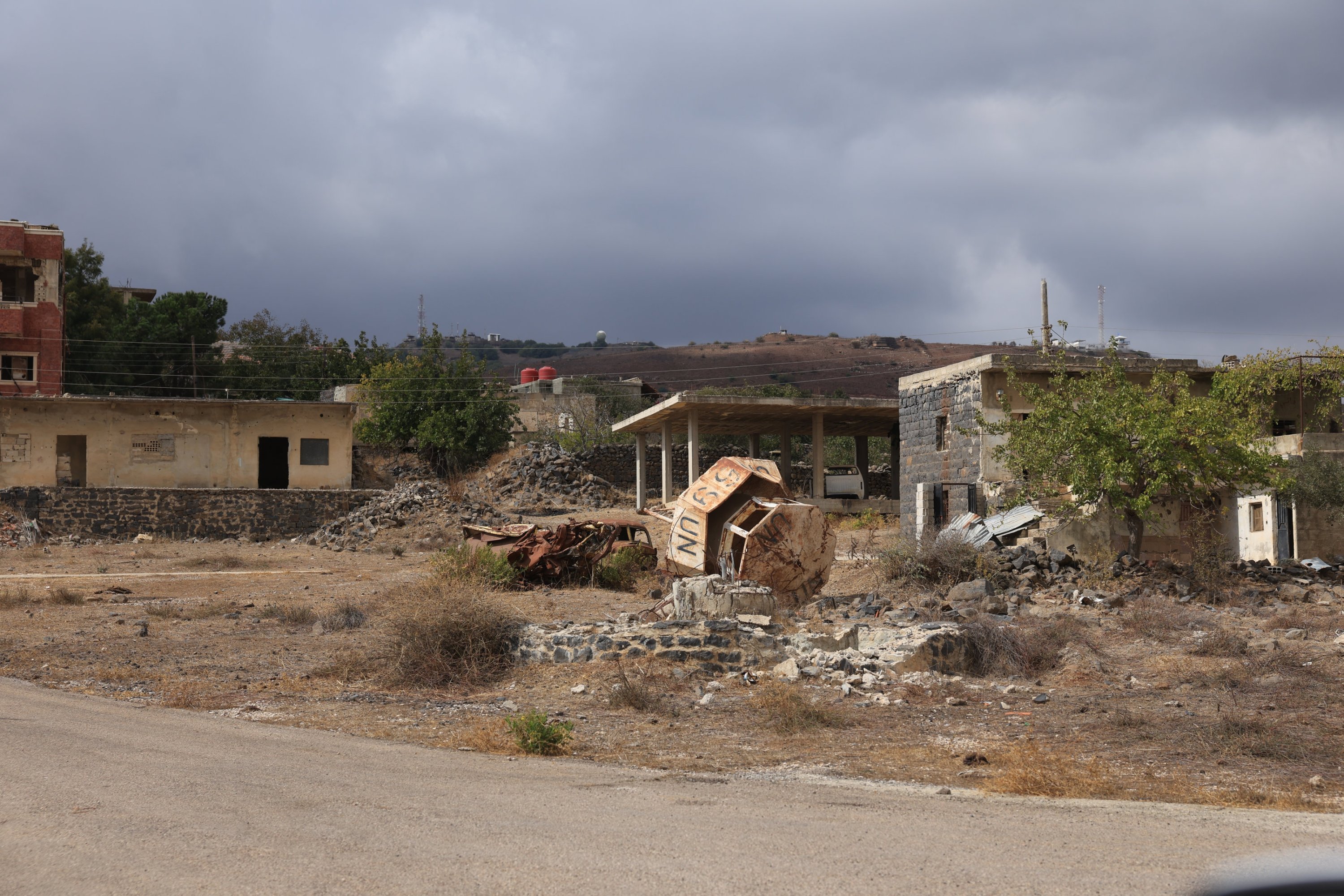
Two predominantly Circassian villages, Breqa and Bir Ajam, in Syria’s southern Quneitra governorate have been reeling from repeated Israeli attacks and incursions, triggering a mass exodus that has left the once-thriving communities nearly empty.
Saif al-Din Çavuş, a resident of the area, told Anadolu Agency (AA) what is really happening in Breqa and Bir Ajam, situated about 3 kilometers from the cease-fire line between Syria and Israel.
Before 2011, the two villages were home to around 250 Circassian families. Today, only about 60 remain, mostly elderly people and retirees, as young people prefer not to return to areas lacking employment opportunities and daily security.
The residents attribute this decline to the intensity of Israeli military activity, constant surveillance and the restrictions on movement imposed by Israeli forces.
Located in a sensitive zone near the front line, Breqa and Bir Ajam are exposed to regular Israeli patrols, which often approach residential areas and sometimes impose partial blockades on certain neighborhoods.
Moreover, the establishment by Israel of military positions around the villages, along with the periodic incursions of military vehicles into residential areas, has turned several homes into ruins, while the few remaining inhabitants struggle to survive under extremely harsh conditions.
In his interview with AA, Çavuş said:
“Transportation in both villages has come to a near standstill; students and employees can no longer reach their schools or workplaces.”
He added that the area once attracted visitors from Damascus, Daraa and other localities and that commercial and social life was vibrant. Today, these activities have almost disappeared, as most of the young people have left for major cities or abroad due to the escalating Israeli assaults.
Çavuş explained that Israeli patrols cross the villages several times a day, in the morning, at noon and in the evening, and sometimes enter houses and detain residents for short periods.
He added: “Villagers used to welcome family members visiting from Damascus on weekends, but now everyone is afraid even to step outside.”
According to him, Israel has built military outposts on the hills surrounding the villages and their presence stifles daily life, making residents feel as though a military force constantly weighs on their chests.
Speaking wearily, Çavuş said: “We, the Circassians, live peacefully in these two villages. In recent months, Israel has arrested several of our young people. We are exhausted by wars and long for peace and security.”
He called on Israel to withdraw from their lands and return to the cease-fire line, stating: “We have spent our lives amid wars and destruction; it is time for this nightmare to end.”
He also pointed out that this situation is reflected in the abandoned buildings, including a United Nations observation post and other official structures severely damaged by Israeli incursions.
Although the new Syrian administration, in place since late December 2024, poses no threat to Tel Aviv, the Israeli army has repeatedly entered Syrian territory and carried out air raids that have killed civilians and destroyed sites, military vehicles, weapons and munitions belonging to the Syrian army.
Since 1967, Israel has occupied most of the Syrian Golan Heights. Taking advantage of the fall of President Bashar Assad at the end of 2024, it has expanded its area of occupation.
For the past seven months, the Israeli army has controlled a security strip about 15 kilometers (9.3 miles) wide in certain parts of southern Syria, exercising authority over more than 40,000 Syrians living inside the occupied buffer zone.