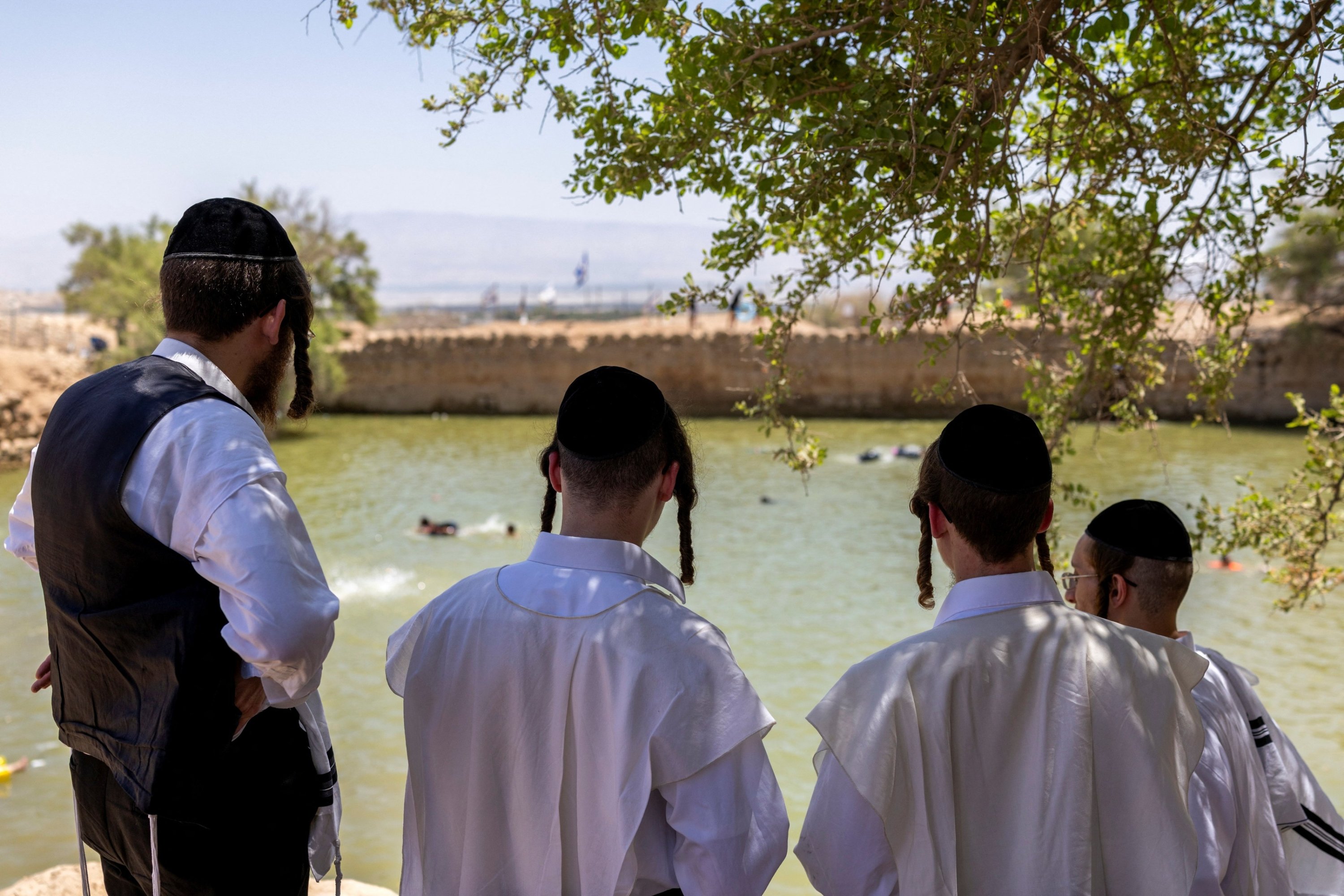
On a scorching summer afternoon in the occupied West Bank, Israeli settlers gathered to swim in a pool fed by water diverted from Palestinian farmland, turning a vital local water source into a recreational attraction.
The pool sits near Fasayil, a Palestinian village in the fertile Jordan Valley where residents have relied on the spring for generations. Its water has supported crops, provided jobs and helped families cope with irregular supplies through Israeli-controlled networks.
For farmer Saad Nemer, the loss of access has come at a steep cost.
“Our water supply remains cut off to this day, depriving us of the water we depend on for our homes, our livelihoods and our agricultural land,” Nemer said.
In June, settlers seized Nemer’s irrigation pipeline and redirected the water to an ancient pool at a nearby archaeological site.
The pool was soon promoted as an Israeli tourist attraction, with Israel’s far-right Finance Minister Bezalel Smotrich pledging 3 million shekels ($1 million) toward its restoration and development.
“They are now in the process of developing a recreational park around the pool,” Nemer said.
The development has left Nemer unable to plant his fields and greenhouses, which would normally produce eggplant, zucchini and watermelons during the summer.
“The settlers cutting off our water has caused us losses and has meant that many families will lose their work and their livelihoods,” he said.
Nemer said one of his employees was beaten by settlers and that he had faced threats himself when trying to approach the spring, including incidents dating back two years.
The seizure of the water source in Fasayil is part of a broader pattern that Palestinians and rights groups say is aimed at making life increasingly difficult for Palestinian communities in the West Bank.
United Nations data shows Israeli settlers have attacked at least 160 water and sanitation facilities across the Palestinian territory this year.
At Fasayil, Israeli settlers now freely use the pool while Palestinian villagers say they are afraid to approach it.
Yishai Shreiber, a 21-year-old Israeli settler who visited the pool on a recent August afternoon, said the growing number of Israeli visitors had effectively kept Palestinians away.
“Now that they see this entire mass of people, all these large groups of Jews coming here to bathe, they are afraid to come here,” Shreiber said.
He said he believed the West Bank belonged to the Jewish people and argued that Palestinians who did not accept Jewish authority should leave.
Nemer showed Reuters a 2025 land ownership document issued by COGAT, the Israeli military agency responsible for implementing civilian policy in the occupied territories. He also produced a map from a 1957 land registration showing that his property included both the spring and the pool.
COGAT and Smotrich did not respond to requests for comment.
The dispute over Fasayil’s spring comes amid a sharp increase in Israeli settlement activity and settler violence across the West Bank.
Israel's far-right coalition government has backed extensive settlement construction. Smotrich has said the policy is intended to prevent the establishment of a Palestinian state.
More than 150 of the 193 U.N. member states recognize a Palestinian state comprising the Gaza Strip and West Bank, including East Jerusalem.
The United Nations and most governments consider Israeli settlements in the occupied West Bank illegal under international law. Israel disputes that characterization and says the territory is contested.
Palestinian communities have increasingly reported losing access to natural springs, which are particularly important in the Jordan Valley.
Palestinian field researcher Fares Foqahaa estimated that settlers have seized control of 95% of springs in the northern Jordan Valley, contributing to the displacement of Palestinian communities.
In the West Bank village of Qusra, settlers were still besieging three Palestinian homes on Thursday, residents said. The homes had also been cut off from water and electricity.
Adel Yassin, an official with the Palestinian Authority's water authority, described the campaign as an attempt to make Palestinian communities economically and physically unsustainable.
“I see this as a water war. It is the silent bullet that kills Palestinians without a sound,” he said.
The pool at Fasayil has also become a point of contention over archaeology and competing claims to the land.
In early June, Eliav Libi, a settler leader who has been targeted by sanctions from Canada and other countries, posted a video showing the pool beginning to fill with water.
Libi and other settlers have said the pool belonged to the biblical-era Jewish King Herod.
But Alon Arad, an archaeologist with the Israeli rights group Emek Shaveh, said the origins of the pool remain uncertain.
Arad accused settlers of using archaeology to reinforce claims that the West Bank is exclusively Jewish and said filling the archaeological site with water could damage it.
“We see in many cases the use of archaeology ... to create this feeling that the West Bank is exclusively Jewish,” Arad said.
A billboard outside the pool advertised Smotrich's 3 million shekel investment in the site, describing the project as the restoration and development of “Herod's Pools.”
The pool and nearby spring were crowded with Israeli families swimming and wading in the water. No Palestinians were seen there.
Fasayil is not the only Palestinian community where access to natural springs has become increasingly contested.
Near Nablus, the springs at Wadi al-Badhan have long been a popular destination for Palestinians seeking relief from the summer heat. Families would gather around plastic tables set in shallow streams, eating meals and cooling their feet in the running water.
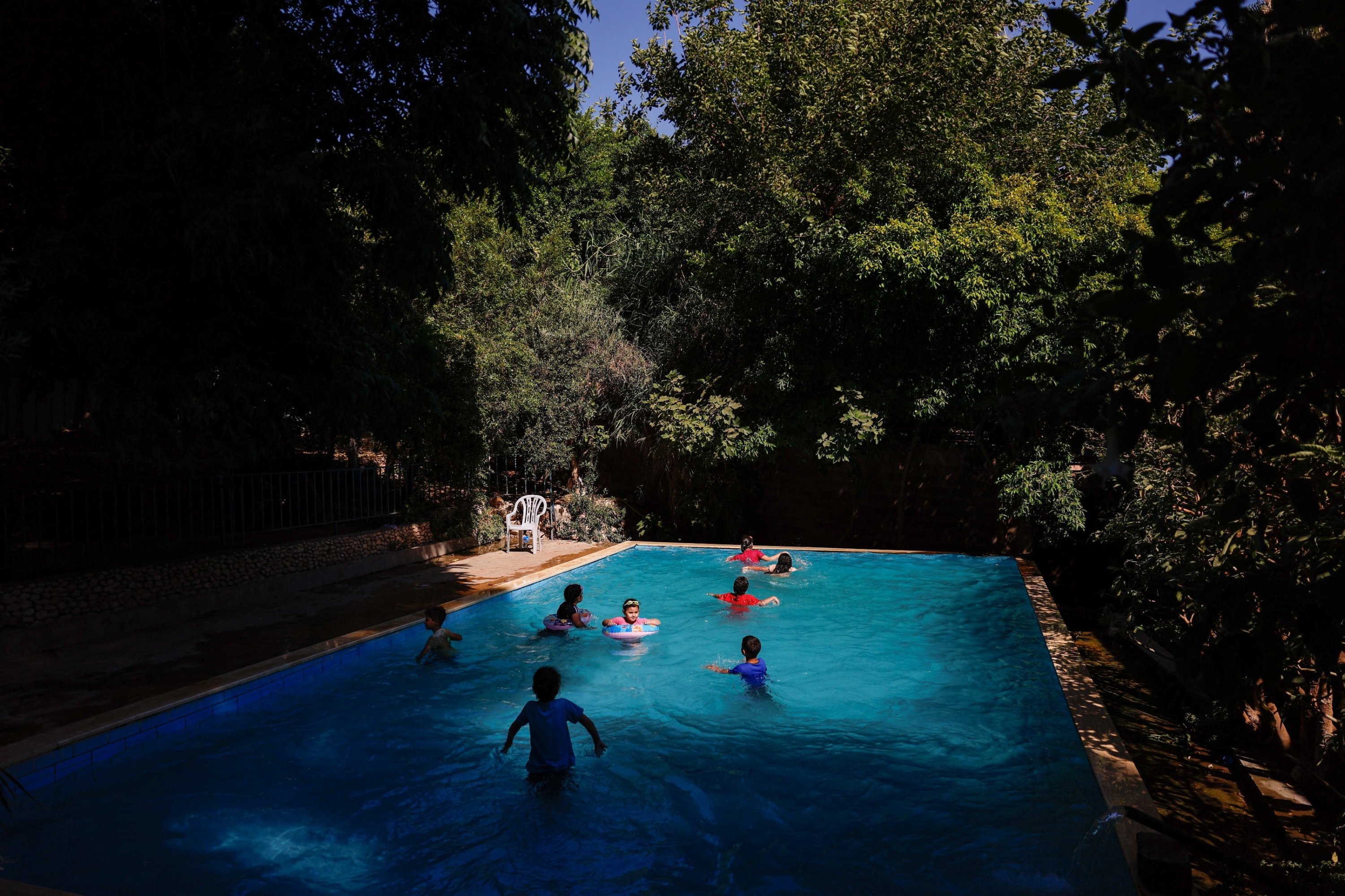
The springs had rarely faced incursions by Israeli settlers before this year.
But hundreds of settlers descended on the area earlier this summer, according to five Palestinians who witnessed the visits. They sat at the tables and walked through the pools, changing the atmosphere of a place that had traditionally been a local gathering spot.
Nizam Fares, who owns a natural spring park in al-Badhan, said Palestinians now feel uneasy about returning.
“People have become scared and jumpy. They come and ask if the settlers are coming or not?” he said.