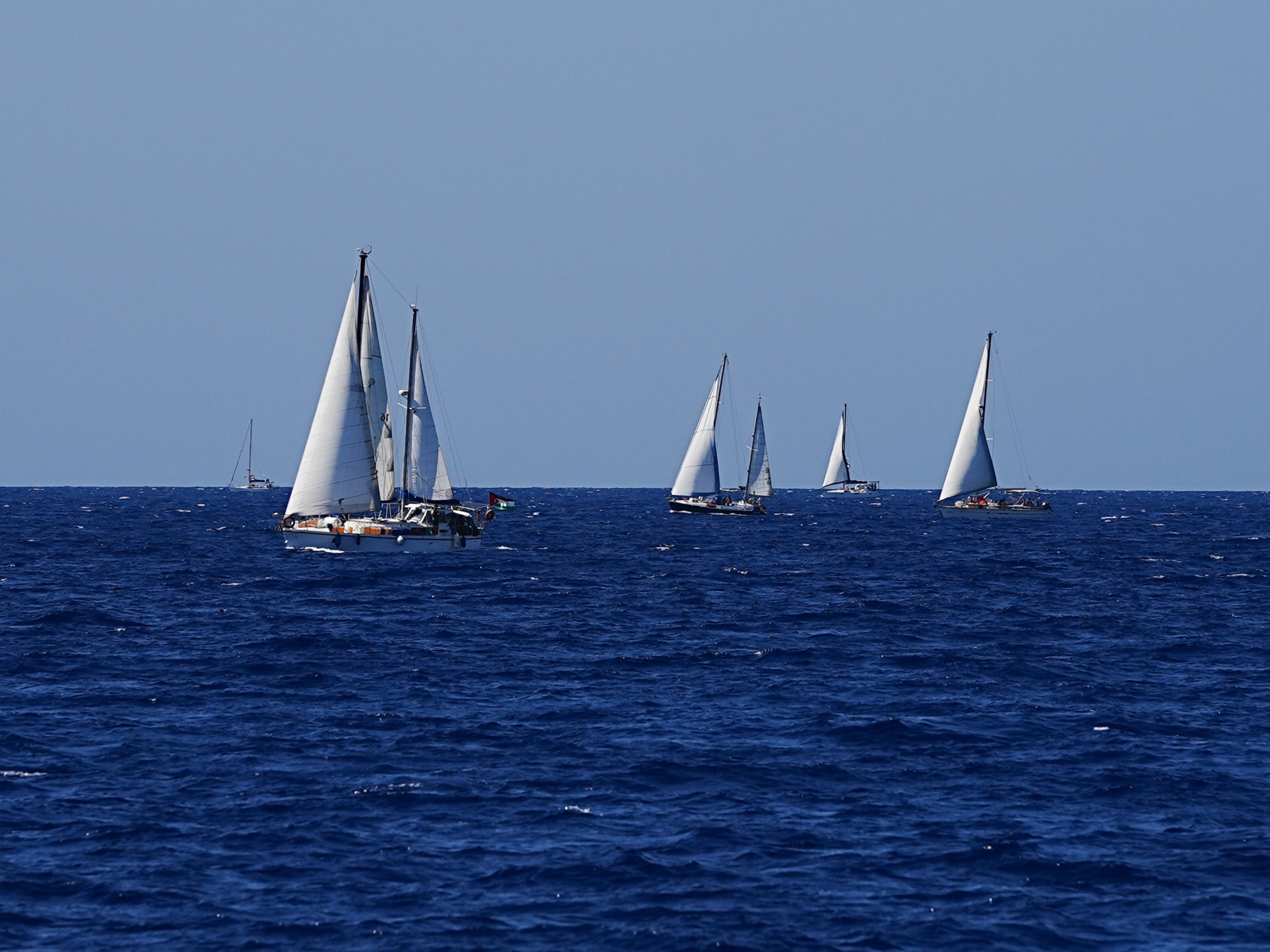
Organizers of the Global Sumud Flotilla said Wednesday that the Israeli navy is expected to begin intercepting dozens of aid boats within an hour, after declaring a state of emergency on board, as the vessels near Gaza.
They noted Israeli warships had closed in to within about 10 miles, underscoring what they called a critical moment in the mission to deliver humanitarian aid to Palestinians.
A spokesman for the Global Sumud Flotilla said the Israeli boats were moving to impose a naval blockade on the convoy.
The Israeli vessels were detected approximately three nautical miles away from the flotilla, the Global Sumud Flotilla said in a statement.
"At the current pace, we would reach their position in about 30 minutes if they don't move," the flotilla said.
A state of emergency was declared across the vessels of the global mission.
Wael Naouar, the spokesman for the Maghreb branch of the Global Sumud Flotilla, said on Facebook that an Israeli interception attempt is expected within an hour.
The Alma, the flotilla's flagship, announced that it is four nautical miles away from the rest of the flotilla.
The Alma was approached by an Israeli naval vessel early Wednesday, which led to the disruption of the internet and communication networks.
The vessels are sailing in international waters north of Egypt and had entered what activists and others called a "danger zone" or "high risk zone." While still in international waters, it is an area where the Israeli navy has stopped other boats attempting to break its blockade in the past and which the flotilla has been warned not to cross.
Overnight, the activists said two Israeli warships aggressively approached two of their boats, circling them and jamming their communications, including the live cameras on board.
"It was an intimidation act. They wanted us to see them," said Lisi Proença, another activist who was on board the Sirius, a vessel that was targeted alongside the Alma.
After the close encounter overnight, the military vessels eventually left and the flotilla continued on its journey, broadcasting live cameras from many of its boats.
The flotilla, loaded mainly with humanitarian aid and medical supplies, set sail several days ago in a bid to break the Israeli blockade.
Israel tightened the siege further this March by closing all border crossings and blocking food, medicine, and aid, pushing Gaza into famine despite aid trucks piling up at its borders.
The Israeli army has killed over 66,100 Palestinians, most of them women and children, in Gaza since October 2023. The relentless bombardment has rendered the enclave uninhabitable and led to starvation and the spread of diseases.
Israel’s blockade of Gaza has long been denounced by rights groups and U.N. bodies as a violation of international law, particularly the Fourth Geneva Convention, which prohibits collective punishment of civilians. Imposed since 2007, the blockade restricts the movement of people and goods by land, air and sea, creating what the U.N. has repeatedly described as a “humanitarian crisis.” International legal experts argue that because the blockade targets an entire civilian population rather than specific military objectives, it breaches the principles of proportionality and distinction under international humanitarian law. The U.N. Human Rights Council and numerous humanitarian organizations maintain that such measures effectively amount to an unlawful siege, exacerbating suffering in Gaza and undermining fundamental human rights.