Daily Sabah logo

Politics
Diplomacy Legislation War On Terror EU Affairs Elections News Analysis
TÜRKİYE
Istanbul Education Investigations Minorities Expat Corner Diaspora
World
Mid-East Europe Americas Asia Pacific Africa Syrian Crisis Islamophobia
Business
Automotive Economy Energy Finance Tourism Tech Defense Transportation News Analysis
Lifestyle
Health Environment Travel Food Fashion Science Religion History Feature Expat Corner
Arts
Cinema Music Events Portrait Reviews Performing Arts
Sports
Football Basketball Motorsports Tennis
Opinion
Columns Op-Ed Reader's Corner Editorial
PHOTO GALLERY
JOBS ABOUT US RSS PRIVACY CONTACT US
© Turkuvaz Haberleşme ve Yayıncılık 2025

Daily Sabah - Latest & Breaking News from Turkey | Istanbul

  • Politics
    • Diplomacy
    • Legislation
    • War On Terror
    • EU Affairs
    • Elections
    • News Analysis
  • TÜRKİYE
    • Istanbul
    • Education
    • Investigations
    • Minorities
    • Expat Corner
    • Diaspora
  • World
    • Mid-East
    • Europe
    • Americas
    • Asia Pacific
    • Africa
    • Syrian Crisis
    • Islamophobia
  • Business
    • Automotive
    • Economy
    • Energy
    • Finance
    • Tourism
    • Tech
    • Defense
    • Transportation
    • News Analysis
  • Lifestyle
    • Health
    • Environment
    • Travel
    • Food
    • Fashion
    • Science
    • Religion
    • History
    • Feature
    • Expat Corner
  • Arts
    • Cinema
    • Music
    • Events
    • Portrait
    • Reviews
    • Performing Arts
  • Sports
    • Football
    • Basketball
    • Motorsports
    • Tennis
  • Gallery
  • Opinion
    • Columns
    • Op-Ed
    • Reader's Corner
    • Editorial
  • TV
  • World
  • Mid-East
  • Europe
  • Americas
  • Asia Pacific
  • Africa
  • Syrian Crisis
  • Islamophobia

Living among dead: War-displaced Gazans seek refuge in cemeteries

by Daily Sabah with AP

KHAN YOUNIS, Gaza Strip Nov 03, 2025 - 2:34 pm GMT+3
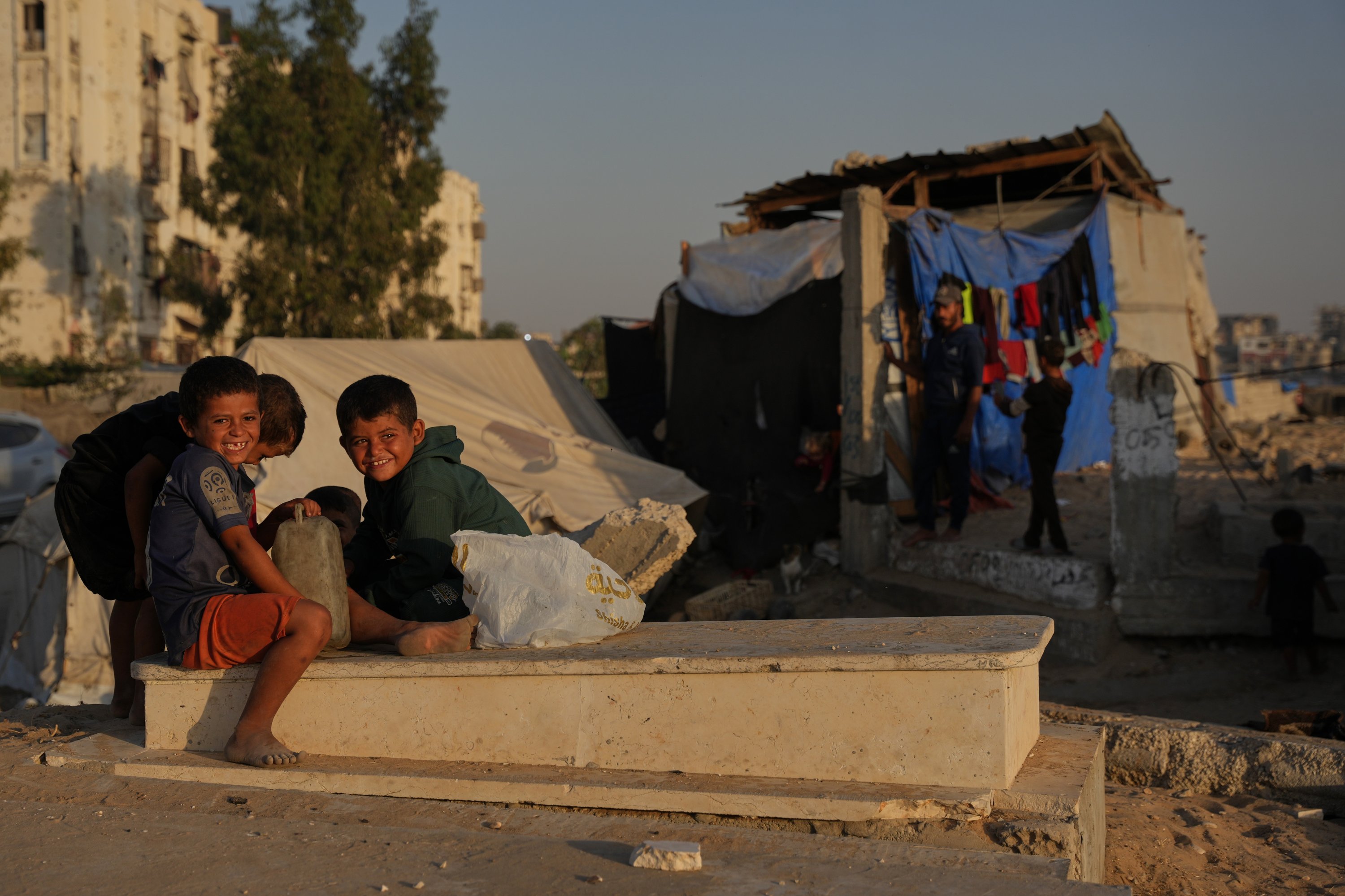
Palestinian children sit on a grave near makeshift tents for displaced people that were set up in a cemetery in Khan Younis, in the southern Gaza Strip, Palestine, Oct. 31, 2025. (AP Photo)
by Daily Sabah with AP Nov 03, 2025 2:34 pm

With no other refuge from the war, dozens of Palestinian families in Gaza, including Maisa Brikah and her children, have spent five months living amid gravestones in a sun-baked cemetery in Khan Younis.

A blonde-haired toddler sits outside one tent, running fingers through the sand. Another peeks playfully from behind a drape of fabric.

Nighttime is another matter.

"When the sun goes down, the children get scared and don't want to go, and I have a few children, four small ones," Brikah said. "They are afraid to go out because of the dogs at night, and the dead."

The vast majority of Gaza's population of over 2 million people has been displaced by Israel's two-year genocidal war. With the cease-fire that began on Oct. 10, some have returned to what remains of their homes. Others are still crowded into the strip of remaining territory that Israeli forces don't control.

Here and in other cemeteries in Gaza, there is life among the dead. A prayer rug hangs on a line. A child pushes a water jug on a wheelchair between the graves. Smoke rises from a cooking fire.

One of Brikah's nearest neighbors is Ahmad Abu Said, who died in 1991 at the age of 18, according to the carving on his tombstone that begins with lines from the Quran. There is unease, a feeling of disrespect, at setting up camp here.

But there is little choice. Brikah said her family's home elsewhere in Khan Younis was destroyed. There is no return for now. Israeli forces occupy their neighborhood.

Other residents of this cemetery come from Gaza's north. They are often far from the land where their own loved ones are buried.

'Scared of the graves'

Mohammed Shmah said he has been living here for three months. He said his house had been destroyed, too.

"I'm a grown man, but I still get scared of the graves at night. I hide in my tent," he said, perched on a broken tombstone and squinting in the sun.

He said he had only 200 shekels (around $60) on him when a friend took it to help bring his family to the cemetery.
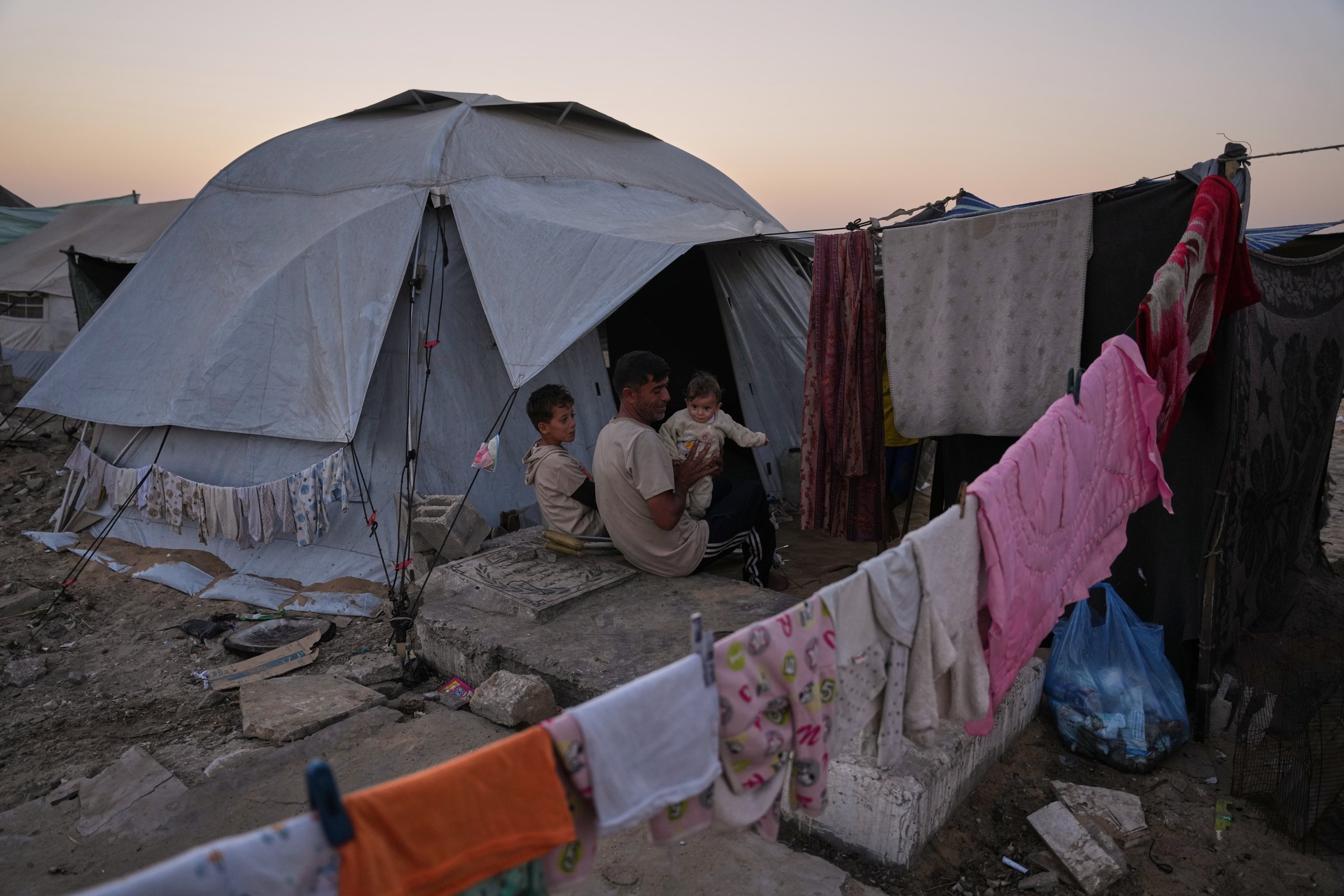
Mohammed Barabakh sits on a grave with his children at the entrance to his tent, that was set up in a cemetery in Khan Younis, in the southern Gaza Strip, Palestine, Oct. 31, 2025. (AP Photo)

The lack of money for shelter elsewhere is one reason keeping families living among the graves, said Hanan Shmah, Mohammed's wife. With care, she washed dishes in a soapy container the size of a pie tin, guarding precious water.

"Of course, life in the cemetery is full of fear, dread and worries, and you don't sleep in addition to the stress we experience," she said.

There is no guarantee of safety, even among the dead. Israeli forces have bombed cemeteries during the war, according to the United Nations and other observers.

Israel, as always, accused Hamas of using some cemeteries for cover, and has argued that the sites lose their protection when they are used for military purposes.

During the war, bodies in Gaza were buried wherever they could, including in hospital courtyards. According to custom, Palestinian families are buried near loved ones. The fighting has largely disrupted that.

Now, with the cease-fire, the search is on for the dead.

Israel presses Hamas to turn over the remains of hostages. Palestinian health officials post gruesome photos of bodies returned by Israel in the hope that families can identify them. Others search Gaza's vast stretches of rubble for bodies that the fighting long made unable to claim.

The death toll in Gaza from Israel's genocidal war – now over 68,800 – has jumped by hundreds since the cease-fire began from the recovery of such remains alone.

Families in this Khan Younis cemetery have watched the arrival of new additions, often buried not under slabs but under sand, marked off by stones.

Recovery, reconstruction, return. All feel far away.

"After the cease-fire my life is the same inside the cemetery, meaning I gained nothing," Mohammed Shmah said.


  • shortlink copied
  • KEYWORDS
    israeli genocide in gaza israeli atrocities in gaza israeli-palestinian conflict gaza strip palestine
    The Daily Sabah Newsletter
    Keep up to date with what’s happening in Turkey, it’s region and the world.
    You can unsubscribe at any time. By signing up you are agreeing to our Terms of Use and Privacy Policy. This site is protected by reCAPTCHA and the Google Privacy Policy and Terms of Service apply.
    No Image
    In photos: Aftermath of earthquake in Croatia
    PHOTOGALLERY
    • POLITICS
    • Diplomacy
    • Legislation
    • War On Terror
    • EU Affairs
    • News Analysis
    • TÜRKİYE
    • Istanbul
    • Education
    • Investigations
    • Minorities
    • Diaspora
    • World
    • Mid-East
    • Europe
    • Americas
    • Asia Pacific
    • Africa
    • Syrian Crisis
    • İslamophobia
    • Business
    • Automotive
    • Economy
    • Energy
    • Finance
    • Tourism
    • Tech
    • Defense
    • Transportation
    • News Analysis
    • Lifestyle
    • Health
    • Environment
    • Travel
    • Food
    • Fashion
    • Science
    • Religion
    • History
    • Feature
    • Expat Corner
    • Arts
    • Cinema
    • Music
    • Events
    • Portrait
    • Performing Arts
    • Reviews
    • Sports
    • Football
    • Basketball
    • Motorsports
    • Tennis
    • Opinion
    • Columns
    • Op-Ed
    • Reader's Corner
    • Editorial
    • Photo gallery
    • DS TV
    • Jobs
    • privacy
    • about us
    • contact us
    • RSS
    © Turkuvaz Haberleşme ve Yayıncılık 2021