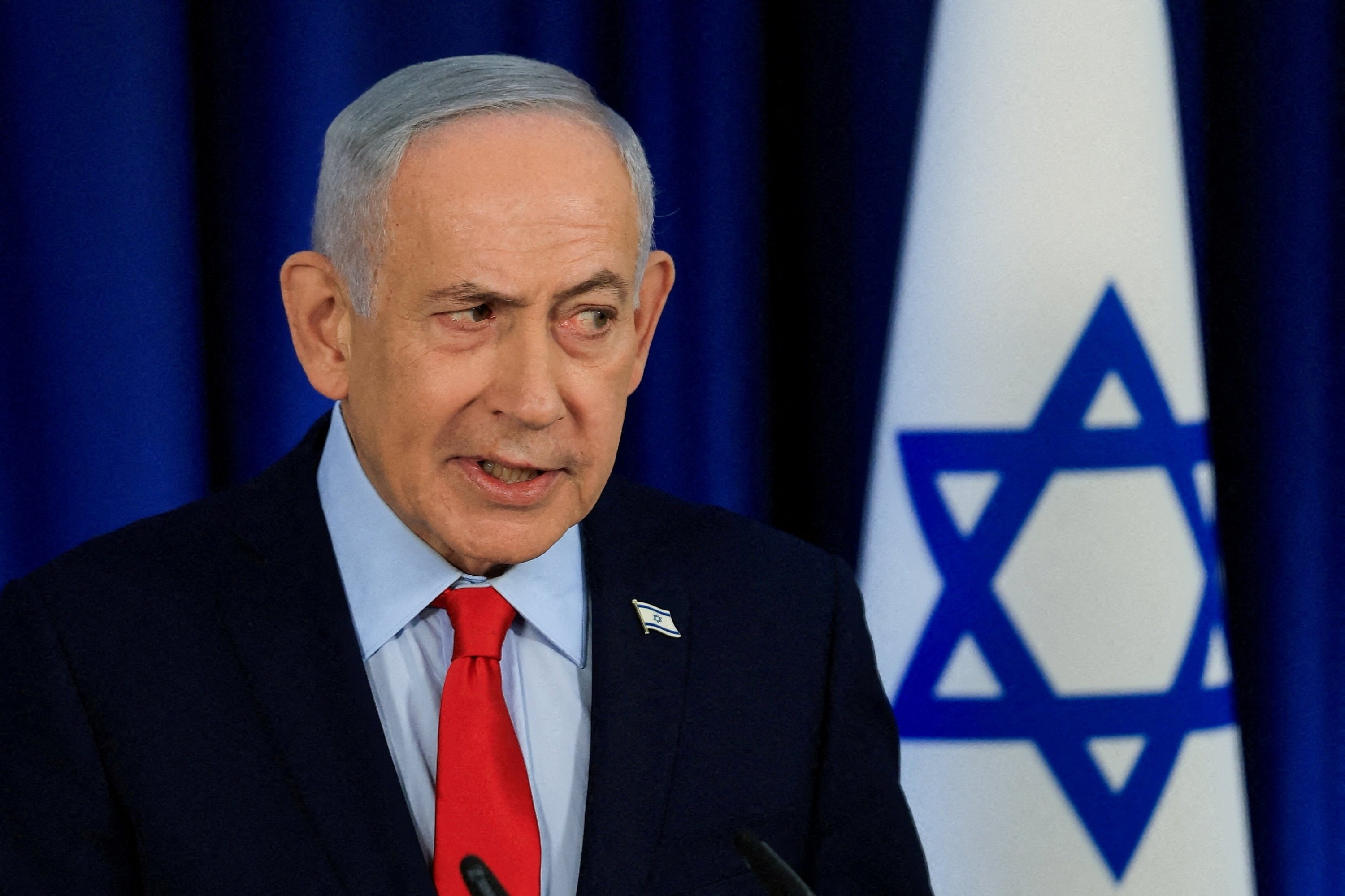
Israeli Prime Minister Benjamin Netanyahu on Thursday ruled out a withdrawal of Israeli troops from territory occupied in southern Lebanon for the foreseeable future, despite a U.S.-Iran agreement to halt the conflict.
Israel "will restore security to the north," Netanyahu said in statements reported by the daily Yedioth Ahronoth.
"This requires maintaining the security strip in southern Lebanon, and that requires that we not withdraw as long as Israel's security needs require it."
Netanyahu's remarks came as relations with the United States have come under strain over the U.S.-Iran agreement to halt the war.
Netanyahu has still not commented directly on the deal, though some of his coalition members dismissed it even before the text's details were released on Wednesday.
The deal's terms call for "an immediate and permanent termination of military operations on all fronts, including in Lebanon," where Israel has carried out a large-scale offensive since early March.
Its strikes have killed more than 3,910 people and injured over 11,870 others, while displacing more than one million, according to official Lebanese figures.
Hours before the agreement was announced, U.S. President Donald Trump excoriated Netanyahu for launching attacks in Lebanon that threatened to derail it.
"He's a very difficult guy," Trump said of Netanyahu, "and to be honest with you, he should be very thankful to us for doing this. Because if Iran had a nuclear weapon, Israel wouldn't be around for two hours."
Trump has been increasingly critical of the high death toll from Israeli attacks.
"When two drones are shot into the desert and drop harmlessly, you don't have to knock down buildings in Beirut. They could behave better, and frankly, they could do a better job," he said in a press conference at the G-7 summit in France on Wednesday.
The deal with Iran also pledges to "guarantee Lebanon's territorial integrity and sovereignty."
Earlier Thursday, the Israeli army published a map showing its occupation of a strip extending up to 10 kilometers inside Lebanese territory, vowing to maintain its presence in what it calls a "security zone" in the south.
According to the map, Israel's deployment inside southern Lebanon stretches across wide border sectors that include several southern towns, with the depth of the incursion ranging from about 6 to 10 kilometers.
In some western and central areas, the incursion reaches nearly 10 kilometers, with the occupied zone extending northward toward the Litani River in limited sections.
Netanyahu claimed that the central goal of Israel's policy is "to prevent Iran from acquiring a nuclear weapon."
"The battle is not over yet," he said. "Israel still faces additional challenges."
U.S. Vice President JD Vance, meanwhile, rebuked Israeli ministers who criticized the Iran deal, saying they should "wake up and smell the reality."
"If I was in the cabinet of the Israeli government, I might not be attacking the only powerful ally that I have anywhere left in the entire world," Vance told a briefing at the White House on Thursday.