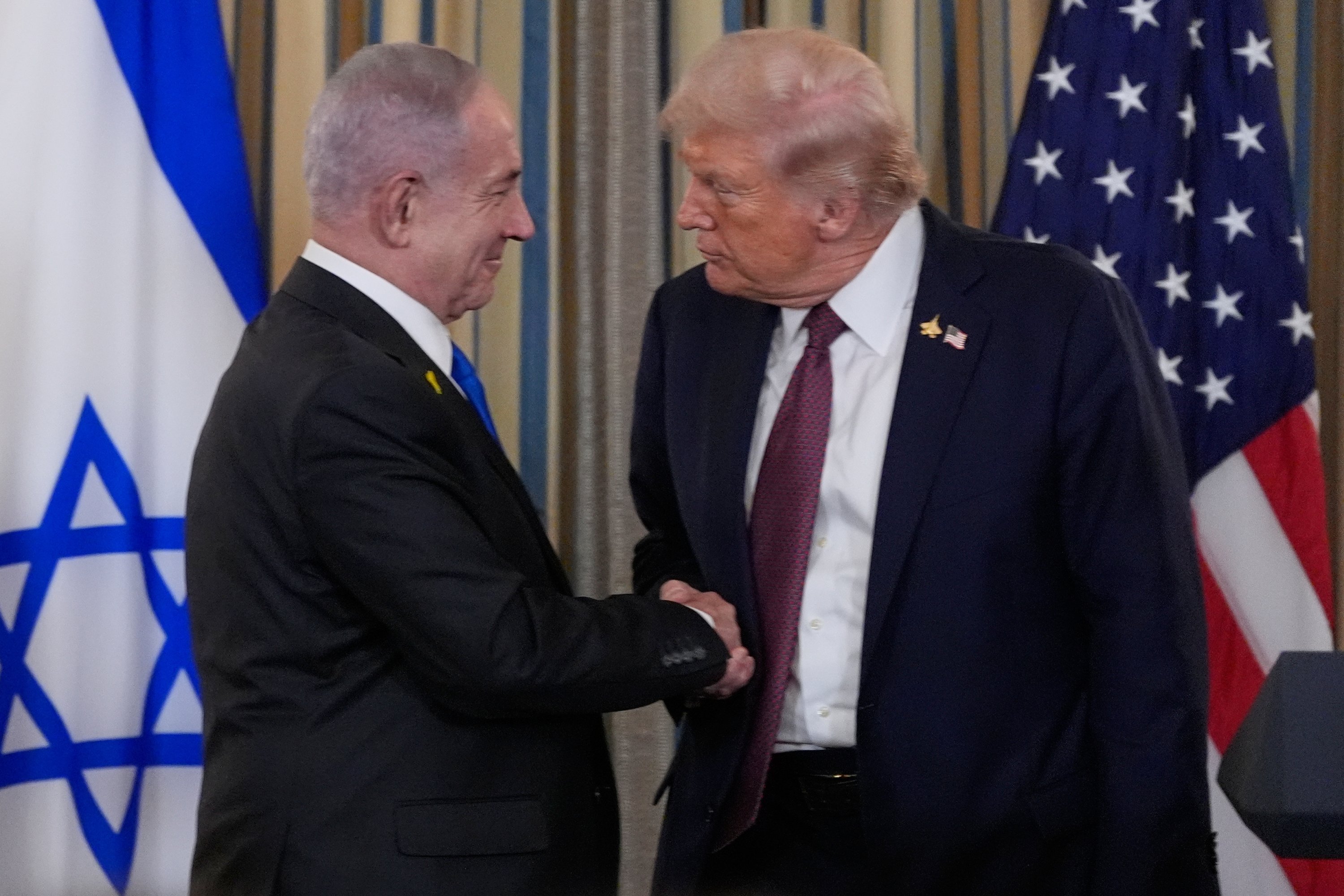
President Donald Trump on Monday won Israeli Prime Minister Benjamin Netanyahu’s support for a U.S.-sponsored peace plan to end nearly two years of war in Gaza, but the plan’s ultimate success hinges on whether Hamas agrees to participate.
At a joint White House press conference, Trump described the negotiations as “beyond very close” while warning Hamas that Israel would have full U.S. support to act if the group rejects the proposal.
The White House simultaneously released a 20-point plan calling for an immediate cease-fire, a hostages-for-prisoners swap, a phased Israeli withdrawal, Hamas disarmament and governance of Gaza under an international transitional authority.
Under the plan, Gaza’s daily administration would be managed by a technocratic Palestinian committee under the oversight of a “Board of Peace” chaired by Trump and former British Prime Minister Tony Blair.
While the proposal outlines a potential path to Palestinian statehood, it is contingent on Gaza’s redevelopment and reforms by the Palestinian Authority (PA).
Netanyahu has consistently rejected the prospect of a sovereign Palestinian state, leaving this a key sticking point.
Trump aimed to address Israeli concerns during the meeting, thanking Netanyahu “for agreeing to the plan and trusting that if we work together, we can bring an end to the death and destruction that have plagued this region for decades.”
Netanyahu praised the plan as achieving Israel’s war objectives: the return of hostages, dismantling Hamas’ infrastructure, ending its political control of Gaza and preventing future threats to Israel.
Hamas remains the critical variable.
The group continues to hold 48 hostages and has historically resisted disarmament.
A senior Hamas official told Reuters the plan had not yet been received formally but would be reviewed in coordination with other Palestinian factions.
Mediators from Egypt and Qatar have already shared the proposal with Hamas.
The initiative received broad international attention.
German Chancellor Friedrich Merz praised Trump’s “persistent efforts” and the influence of Arab and Muslim states in engaging Hamas.
Spanish Prime Minister Pedro Sanchez called for an immediate cessation of violence, the release of all hostages and humanitarian aid, reaffirming that a two-state solution remains “the only possible” path.
French President Emmanuel Macron welcomed Trump’s commitment to peace, emphasizing that the plan should pave the way for in-depth discussions with all parties.
Indian Prime Minister Narendra Modi described it as a “viable pathway to long-term and sustainable peace.”
Australian Prime Minister Anthony Albanese lauded the focus on Palestinian self-determination and statehood, urging all parties to implement the plan promptly.
Amid these diplomatic developments, the Gaza-bound Global Sumud Flotilla sought to deliver humanitarian aid and challenge Israel’s blockade.
Turkish naval forces assisted in evacuating activists from the vessel Johnny M after it began taking on water near Crete.
Meanwhile, Egyptian authorities arrested at least three flotilla activists, though their current status remains unclear.
The flotilla, composed of 52 small vessels from dozens of countries, carries symbolic aid, including food and medicine, for Gaza’s besieged population.
The Palestinian Authority welcomed Trump’s initiative, pledging reforms to govern Gaza, hold elections and lay the groundwork for a nonmilitarized, democratic Palestinian state.
The plan envisages immediate humanitarian aid, reconstruction and security oversight.
An international security force would maintain order and train Palestinian police, with Egypt preparing thousands for deployment to Gaza.
The conflict has exacted a staggering toll.
The conflict was triggered by Hamas' Oct. 7, 2023, incursion on southern Israel, which killed approximately 1,200 Israelis and took 251 hostages, while Israeli operations have killed more than 66,000 Palestinians, leaving Gaza’s infrastructure in ruins and creating a severe humanitarian crisis.
Netanyahu faces mounting pressure from hostages’ families and a war-weary public, while balancing far-right coalition members wary of perceived concessions.
Trump, who repeatedly vowed during his 2024 campaign to end the conflict, described Monday’s agreement as progress, but observers caution that substantial work remains.
Effective diplomacy with Hamas, pressure from international mediators and Israeli political consensus will be crucial to turning the plan into a lasting cease-fire.