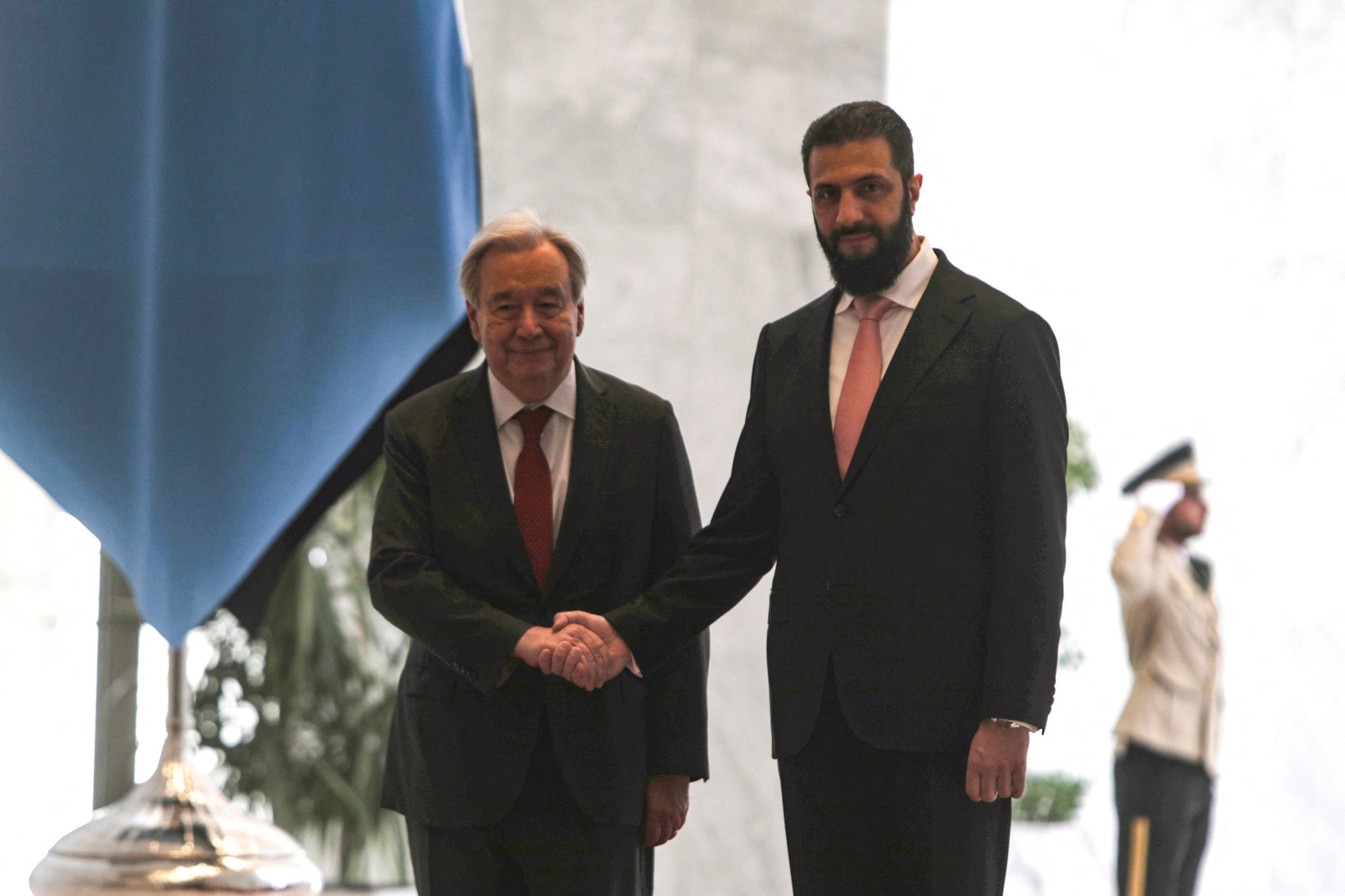
United Nations Secretary-General Antonio Guterres arrived in Damascus on Saturday for the first visit by a U.N. chief to Syria in 17 years, calling on the international community to rally behind the country's fragile recovery as it emerges from more than a decade of devastating civil war and begins rebuilding under its new leadership.
Guterres' trip marks the first visit by a U.N. secretary-general since Ban Ki-moon traveled to Damascus in 2009, two years before Syria descended into a conflict that claimed more than half a million lives, displaced millions and devastated much of the country's infrastructure.
The visit comes months after longtime President Bashar Assad was overthrown in December 2024, paving the way for the new government led by President Ahmad al-Sharaa.
"I have just arrived in Damascus for a visit of solidarity," Guterres wrote on X shortly after landing. "The U.N. stands with Syria at this pivotal moment, and I appeal to the international community to spare no effort to support the people of Syria as well."
Syrian state media reported that Guterres met al-Sharaa at the People's Palace in Damascus soon after his arrival. Images released by state outlets also showed the U.N. chief touring the capital's historic Old City and visiting the iconic Umayyad Mosque, one of the oldest and most significant religious landmarks in the region.
Foreign Minister Asaad al-Shaibani welcomed Guterres and the accompanying U.N. delegation at Damascus International Airport before the secretary-general began a visit expected to last several days.
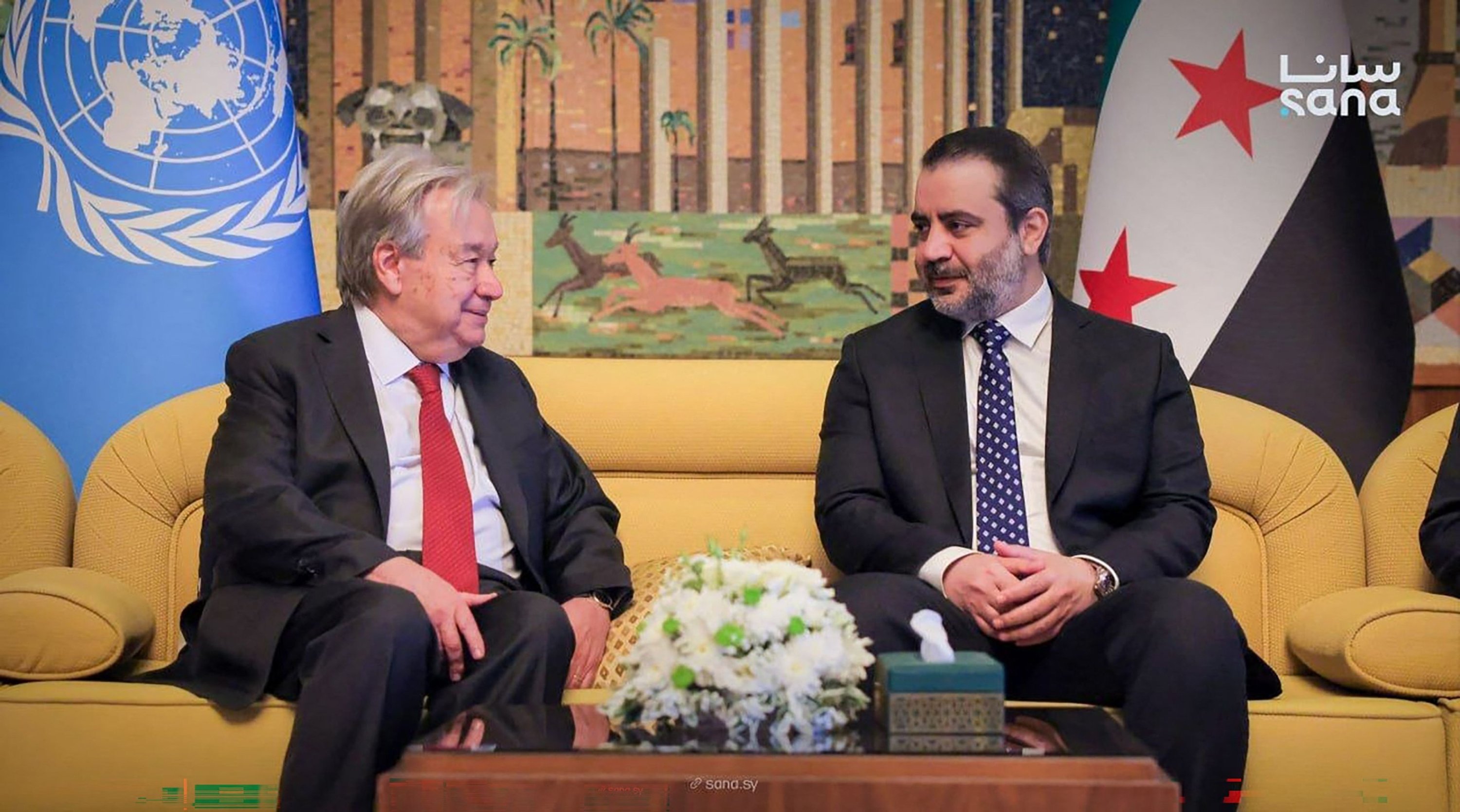
The visit signals a new phase in relations between the United Nations and Syria following the end of the country's civil war and reflects renewed international engagement with the transitional government. It also elevates discussions on Syria's future from crisis management led by special envoys to direct engagement at the highest levels of the United Nations.
Ahead of the trip, U.N. spokesman Stephane Dujarric said Guterres would emphasize that Syria now has an opportunity not only to recover from years of conflict but also to build a more stable, inclusive and prosperous future.
"The opportunity now is not only to recover from conflict, but also to lay the foundations for a future for Syria that will be more stable, more inclusive and more prosperous for all Syrians," Dujarric said.
He added that Guterres would reaffirm the U.N.'s commitment to supporting Syrians as they rebuild their country and strengthen national institutions.
Since taking power, al-Sharaa's government has faced growing international pressure to establish transparent and effective institutions while ensuring that Syria's diverse ethnic and religious communities are represented in an inclusive political system.
During his visit, Guterres is also expected to meet representatives of Syrian civil society and organizations advocating for women's rights, highlighting the U.N.'s broader focus on rebuilding democratic institutions and supporting vulnerable communities.
The secretary-general will also travel to the Israeli-occupied Golan Heights to inspect the United Nations Disengagement Observer Force (UNDOF), the peacekeeping mission stationed there since 1974 to monitor the ceasefire between Israel and Syria.
The mission has taken on renewed importance following Assad's removal. Israeli forces moved into the U.N.-monitored buffer zone separating Israeli and Syrian troops after the government's collapse and have since carried out repeated military operations deeper inside Syrian territory.
Israeli officials have said they intend to maintain troops in what they describe as a security zone in southern Syria while seeking the establishment of a wider demilitarized area.
Although Israel and Syria's new authorities have held several rounds of direct talks and agreed to establish an intelligence-sharing mechanism, the diplomatic contacts have not halted Israeli military operations inside Syria.
The humanitarian challenges facing Syria remain immense despite the end of active conflict.
According to U.N. estimates, about 1.9 million internally displaced Syrians and another 1.7 million refugees living abroad have returned since Assad's ouster. Even so, roughly 5.5 million people remain displaced within Syria, while another six million continue living as refugees overseas.
Years of war have left much of the country's infrastructure in ruins and pushed large sections of the population into poverty. The United Nations estimates that approximately 15.6 million Syrians still require humanitarian assistance.
Guterres' visit follows a series of high-level U.N. missions to Syria since the political transition, including trips by U.N. High Commissioner for Human Rights Volker Türk and International Atomic Energy Agency Director General Rafael Grossi. A U.N. Security Council delegation also made its first-ever visit to Syria late last year.
Al-Sharaa further signaled Syria's re-engagement with the international community when he addressed the U.N. General Assembly last year, becoming the first Syrian president in decades to speak before the world body.