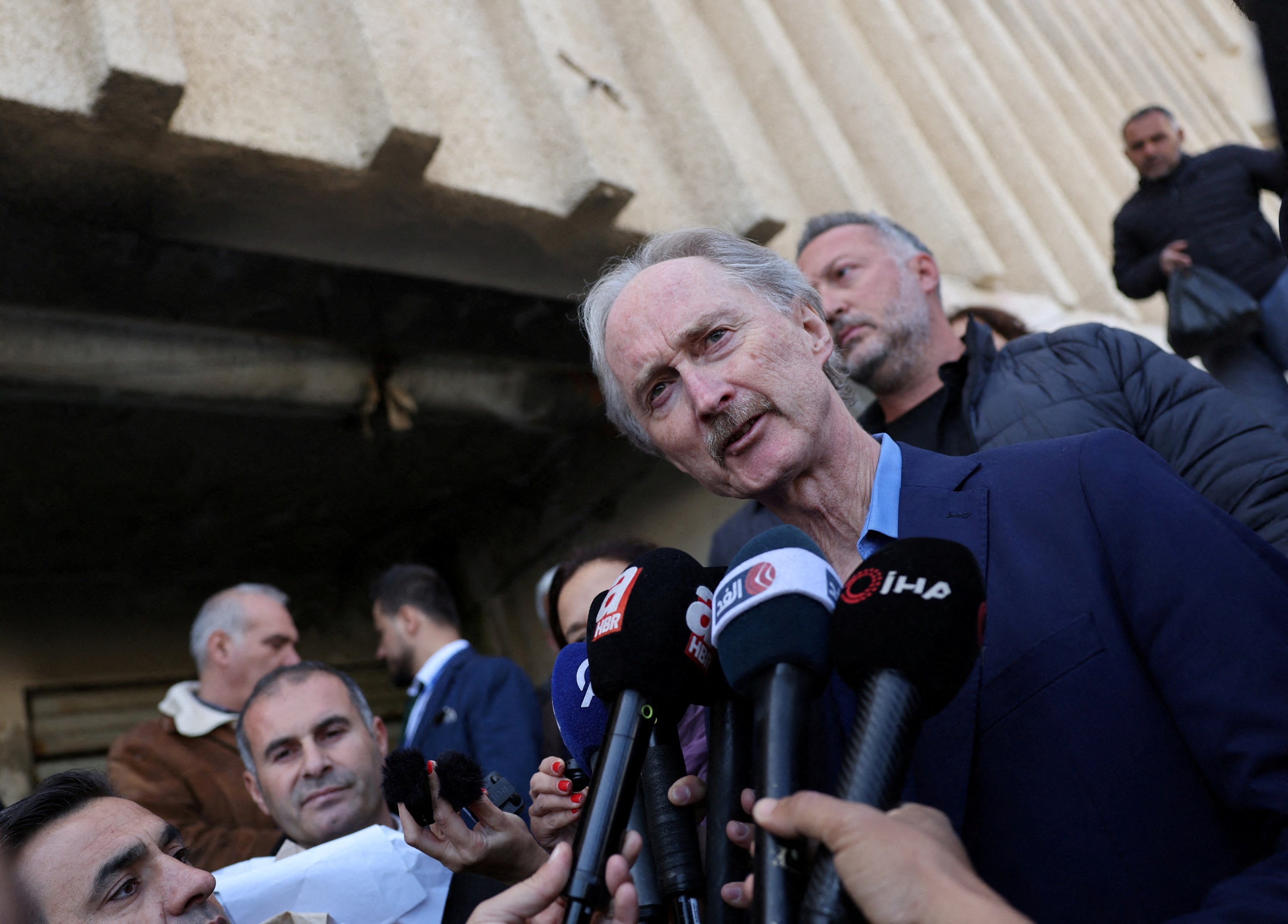
The U.N.'s special envoy to Syria, Geir Pedersen, unexpectedly announced on Thursday he was resigning after almost seven years serving as the organization's top official in the war-torn country.
Pedersen, who has held diplomatic posts for decades for the world body and his native Norway, told the U.N. Security Council that "I have informed the secretary-general of my intention to step down."
"And he has graciously accepted my request," he said.
The 69-year-old diplomat said he would leave his position in the "near future," but did not say when. He said he had intended for a while "to move on for personal reasons" and stayed on because of rapid and major developments in Syria.
Pedersen was appointed as the U.N.'s special envoy to Syria in 2018, seven years into the country's civil war. Amid the chaos, Daesh took over significant parts of the nation. In 2019, the terrorist group lost the last sliver of land its fighters controlled, but sleeper cells linger.
Pedersen was charged with the implementation of U.N. Security Council Resolution 2254, which aimed to usher in a political solution to the conflict between the Bashar Assad regime and its opponents, but efforts to broker one repeatedly faltered.
The civil war began after mass anti-government protests in 2011 were met by a brutal crackdown. The fighting killed nearly half a million people and displaced half of the country's prewar population of 23 million.
The conflict was largely frozen for years, with the country carved up into areas controlled by the Assad regime and different opposition groups until December 2024, when Assad was ousted in a lightning opposition offensive led by Syria's now-interim President Ahmad al-Sharaa.
"My experience in Syria has affirmed an enduring truth – that sometimes it's darkest before the dawn. For so long, progress seemed absolutely impossible, until suddenly it came," Pedersen told the Security Council on Thursday.
"Today, the Syrian people have a new dawn, and we must ensure that this becomes a bright day. They deserve this so much," he said, praising the population's resilience and determination.
The current government and the Syrian people "are attempting a transition in the face of challenges and realities as complex and difficult as have been faced almost anywhere," he noted.
He stressed that authorities in Damascus are grappling with "a massive legacy of war and autocracy."
"They have inherited not just the ruins of shattered buildings, but the deeper wreckage of a battered social fabric, decayed institutions, and a hollowed-out economy," Pedersen said. "Syria urgently requires international material assistance on a scale commensurate with its needs and ambition."
He called for international support for Syria and for its government to give all its people a voice in their nation's next chapter.
Despite Syria's difficulties, Pedersen said he believed that "with genuine negotiation and bold compromise, unity is within reach, and success against the odds is possible."
Pedersen previously held various U.N. roles, including special coordinator for Lebanon in 2007-08. He was a member of Norway's team that negotiated the 1993 Oslo accords, which resulted in mutual recognition between the Palestine Liberation Organization (PLO) and Israel, and he was Norway's representative to the Palestinian Authority between 1998 and 2003.