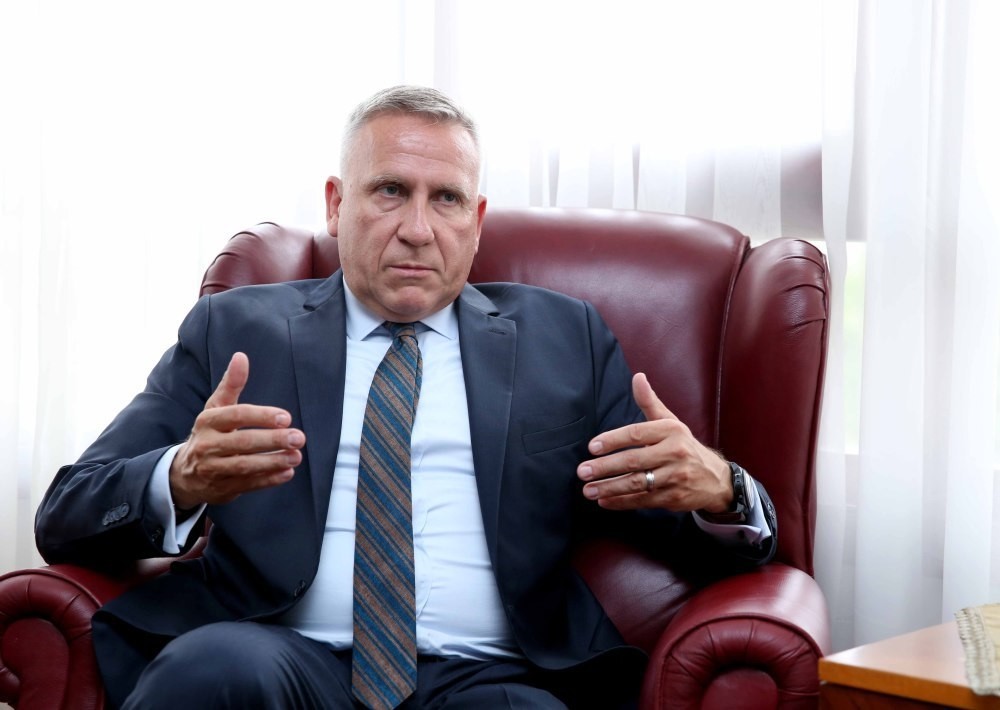
The Hungarian refugee policy has been criticized by Turkey and several EU countries since Europe began struggling to cope with the refugee crisis last year. However, the tone of criticism rose to another level when Luxembourg's Foreign Minister Jean Asselborn suggested the suspension or even expulsion of Hungary from the EU last week. Refraining to comment on this statement, Hungarian Ambassador to Ankara Gabor Kiss said in his exclusive interview to Daily Sabah that these kinds of ideas reflect a very isolated opinion and that many of these messages are actually intended for internal consumption. Underlining that Hungary has no intention to leave the EU whatsoever, Ambassador Kiss said that Hungary, has done a lot to protect the EU's external borders and his country cannot be punished for protecting the EU's borders and values.
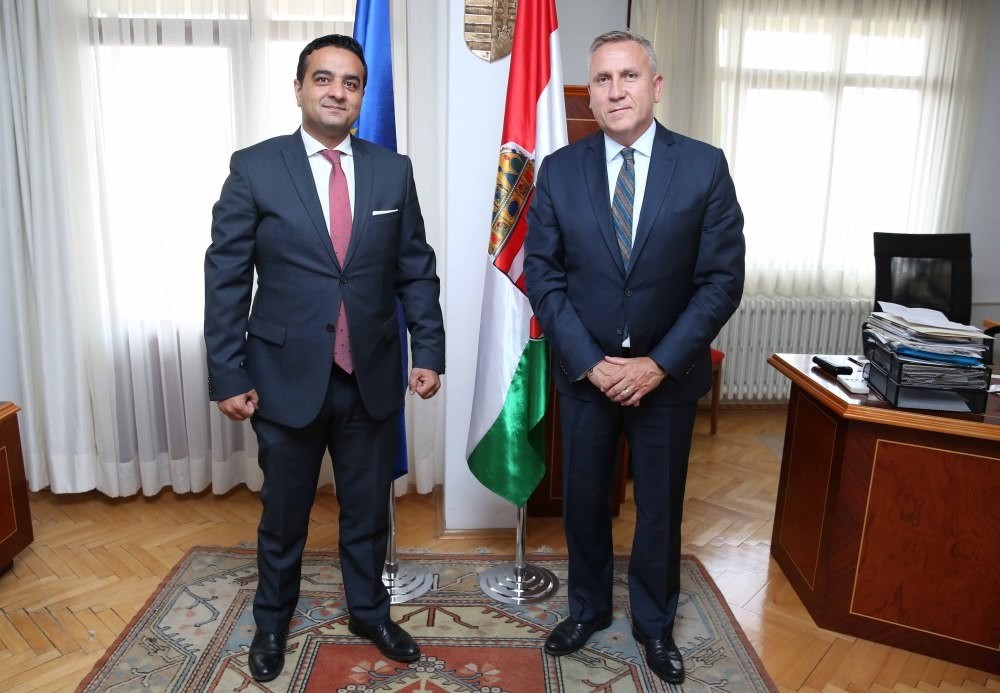 Hungary's Ambassador to Ankara Gabor Kiss (R) and Daily Sabah's Ali Ünal
Regarding the July 15 failed coup attempt, Ambassador Kiss stressed that Hungary has condemned the coup attempt since the very first moment. Hungarian officials recently announced that they will launch an investigation into Gülenist Terror Group (FETÖ)-affiliated institutions in the country. Touching upon this issue, he said that if the investigation yields concrete results, Hungary will take the measures that may be necessary to guarantee its own security as well as that of Turkey and Europe.
Daily Sabah: Last week, Luxembourg's Foreign Minister Jean Asselborn called for Hungary to be suspended or even expelled from the European Union due to its "massive violation" of the EU's fundamental values. How would you respond to this statement?
Gabor Kiss: Actually, I wouldn't like to comment on this statement. But I can say that the idea of Hungary's suspension from the EU is a very isolated opinion and many of these messages are actually intended for internal consumption.
Both the Hungarian Prime Minister and the minister of Foreign Affairs and Trade have given their answers: Hungary is adhering to the Schengen and Dublin rules while trying to halt the flow of migrants. Not only Hungarian politicians but also many European leaders – including Germany's Frank-Walter Steinmeier and Austria's Sebastian Kurz – have also expressed their disagreement with Mr. Asselborn's statements.
Expulsion or exclusion can't be solutions to the problems. We truly believe that dialogue and constant self-reflection are the key to finding answers. Of course, in any cooperation and cohabitation you will have disagreements just like in a family. But it is obvious that Europe's problems cannot be solved by conveying messages through the press. In fact, this only deepens the crisis Europe is in, instead of offering solutions.
DS: EU-member states as well as international organizations have been criticizing the Hungarian migration policy and attitude of security officials toward refugees since the crisis began. From your point of view, where do all of the problems occur?
GS: Hungary has maintained a clear and unchanged view on migration since the beginning of the migration crisis: borders must be protected and rules should be kept. Criticism about the Hungarian migration policy was extremely strong one year ago but it has eased now and many countries have started to understand our policies. Illegal migrants came to Europe without control (we don't know about their goals, we don't know who they are, where they want to go, what they want to do.) It is Hungary's obligation to enforce the Schengen rules and EU regulations.
We think that aid must be taken to the places where the migrants come from, rather than the problems being brought to Europe. We should provide these people with shelter and food at the nearest safe place and make it possible for them to return to their homes as soon as possible. Rather than providing these people with new lives, our task is to help them getting back their old ones.
Hungary, along with the other countries of the Visegrád Group, has done a lot to protect the EU's external borders. The Visegrád Four – an alliance formed by the Czech Republic, Slovakia, Poland and Hungary – is one of the most effective and closest cooperation in Europe. We need to talk straight and name the problems: the V4 has done this. The states of the Visegrad Group have, therefore, been underlining that enhanced cooperation with third countries, including Turkey, whether transit or origin, as well as protection of EU external borders are key tools.
DS: A referendum related to the European Union's migrant resettlement plans is to be held on Oct. 2. What will be the possible consequences of the referendum?
The referendum is basically about who is going to decide on behalf of the Hungarian nation and about whether the EU can force the member states by means of mandates to relocate migrants among its members. It's about whether the decision is in the EU's competence or the member states' competence. The question in the referendum is very clear: Do Hungarians agree that the European Union should have the power to impose the compulsory relocation of non-Hungarian citizens in Hungary without the consent of the Hungarian National Assembly? We believe that this is a dispute between Hungary and the EU rather than a migration question.
Hungary is prepared to listen to the people's opinion. The Hungarian people have the right to give their opinion, and shall have the right to decide whom they want to live with. This is an unalienable right. The Hungarian Government needs strong support of the people, so it can effectively represent their interests in Brussels.
Regarding the result of the referendum, the Hungarian government will have a very strong mandate if the referendum will be successful. Then we can negotiate further with the EU. But everybody should understand that the result of the referendum is not a life-or-death question.
DS: Even though different approaches toward the refugee issue has appeared to be the major problem between the EU and Hungary in recent years, the death penalty, the retirement age of judges and the independence of the Hungarian Central Bank have also became problematic issues. Do you think that these problems would trigger Hun-Exit?
Hungary has no intention to leave the EU whatsoever. We are strongly positioned in the EU and Hungary has both political and economic interests in being a member state of the EU. We are Europeans and we have always been Europeans. Moreover, Hungary cannot be punished for protecting the EU's borders and values.
Becoming an EU member doesn't mean that you need to give up national sovereignty. We need to find a balance between community interests and national interests. But, the EU needs reforms and it needs to regain its competitiveness. The judiciary is independent and impartial in Hungary as well as the National Bank. Contentious issues have been soothed and closed between the EU and Hungary.
DS: Turkish officials made it clear that they will not implement an EU-Turkey refugee deal if the EU will not grant visa liberalization to Turkish citizens. What are your thoughts on this issue?
Turkey has achieved a lot on the path of visa liberalization and Hungary has supported Turkey's efforts from the beginning. Turkey also has done a great job in defending EU borders. A substantial number of refugees were prevented from crossing to Greece over the Aegean Sea. We hope Turkey will fulfil all the requirements in the best possible way. Regarding the re-definition of terrorism which is the most critical requirement, I think the EU needs introspection. Regarding g the criticism of Turkey about its measures after the military coup, our position is very clear: the military coup attempt was a very serious attack on democracy, and one can only fight this threat with serious responses. I think the EU needs to be much more humble about this. Many EU states have never experienced coups themselves, thus Europe should be much more careful in criticizing Turkey's measures.
I hope that there will be a high-level dialogue between Turkey and the EU to find a solution and a healthy comprise. I'm confident that Turkey will be able to achieve the desired results by fulfilling the benchmarks.
DS: Hungarian officials have recently announced that they will launch an investigation into the FETÖ-affiliated institutions in the country. What's the latest on this investigation?
First of all, let me take this opportunity to remind once again that Hungary has condemned the coup attempt since the very first moment. Our Foreign Minister Péter Szijjártó called his counterpart Mevlüt Çavuşoğlu and held a press conference at 8:00 a.m. on July 16 as soon as he arrived in Budapest from an overseas visit to condemn the coup attempt. And then, on Aug. 23, Szijjártó was one of the very first foreign ministers from any EU member state to visit Ankara after the coup attempt.
Regarding your question, I can say that based on the Turkish request, the Hungarian authorities are investigating whether certain organizations operating in Hungary indeed pose a threat to the stability of Turkey and whether they cooperate with movements which are engaged in terrorist activities. But, for now, we don't have any information that I can disclose and it would be very unethical to share information about an ongoing investigation.
If the investigation were to yield concrete results, Hungary would take the necessary measures for guaranteeing its own security as well as that of Turkey and Europe.
DS: The head of the Hungary-Turkey Friendship Group in the Hungarian Parliament, Gabor Vona, recently said that "The West is uncomfortable with the idea that Turkey will remain strong as long as [President Recep Tayyip] Erdoğan is its leader." What do you have to say about this comment?
I will not comment on Vona's remark. But, as Hungarian ambassador I can say that all attempts aimed at the destabilization of Turkey must be rejected. Stability in Turkey is in the interest of Europe and Hungary as well. Accordingly, Hungary condemned the attempted military coup of July 15. Those who attack Turkey's stability attack Europe's security. A military coup is a serious matter, and therefore calls for a serious response. Whatever response the democratically elected president and government may opt for in the wake of the incident must be respected.
DS: Regarding economic relations, even though both parties agreed to increase total trade volume up to $5 billion, the current level is below this target. Which sectors do you think have more potential in reaching this goal?
We need further strategic analysis to achieve the commonly defined target. Our approach in this field is comprised of various elements. Research and development (R&D) are equally important for our countries. We are also defining areas where high added value can be created. Automotive industry is a good example. Both the Turkish and the Hungarian automotive industries are highly developed and competitive on the world market.
We consider the Hungarian-Turkish Joint Economic Committee a proper structure for discussing the ways to improve economic relations and identify potential new fields of mutually beneficial cooperation. There are numerous other areas of focus for Hungary where we would seek to boost our exports; info-communications, water and wastewater management services, engineering, defense industry and knowledge transfer; just to name a few.
Hungary has outstanding experience in the field of water and wastewater management. The Budapest Waterworks, Ltd. is a nearly 150-year-old company which not only provides approximately 2 million people with healthy potable water each day but also has vast amount of experience in using wastewater to create energy. This is just one of the unique solutions that we are offering our Turkish partners and they are in close collaboration with İSKİ, ASKİ and İZSU to create an innovative project base that will lead to common projects in third countries.
Turkey has excellent relations with Africa, the Middle East as well as the Far East, where we see enormous potential for further economic cooperation. In March 2016, we organized the first Hungarian-Turkish Business Forum entitled, "Go Africa" in Budapest, with the presence of more than 100 business partners to discuss possible partnerships in third countries.
Sufficient funding and finance are key components of a successful project. The Hungarian Eximbank has opened an office in Turkey, creating an additional financing option for joint Turkish-Hungarian projects in Turkey or in third countries. Eximbank has allocated $145 million for business in Turkey.
Tourism is also an area with great potential. Turkey has already been very attractive among Hungarian tourists. We would also like to welcome more and more Turkish tourists to Hungary as a holiday destination with its rich Ottoman-era cultural heritage sites.
One of the critical issues that we need to work on is the number of days that Turkish tourists spend in Hungary. There are two major destinations for Turkish tourists in Hungary: Budapest and Esztergom. Most of the Turkish tourists – I'm talking about only 60,000 tourists a year – come as part of a three-city tour which covers Budapest, Vienna and Prague. They have no idea of the Ottoman relics, the cultural treasures, or the healing powers Hungary has to offer. Our goal together with the Hungarian government is to promote Hungary as an independent destination for Turkish tourists. There are now four Turkish Airlines flights and two budget flights daily between Istanbul and Budapest, so we would like Turkish tourists to come and spend maybe five days and get healed by the thermal waters of Hungary. We would like them to come and see the mosque in Pécs, the castle of Szigetvár.
DS: Turkish-Hungarian relations also have strong historical and cultural roots and recently a tomb of Sultan Süleyman the Magnificent was discovered. What's the latest on this?
Deputy Prime Minister Veysi Kaynak came to Hungary in the beginning of September to participate in the commemorations of the 450th anniversary of the siege of Szigetvár, when Sultan Süleyman the Magnificent and our national hero, Miklós Zrínyi with their respective armies clashed each other. (Szigetvár is a city of 10,000 people in Southern Hungary, about 30 kilometers from the Croatian border).
A team of researchers from the University of Pécs (led by Professor Erika Hancz and Norbert Pap), announced in September 2013 that their excavations had revealed the remnants of a lost Ottoman settlement. The researchers are confident that the settlement was founded on the spot of Suleiman's final campsite, where he spent the night before his death in 1566. The Ottomans built a mausoleum here where the sultan's entrails and heart were buried, and later a lavish memorial site was created around it, encompassing a mosque and a Dervish cloister. The site stood until 1692 when the Habsburgs removed all precious items and took them to Vienna.
The excavations are supervised by a team of fifteen Hungarian and three Turkish researchers. This year's excavation season lasted from early May until July 15. This year's most important result was the finding of the remnants of the Dervish cloister. They have also found the site of another building, which might as well have been the barracks of the mausoleum's guards. The researchers also unearthed several interesting relics, including 16th- and 17th-century coins, porcelain, and even playing dices and opium pipes.
DS: Is there anything you would like to add?
I'm proud to say that bilateral relations between our countries are well on track and during the two years I have been serving in Ankara I was looking for opportunities to strengthen it further.
Regarding some migration issues, we might have differing views with the Turkish government but our relations are based on dialogue and our political and economic relations are unique and dynamic.
High-level visits between our countries are ongoing. This week, Economy Minister Nihat Zeybekci is visiting Hungary and we are expecting to hold a high level strategic council meeting in Ankara before the end of this year.