Colombia has been exhausted with the war that has killed around 300,000 people and left 45,000 others missing. The country is now facing a serious refugee problem with neighbors Venezuela facing an internal conflict that has displaced 7 million people.
The Latin American country, which previously showed its support for Turkey's efforts in solving the conflict in bordering Syria, is asking for help from Turkey in dealing with the issue to tackle its growing refugee problem.
With Turkey being the most appreciated and praised country for its successful methods in coping with an influx of refugees after civil war broke out in Syria in 2011, a high-level Colombian envoy has applied to the Turkish Cooperation and Coordination Agency's (TİKA) office in the Colombian capital city of Bogota.
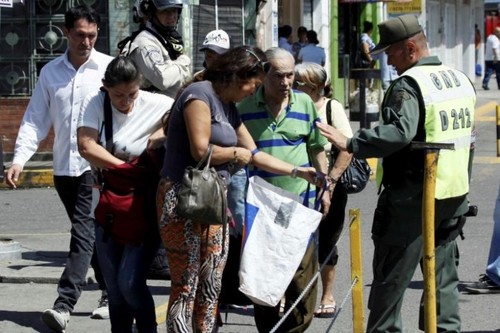
A Venezuelan soldier talks to people as they cross into Colombia over the Simon Bolivar international bridge, in San Antonio del Tachira, Venezuela.
A new law even has recently ratified provisions of the peace agreement that allows former FARC members to be placed in legal politics. What would potentially be a very positive time of the country has become an obstacle overshadowed by the refugee issue.
Yet, taking early steps, the Colombian government has decided to copy the Turkish model in dealing with the issue.
Mehmet Özkan, an associate professor at the Turkish National Police Academy and director of TİKA's Bogota branch, said the Colombian foreign ministry appealed to the office to receive information about Turkey's refugee policy.
After a briefing, the ministry declared its intention to send a delegate envoy to Turkey.
Juan Carlos Restrepo Piedrahita, adviser to the Colombian presidency on security issues, Victor Alfonso Bautista Olarte, the head of the border development and integration department at the presidency and Pedro Felipe Lopez, the head of the National Unit for the Management of the Risk of Disasters, paid a week-long visit to Turkey.
Piedrahita said their envoy was in Turkey to see how the Turkish government dealt with the six-year-long problem and what experiences Ankara has gained.
The presidential adviser stressed that Colombia is need of learning from Turkey's experiences due to the unrest in Venezuela.
He also said Colombian citizens who have fled to Venezuela previously due to the conflict with FARC, may come back to their country along with Venezuelans.
"We want to be prepared as we expect a grand migration wave," he said.
Meanwhile, Olarte, the country's border development and integration department head thanked TİKA for its cooperation.
"We have looked at other countries as well, yet we have seen that Turkey is the most successful model," Olarte said.
Underlining that in a very short time Turkey has achieved great success; he said that, "Turkey's approach is not based only on politics but also on humanitarianism. What we saw during our stay is that Turkish institutions as well as Turkish people do their best. Moreover, we have visited the Foundation for Political, Economic and Social Research (SETA) and saw the academic and sociological approach to the issue and have obtained information from the Turkish Education Ministry as well."
Lopez, the head of the National Unit for the Management of the Risk of Disasters also chimed in revealing his astonishment at Turkey's efforts, saying, "There is like a race between Turkish institutions. All of them work towards solving problems with the refugees. Every institution seems free to carry out projects for the refugees. As a result, a very comprehensive approach appears."
Emphasizing the fact that not only the state but also the Turkish people endeavor to embrace refugees, he said that, "One of the most important issues is the brotherhood between Turkish and Syrian people."
Lopez also emphasized that Colombia would copy the Turkish model, which is, according to him, solution-oriented.
On the Turkish side, TİKA's Bogota office director Özkan stated that they were happy to welcome the Colombian delegation and open to sharing any information and experience.
"The nature of the conflicts in Syria and Venezuela is different. However, both of the countries face a similar humanitarian crisis at their borders," he said.
Underlining that Colombia had limited knowledge on the issue, he said, "They wanted to see what kind of system Turkey established in registration, education, health, security, social life in the camps and integration."
Although the number of refugees is not known clearly, he added, "Many people are expected to come. Therefore, Colombia wants to be prepared."
Giving the example of the city of Cucuta which hosts thousands of Venezuelan refugees, he indicated that TİKA would launch projects for the coming refugees, especially for those in the border cities.
He also emphasized Turkey's changing role on the continent and underlined that Turkey appears as a country to potentially benefit from its experiences.
"Turkey and its institutions in Latin America, primarily TİKA, are considered to be a source for inspiration. This will bring about more cooperation between Turkey and the continent. In particular, we can talk about the 'South-South' cooperation between Colombia and Turkey. This cooperation will be more sensible when the share of experience begins," Özkan said.
Hosting almost half of the 4.2 million displaced Syrians in the region over the past three years; Turkey has borne the largest share of the refugee burden.
The number of Syrian refugees living in Turkey has exceeded the sum of the populations of the 15 least populated Turkish provinces. Contributing nearly $9 billion in humanitarian aid during the ongoing Syrian crisis, Turkey's aid for Syrian refugees has been 20 times more than the aid received from international organizations, according to the Prime Ministry Disaster and Emergency Management Authority (AFAD).