‘Sunstroke,' another fairy tale from Nikita Mikhalkov
by Nagihan Haliloğlu
ISTANBULDec 25, 2015 - 12:00 am GMT+3
by Nagihan Haliloğlu
Dec 25, 2015 12:00 am
Having won many awards in film festivals like like Cannes, Venice, Moscow and Karlovy Vary, Russian director Nikita Mikhalkov's 2014 film 'Sunstroke' provides an insight into Stalin Era focusing on painful experiences of a family Nikita Mikhalkov's "Sunstroke" (2014), which debuted at the rather quietly held Rendez-Vous Film Festival in Nişantaşı in December, focuses on the transformation of the idyllic Russian Empire into the harsh Soviet Union, which ruled whole nations with an iron fist. It follows in the footsteps of "Burnt by the Sun" (1994) and "The Barber of Siberia" (1998) that also deal with the effects of the change of a political system. "Sunstroke" opens with a tramcar coming toward the audience - there are red flags on the car that signal that the Bolsheviks have taken over - with a background of turn-of-the-century buildings, not unlike Istanbul. Indeed, when the tram approaches, we see that it is exactly the same design as the tram that was revived a few decades ago on İstiklal Avenue. From the very beginning, the Turkish audience is reminded that they will be watching the trials and tribulations of a nation very similar to themselves: Similar in tastes, similar in traditionalism but most importantly, similar in their hankering after all things European.
The film has a double timeline. The first strand, which opens the film, follows the story of a group of White Russian officers who are inline to hand in their epaulettes to the Soviet command and sign papers that say they give up their positions, which will allow them to leave the country. Everything - the mud, the trees and the military overcoats - is grey. The comrade in charge of relieving the officers of their ranks is very respectful and makes small talk with them. There is no disorderliness; the film builds a parallel universe in which the transition from the empire to the Soviet Union happened without any bloodshed. We, the Turkish audience in particular, know better than that. One of the officers, whose past story is soon told, sits down at the table, hands over his ranks and stops dead for a moment to ask: "How did this happen? How did such a great army, that is now a logistical nightmare to disband, become an unwanted body in its own country? How is it that a peasant is now in charge of stripping off the medals of the officers of a higher class?" Mikhalkov wants us to ponder these questions before he moves on to the central metaphor of his film: A very high-spirited cadet, Junker, determined to take a picture of the White Russian officers, and the Soviet team in charge of them, before they all go their separate ways. This seems to be the driving force of Mikhalkov's oeuvre: Painting a picture of Russia in which all who served, be it under Tsarist Russia or under the Leninist or Stalinist Soviet Union, are heroes to varying degrees. This, of course, coincides with the political vision of Russian President Vladimir Putin, with whom Mikhalkov is said to be very good friends with. It is also not so different from the cultural policies of New Turkey, where Ottoman heritage has been given special attention after decades of neglect, but there is also a drive to preserve the republican heritage.
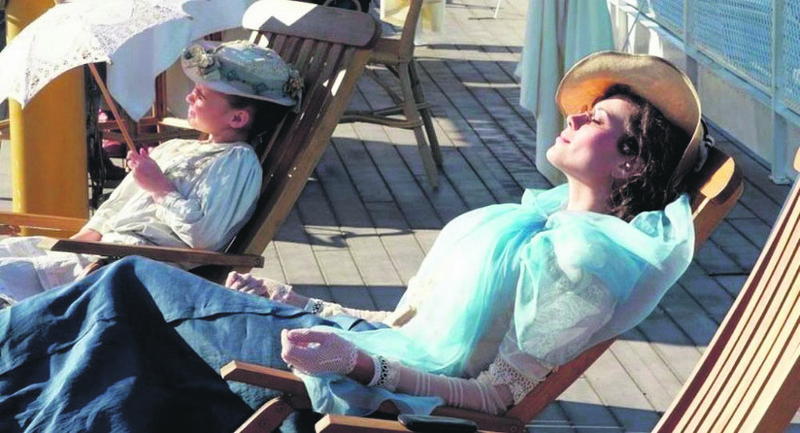
The second timeline is a past summer that the unnamed officer who asked "How is this possible?" remembers, as he keeps musing about how it is that things came to pass in such a way. We are transported from the greyness and mud of the camp to an almost blinding light, a side-wheel steamer on the Volga. From the continuously thwarted efforts of Junker to take a photograph with his machine of which he is very proud, we move on to the lens of the binoculars held by a very beautiful woman, inspecting the new passengers coming aboard, including our own dashing officer from the camp. The binoculars then become the instrument that enables their first encounter and then their affair. The woman, who likes the officer, remains unnamed, has an enchanting smile and the sweetest of voices. She keeps running on deck with some children she has taken to - the very model of the perfect Russian mother or indeed Mother Russia. However, we learn that she has left her own children at home to take this leisure trip, whose purpose is never quite explained. There is a long sequence in which a magician entertaining the boat's passengers breaks and then repairs the officer's pocket watch: Time out of joint, time regained.
Back in the prisoner of war camp the officers talk about the state they are in, trying to make sense of Russia's transformation. One of them provides the usual commentary that their teachers were English, their engineers were German and their tastes, French: No wonder they had no clue what the masses were doing or thinking. They ask: Why didn't we read enough Leo Tolstoy? Why didn't we read enough Nikolai Gogol? The answer is given by the Russia of today: On Dec. 3, a Russian state broadcaster organized a "War and Peace" reading marathon that ran for four days - the sort of thing Mikhalkov would approve, if he did not suggest it himself.
Although the question of why the Russian Empire fell seems to be on the mind of our officer, the past he goes too is one that is unblemished by any civil strife, wrong doing or hunger. In the happy, idyllic river town that he is stranded in after his lover abandons him, he befriends a plump, young boy who wastes his days watching the boats. The only unseemly thing happening in the village involves the priest who charges money to bless new rosaries, and a village photographer who makes fools of his customers by giving them exaggerated props when they want to give "manly poses." The boy takes the officer around the village, and shows him a spot with a wonderful view, and the green lush lands of Russia in the golden sunlight, wash over the audience. We are then just as sunstroke as the characters, and possibly wondering how much a trip down this heavenly river would cost.
However, the film decides to end on a grey, patriotic note. We watch the officers being led to their death on a ship while they think they're being transported to a travel hub where each can go their own way. Just before they get on the ship, Junker has been able to take the photograph, and also has given everyone his handmade business card so they can all write to him and ask for a copy. When the ship is sunk by the Soviet command, we go down to the bottom of the sea with it: The last image we see is Junker's photograph, fully processed and a minute later, the last credits roll, starting with text listing the number of soldiers lost in Crimea and elsewhere during the Soviet purge. Still, despite all its political undertones, the film, with its lush color, attention to the period and regional detail, is like a fairy tale, which you have been privileged to step into for a short time.
Keep up to date with what’s happening in Turkey,
it’s region and the world.
You can unsubscribe at any time. By signing up you are agreeing to our Terms of Use and Privacy Policy.
This site is protected by reCAPTCHA and the Google Privacy Policy and Terms of Service apply.