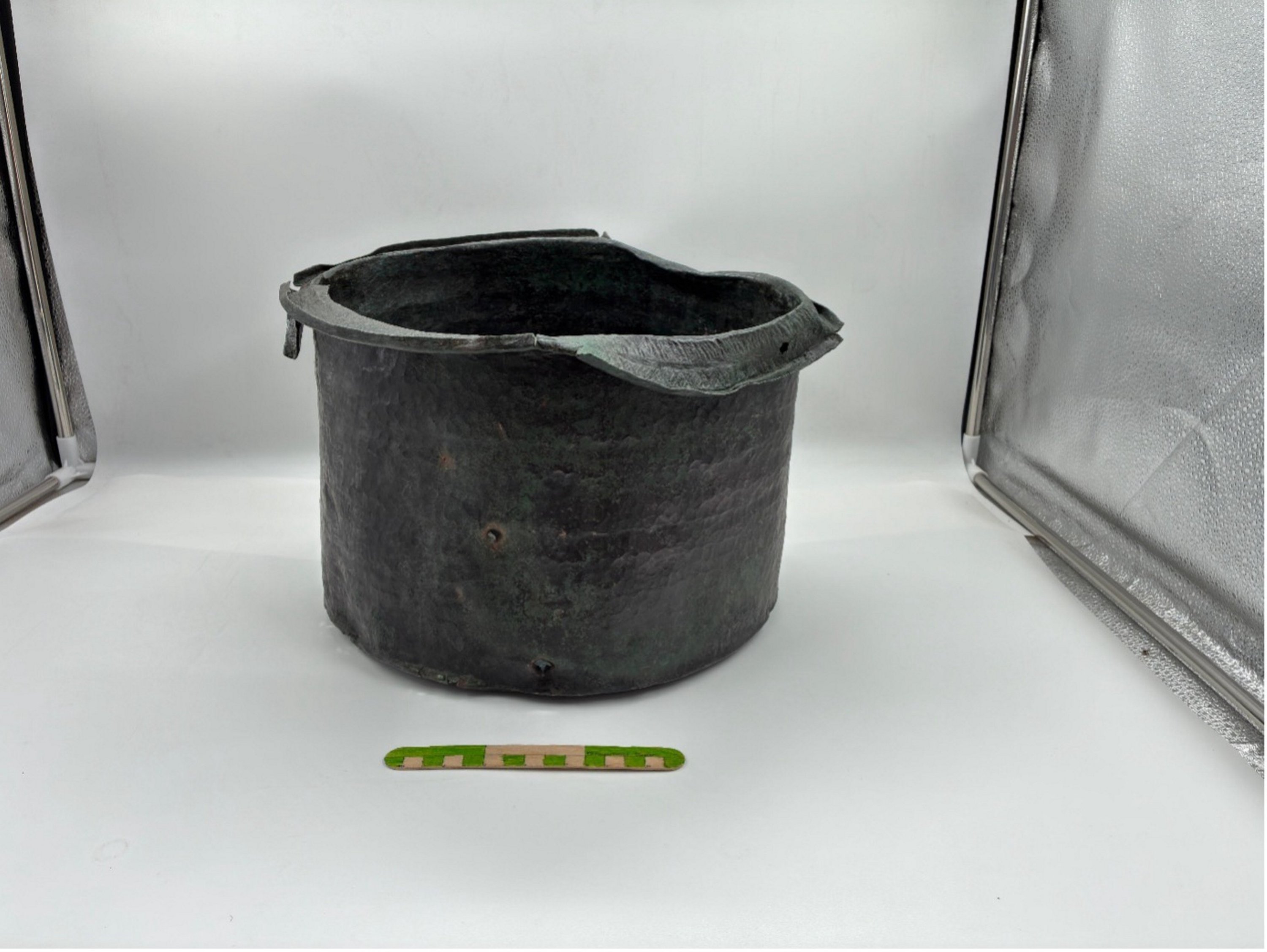
During excavation works carried out at the Pergamon Ancient City in the Bergama district of Izmir, western Türkiye, a bronze cauldron believed to date back to the Roman period, approximately 1,400 years old, was found.
According to a statement from the Pergamon Ancient City Excavation Directorate, the works at the ancient city are being conducted under the "Heritage for the Future" project, led by professor Yusuf Sezgin.
At the excavations near the Red Courtyard, a bronze cauldron was found fully preserved in the pool area of the structure referred to as the "Mosaic House."
The statement noted that the artifact measures 23 centimeters (9.06 inches) in height, 28 centimeters in width, and 21 centimeters in depth and that the bronze cauldron was made using the hammering technique.
It was emphasized that, following conservation and restoration efforts that preserved the bronze vessel well, the hammer marks on its surface can be clearly observed.
The cauldron, which features linear motifs on its upper part, is estimated to be 1,400 years old and from the Roman period.
The bronze cauldron, with its restoration and cleaning process now complete, is planned to be exhibited soon at the Bergama Museum.