Cinema records the visible world; yet when it settles for what is merely visible, it cannot reach the truth of the human being.
Sufism, on the other hand, suggests that there is another layer of meaning behind what is visible and that a person is not limited to the self that appears to them. In this sense, the relationship between cinema and Sufism can be established on a much deeper level than simply bringing religious symbols to the screen. Before offering cinema ready-made stories or images, Sufi thought proposes another way of looking at the human being, time, the world and truth. Perhaps the real question is not how Sufism can be represented in cinema, but whether cinema can look at the world through a Sufi perspective.
The Sufi journey is not the same as the ideas of personal development presented to us in the modern world. The protagonist does not simply become someone who takes control of their life. They may have to forget what they know, recognize the arrogance hidden within their intentions and begin to see the world not as property given to them, but as a temporary station in which they are staying.
For this reason, spiritual growth in cinema does not necessarily have to follow an upward trajectory. Turning back, waiting, getting lost, repeating the same mistake in another form and eventually confronting one's own helplessness can all be stages of this journey. We do not need a character to say, “I am a different person now” to understand that they have changed. What matters is being able to show the protagonist’s inner journey.
Cinema has used certain symbols that evoke the mystical dimension of Sufism. In Andrei Tarkovsky’s "Mirror," for example, nature is not simply an ordinary expression of a state of mind or a collection of symbols waiting to be deciphered. Water, fire, wind, rusted metal and mud take on a presence that challenges the idea that human beings can fully explain the world. Memory, dreams and the present are not separated by clear boundaries; the past ceases to be something that has simply happened and reappears within the present. Much like in Sufism. Although Mirror is not directly a Sufi film, it suggests that truth cannot be grasped through reason alone, and that memory and dreams may also carry a form of knowledge belonging to human existence.
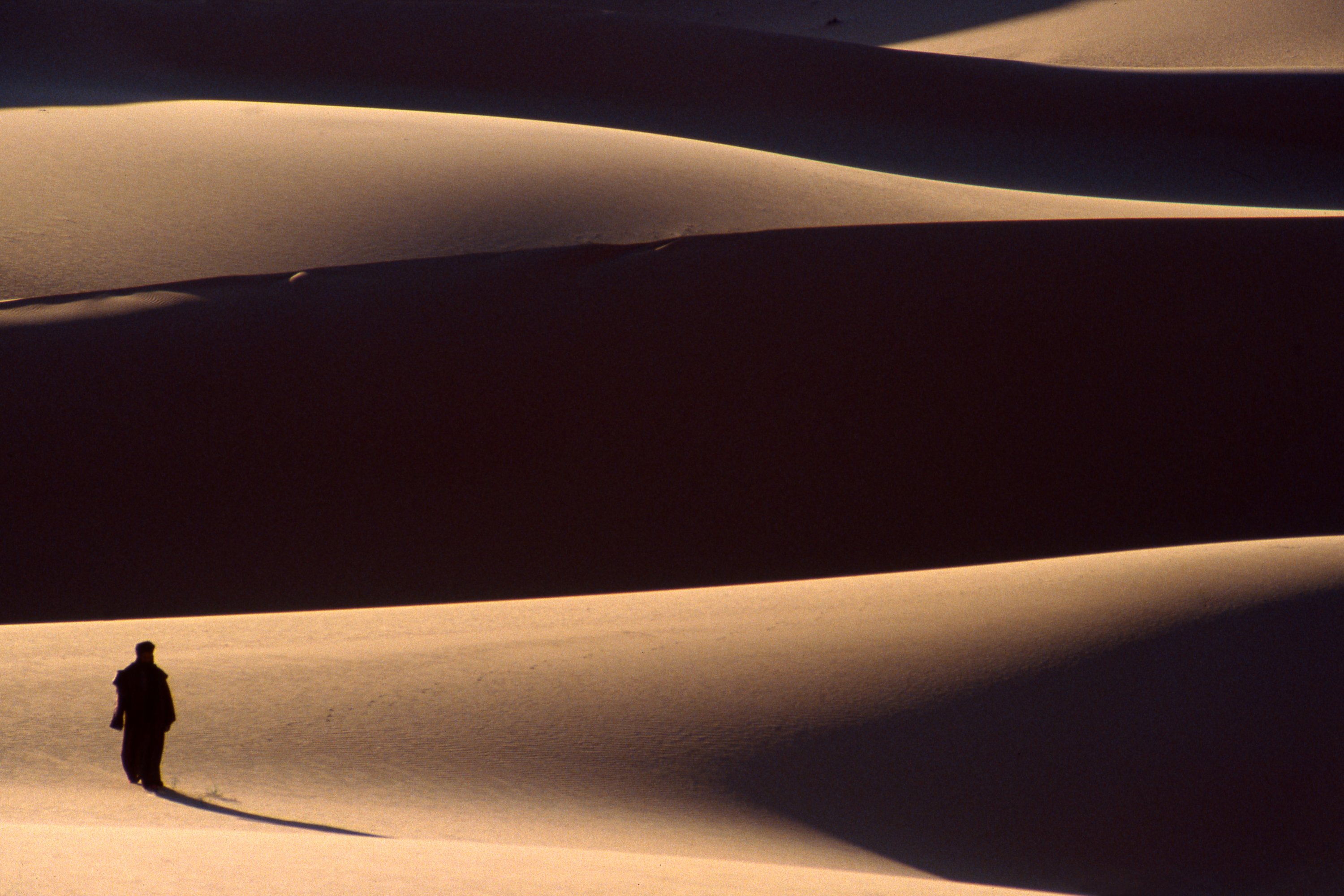
One of the most significant examples of Sufism being directly incorporated into the language of cinema is Tunisian director Nacer Khemir’s Desert Trilogy: "Wanderers of the Desert" (1984), "The Dove’s Lost Necklace" (1991) and "Bab’Aziz" (2005). In all three films, the desert is not merely a setting for the story, but a space for searching and for a person’s journey toward the faith within themselves. Particularly in Bab’Aziz, the journey, stories within stories, dervishes, music and encounters create cinematic counterparts to the Sufi path of spiritual transformation without turning the film into a didactic account of Sufism. Khemir’s cinema does not explain Sufism; instead, it brings its way of thinking into the structure of the narrative.
In Abbas Kiarostami’s "Taste of Cherry," Mr. Badii repeatedly drives the same roads in the dry hills outside Tehran. He intends to commit suicide and is looking for someone who will bury him afterward. The inside of his car becomes a place of intense confession, while the barren landscape outside turns into an extension of his trapped state of mind. Yet, Kiarostami does not reduce the landscape to a single, straightforward metaphor representing Badii’s emotions. He brings the voices of the people he encounters, the curves of the road, the dust and other possibilities of life into the frame. Much like a person’s journey through life.
The lakeside monastery in Kim Ki-duk’s "Spring, Summer, Fall, Winter... and Spring" likewise constructs spiritual change through the cycle of the seasons. The monastery’s gate has no walls and its shore is not connected to a road. Childhood, desire, guilt, punishment and return take place in the same setting at different times. At first glance, it may seem meaningless to equate the film with Sufism, as its story is told through a Buddhist worldview. Yet the way the setting is constructed as a moral and spiritual process reminds cinema drawing on Sufi culture of something important.
Semih Kaplanoğlu’s "Egg," "Milk" and "Honey" almost form an inner journey. In "Egg," Yusuf’s story does not resemble the rise of a hero who achieves success. When Yusuf returns to his hometown following his mother’s death, he realizes that he has not actually been able to break away from the life he thought he had left behind. The journey to fulfill his mother’s vow begins as a small obligation but turns into a confrontation with the past, death and belonging.
In "Grain," the search for the self is taken to a more explicit metaphysical level. Cemil Akman’s journey with Erol Erin, as he reaches the limits of scientific knowledge, becomes a form of seyr-u suluk that requires modern man to relinquish his desire for control.
A genuine Sufi cinema should first move away from the easy option of historical costumes. A dervish robe, the sound of a ney, candlelight and images of whirling dervishes may create an atmosphere, but they do not create thought. Sufism can just as well be sought in today’s metropolis, in an office tower, on the subway, in a hospital or in the life of a person burdened by debt. The nafs, or ego, does not speak only in a Sufi lodge. ıt can also emerge around a meeting table, at the family dinner table, in artistic circles and in the language of someone who believes they are doing good.
Second, such cinema should not create a world of perfect people. There are no perfect human beings. Perfection belongs only to the prophets. What makes us human is our capacity to make mistakes, regret them, learn from them and, according to religious tradition, seek purification from our sins. Sufism is concerned not with the completed human being, but with the person struggling with their own shortcomings. Arrogant sheikhs, disciples who fall into doubt, dervishes tested by money and people who hurt others while searching for truth are not outside this world.
Third, a film should not tell the audience what they are supposed to believe. Sufi cinema is not a film of religious instruction. Rather than offering ready-made answers, it invites the viewer into a way of seeing and experiencing. This does not mean it has to be heavy, dark or incomprehensible. Just as slowness is not depth in itself, ambiguity is not a guarantee of truth. Not every piece of information withheld from the audience becomes a mystery; sometimes it simply conceals a gap in the screenplay.
Spiritual change must come at a cost. If the protagonist finds peace at the end of the film after hearing a few words of wisdom, what we have is not spiritual growth but dramatic convenience. True transformation disrupts the agreement a person has made with their own ego. It may cause them to lose a position, a relationship, money or the favorable opinion they hold of themselves. The film does not have to compensate for this loss. Sometimes transformation does not make a person happier, but more authentic.
The most important thing Sufism can offer cinema is not new stories, but a new way of looking. In this perspective, human beings are not the owners of the world but its guests. Time ceases to be a straight line moving forward; the past returns to the present, and the same place is experienced again in different states. Death is not the end of the story, but a threshold that changes the way those who remain look at life. Dreams are not the opposite of reality, but one of its unseen faces. Love is not about possessing, but belonging.
Perhaps Sufi cinema is cinema that understands that an image cannot show everything. Because some truths are not understood through explanation, but through the silence that emerges within us.