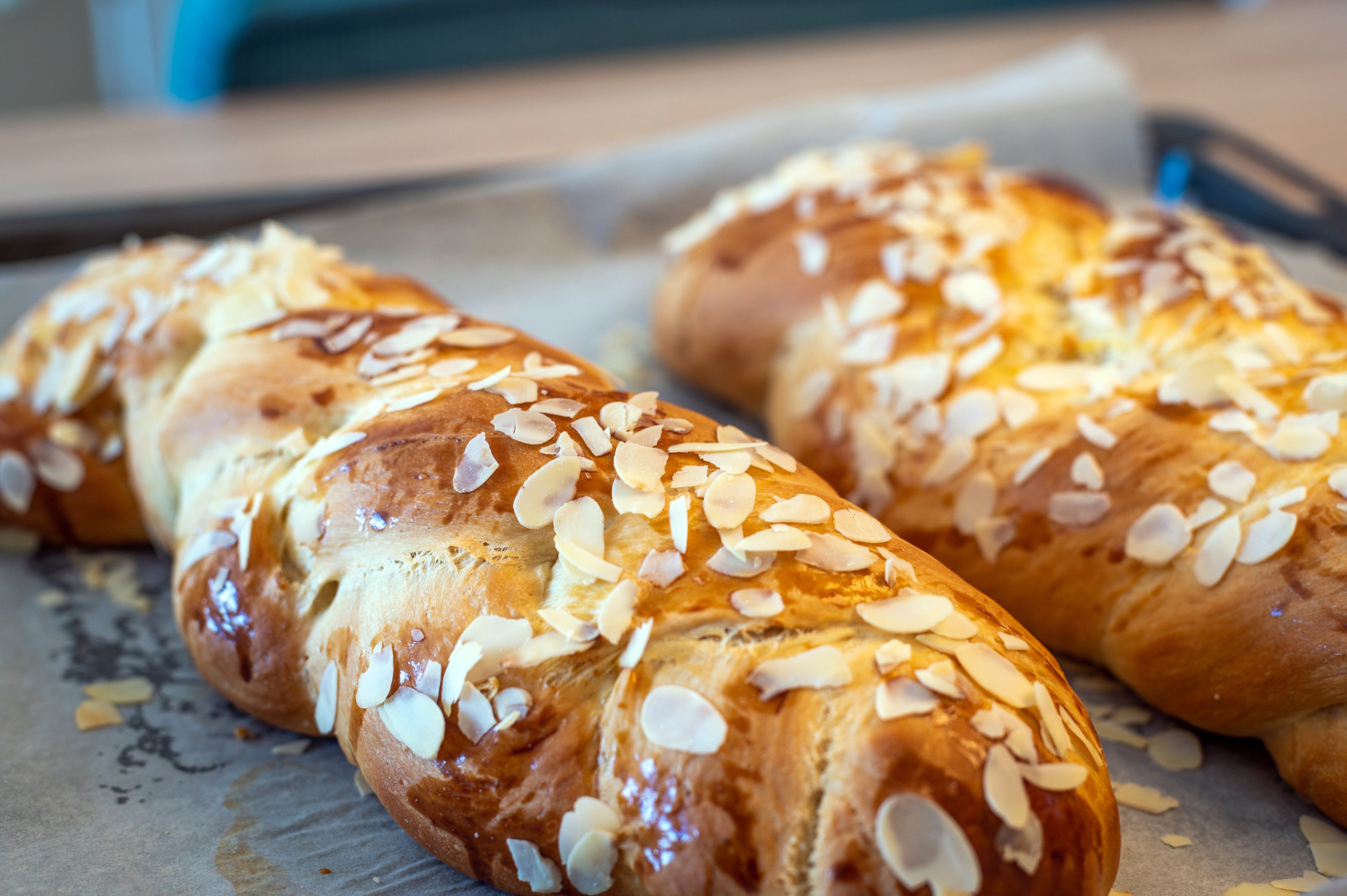
Yet another addition to the ongoing debate between Greece and Türkiye about the origins of certain dishes and cultural values: tsoureki, or paskalya çöreği (Easter buns).
It boasts a bread-like texture, rich in strong flavors and scents that remind many of their childhood years in Turkish Anatolia.
Its distinctive smell while being baked comes from mastic and mahleb, or mahlepi in Greek – spices commonly used in Türkiye, including for ice cream.
Mastic comes from masticohoria from the Greek island of Chios, a unique spice with a bitter taste and strong smell that gives food a different touch. Mahlepi comes from cheery seeds and is an aromatic spice that gives a distinctive smell to the dough while baking.
This strongly scented spice grows in both Türkiye and Syria.
Istanbul cuisine makes great use of rare spices like mastic and mahleb in cooking and not just breads for Easter, Aylin Öney Tan, a food writer and culinary researcher, told Anadolu Agency (AA).
But what exactly is tsoureki or paskalya çöreği? And is it Greek or Turkish?
"We can’t give a definitive time or geography for paskalya çöreği, or say whether it was first made in Greece or Türkiye, and as we all know, food culture back then was more fluid. I mean the borders did not exist as they do today,” said Tan, referring to the countries’ shared Ottoman past.
But she explained that although the origin of it could be attributed to Istanbul because of the Ottoman Empire, due to the metropolis’ multicultural background, it could be a joint product of communities there.
Tsoureki is very simple and has very few ingredients, said Sofia Stavrou, who was born and raised in Istanbul, the former Ottoman capital and now major financial center.
Flour, eggs, milk, and butter, including spices, can make the most delicious tsoureki, said Stavrou. She was quick to clarify that the ingredients are not what makes it delicious and fluffy - one or two simple secrets are behind a successful tsoureki.
"You should pay attention to activating the yeast by dissolving it in some warm water for a few minutes, and the other (secret) is to knead it well,” she said.
"If it's not activated correctly, then the tsoureki won’t rise enough, and then loses its texture,” she cautioned.
The name tsoureki "comes from the Turkish word çörek, which means puffy dough that has yeast,” famed Greek chef Ilias Mamalakis told AA.
Mamalakis explained how the recipe was improved by housewives who added milk and eggs. He said it is mainly baked during Christmas and Easter in Greece, thus accounting for the name "paskalya çöreği,” or Easter (Pascha) çörek.
"I wouldn't say it's a Greek product,” he said. "Tsourekia was also made in Georgia, Armenia, and Kazakhstan with small variations and almost the same name, but because Greeks liked it, it was incorporated into a Greek culture with small additions and variations.”
In Greece, around Easter, it is made with a round shape. But during Christmas it is made long and narrow like a braid used in exorcism, said Mamalakis. Others claim it is prepared to ward off evil.
Tsourekia was initially prepared by Greek and Armenian Christian minorities in Türkiye. From there, it passed to the locals, according to some culinary experts.
Kevser Demir Türkdoğan, a food writer said: "The best versions could be found around Kurtuluş Street in Istanbul, which was once a residence for minorities. These pieces of information could point to it being a Greek recipe.”
On the other hand, the name tsoureki comes from çörek in Turkish, which could mean that Turks or Turkish-speaking Greeks named it. "In that case, I assume that the recipe originally could belong to Greek people who were living in Türkiye, probably in Istanbul,” she said, referring to the city’s large Greek population, especially in centuries past.
"During Easter, it is more available in cities like Istanbul because of a large Christian population but not in other cities. The (southern) city of Antakya, with many active religions, might be a good source for this but unfortunately, the recent earthquakes damaged most of the city now,” Nilay Şenel-Nylund, a food influencer and Turkish cuisine enthusiast, told AA.
Nilay said mahlep-flavored braided çöreks are widely available at most bakeries in Türkiye. It is called braided çörek and is not linked to Easter. "Most of the time I see sliced almonds on top and some raisins inside,” she said.
Tsoureki is enjoyed throughout the year, said Stavrou, saying it has become a year-round treat, not just one for certain holidays.
A cup of tea and a slice of freshly baked tsoureki is something that is relished by many, she said, adding that it is commonly enjoyed by both Greeks and Turks.
"It’s one of these small cultural habits that bring us closer," said Stavrou.