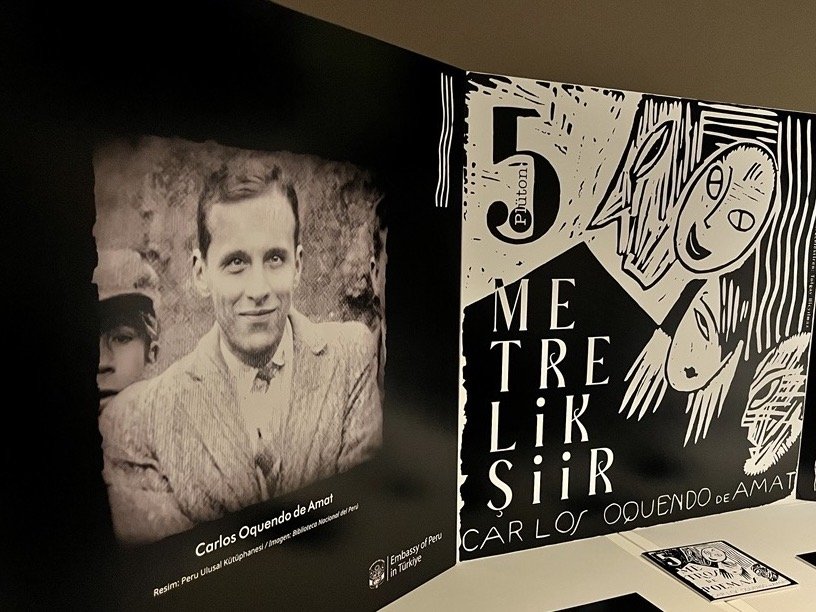
Nearly a century after its publication, Peruvian poet Carlos Oquendo de Amat's experimental poetry collection "5 Metros de Poemas" ("5 Meters of Poetry") continues to challenge conventional ideas of poetry and publishing, bringing its distinctive literary world to Istanbul through an exhibition held as part of the 4th Ibero-American Writers' Meeting.
Displayed in an intimate exhibition space, enlarged reproductions of selected pages printed on large cardboard panels framed the room, offering visitors a closer look at the work's unusual visual language and typographical experimentation. Originally published in 1927, the collection unfolds in an extraordinary 5-meter-long (16-foot) accordion format, inviting readers into a series of different emotions and worlds with every page.
Oquendo de Amat himself offered an unusual instruction to readers, asking them to "open this book as someone who peels a fruit" – an invitation that reflects the sensory and exploratory nature of the work.
The poet's only book of poems, "5 Metros de Poemas," is widely regarded as a masterpiece of Latin American avant-garde literature. Bearing the influence of European avant-garde movements, particularly futurism, the collection stands out for its experimental approach to both poetry and the physical form of the book. Despite being among the most celebrated examples of the poetic diversity of its cultural moment, it remains relatively little known to wider international audiences.
The exhibition opened with remarks by Peru's Ambassador to Türkiye, Luz Caballero, who highlighted the cultural significance of bringing Oquendo de Amat's work to Turkish readers. She described the translation as a cultural bridge between Peru and Türkiye, expressing her pleasure at seeing the two countries share and celebrate a literary heritage of such value.
During the opening ceremony, Caballero also presented an award to the publishing house's editor-in-chief in recognition of the efforts to translate the work and promote Peruvian literature in Türkiye.
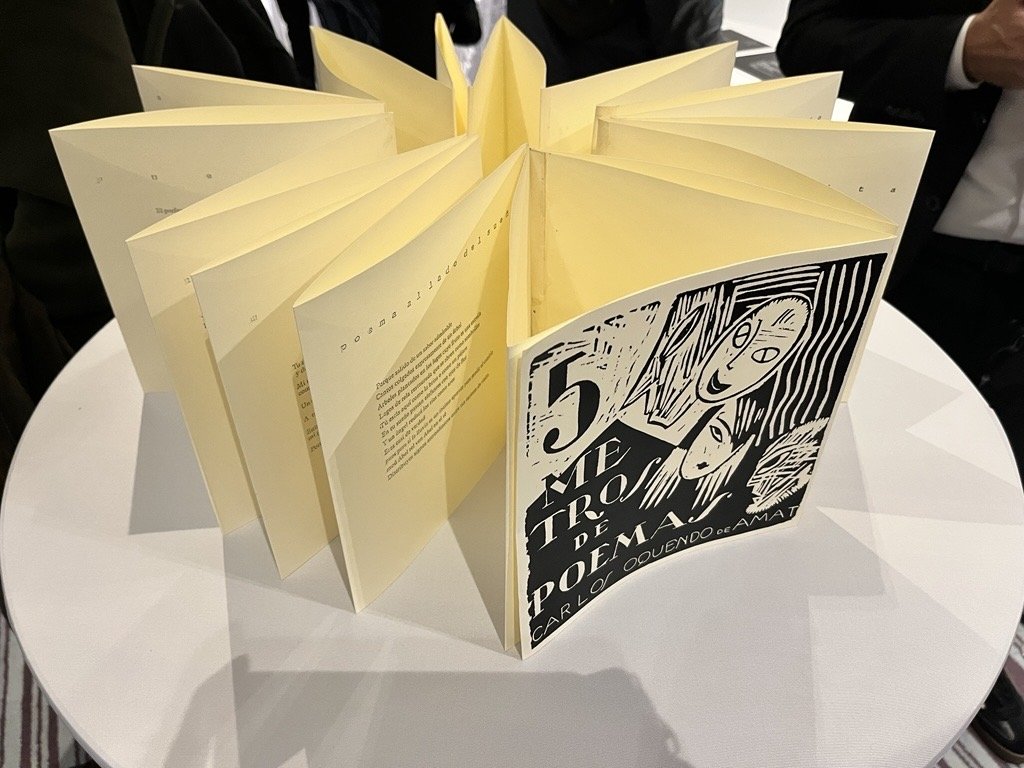
The challenges surrounding the work did not end with its original publication or translation. Even getting the book into print proved challenging, the editor-in-chief of its Turkish publisher explained, as several printing houses had turned down the project because of its unusual 5-meter-long format. The translation and publication of the work therefore required considerable effort, making its presentation to contemporary readers an achievement in its own right.
Describing the collection as a masterpiece, the editor-in-chief emphasized the difficulties of reproducing a work whose unconventional physical structure is inseparable from its literary identity.
Oquendo de Amat died at the age of 32, shortly after the publication of his only collection. Next year will mark the 100th anniversary of "5 Metros de Poemas," a work that remains strikingly ahead of its time and offers a different reading experience with every turn of its pages.
The exhibition is part of the 4th Ibero-American Writers' Meeting, taking place in Istanbul from Nov. 3-5. Organized by the Istanbul Cervantes Institute and the Embassy of Spain in Türkiye, the three-day gathering brings together writers, publishers and literary professionals from Spain, Latin America and Türkiye to discuss literature, translation and the international circulation of literary works.
The program is also supported by the diplomatic missions of several Latin American countries, including Colombia, Ecuador, Mexico, Peru, Uruguay and Venezuela, as well as cultural institutions and private-sector partners.
By bringing together voices from both sides of the Atlantic, the event aims to encourage literary exchange and strengthen connections between Ibero-American and Turkish literary communities.