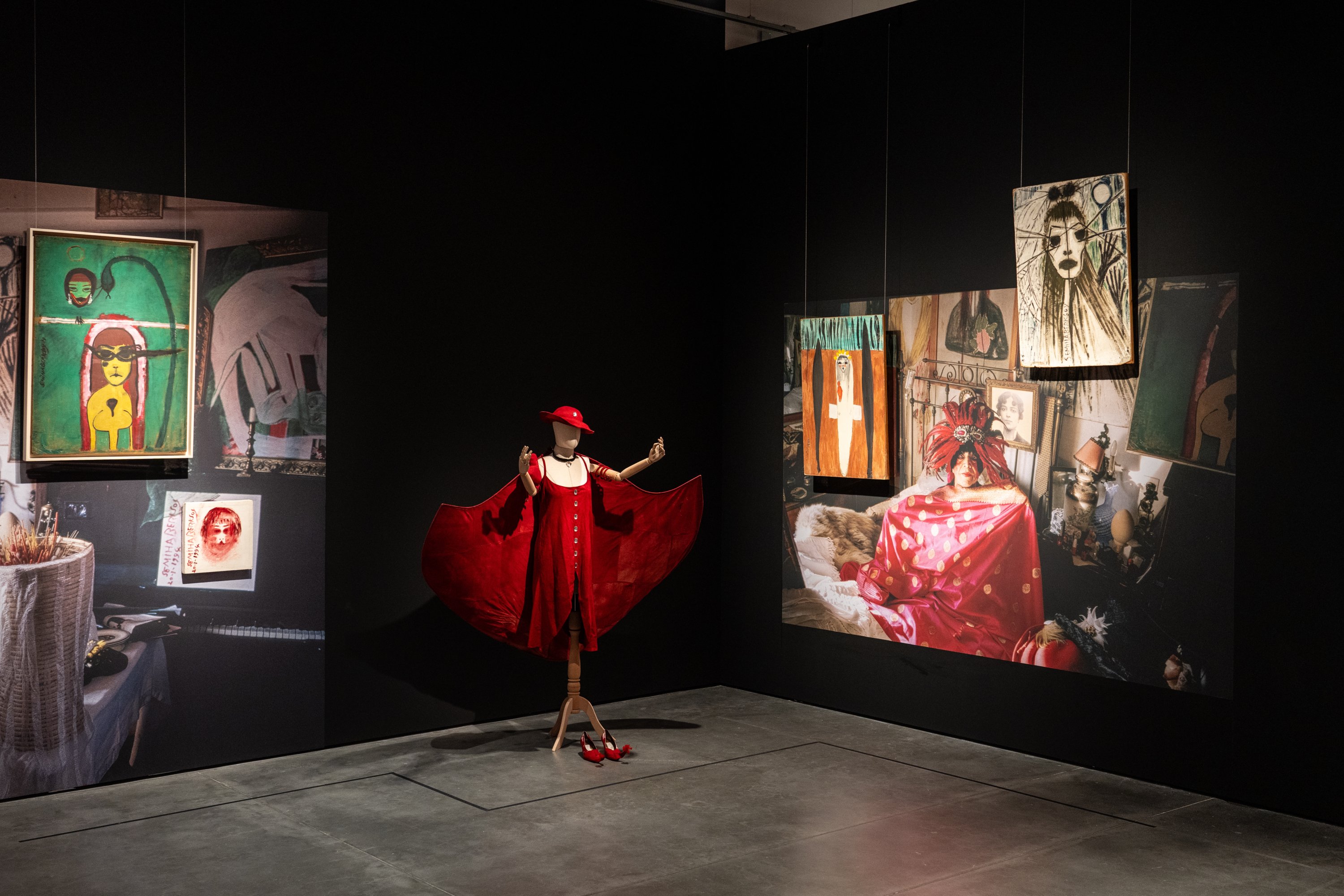
Some souls come to this world to refuse to fit neatly into history books. They spill, tremble, sing and sometimes scream. Semiha Berksoy, the artist and the first opera singer of the Republic of Türkiye, lived such a life. She did not simply pass through the 20th century as an observer or a contributor; she stood at its emotional fault lines, absorbing its ruptures into her voice, her body and her art. To encounter Berksoy today is not to meet a distant pioneer, but to come face to face with an intensity that still feels unsettlingly alive.
She was not interested in being agreeable, nor in being understood too quickly. She belonged to that rare category of artists who choose truth over comfort, expression over elegance, and presence over approval. She sang as if singing were a matter of survival. She painted as if painting were a form of testimony. Every gesture, onstage, on canvas, in letters written late at night, carried the urgency of someone who knew that silence could be fatal.
Born into a world that promised progress while quietly disciplining women into obedience, Berksoy refused to learn the art of containment. Instead, she cultivated excess: emotional, visual, sonic. She allowed her inner life, love, loss, longing, anger, devotion to surface without filters. This refusal to self-censor would cost her comfort and stability, but it would also grant her something far more enduring: an unrepeatable artistic presence that continues to speak across generations.
To write about Semiha Berksoy is not merely to recount a biography. It is to trace the anatomy of resistance, how a woman, armed with little more than her voice, her brush and her relentless sincerity, carved out a space for herself in a cultural landscape that was not built to hold her. It is to witness how art can become a shelter, a weapon, and a lifelong companion all at once.
Semiha Berksoy’s life story is often told as a list of firsts: the first Turkish woman opera singer to gain international recognition, the first Turkish soprano to perform at the Berlin State Opera, a pioneering woman painter who merged autobiography with myth. Yet to reduce her to “firsts” is to miss the point. Semiha Berksoy was not trying to open doors politely. She was trying to burn through walls. And in doing so, she became an unexpected school, a living curriculum, for generations of artists, particularly women, who would come after her.
Born in 1910 in Istanbul, at the twilight of the Ottoman Empire and the dawn of the Turkish republic, Berksoy’s life coincided with one of the most turbulent periods of cultural transformation in the region. This was a time when women were promised emancipation by law but often denied it in daily life; when modernization was celebrated rhetorically yet controlled rigidly in practice. Berksoy absorbed these contradictions into her body and voice. She did not seek harmony but instead, she thrived on this tension.
Her father, the poet and intellectual Ziya Cenap Bey, occupies a central place in her emotional universe. Their correspondence, intimate, intense, sometimes desperate reveals not only a daughter’s longing for approval but also a woman negotiating her right to exist as an autonomous artistic subject. These letters are among the most revealing documents of Berksoy’s inner life. They oscillate between affection and accusation, devotion and rebellion. In them, we see a young woman asking a fundamental question that still resonates today: Is love conditional upon obedience?
For Berksoy, the relationship with her father was both a source of strength and a wound that never fully healed. He encouraged her education, admired her intellect, yet struggled to accept the full implications of her independence, her sexuality, her ambition, her refusal to conform. This ambivalence shaped Berksoy’s art profoundly. Her paintings are filled with fathers, lovers, authority figures, and spectral presences hovering between protection and abandonment. She painted not to resolve these tensions, but to keep them alive, to insist that unresolved emotions deserve visibility.
Her decision to pursue opera was itself an act of rebellion. Opera, with its exaggerated emotions and commanding female voices, offered Berksoy a medium through which she could occupy space unapologetically. Her voice was not trained to soothe; it was trained to pierce. When she performed Wagner’s Ariadne auf Naxos or Puccini’s Madama Butterfly, she did not disappear into the role. Instead, she expanded it, injecting her own biography, her own pain, her own longing into every note. Critics often struggled with this intensity. Some praised her originality; others found her too much. Berksoy accepted both reactions as evidence that she was doing something right.
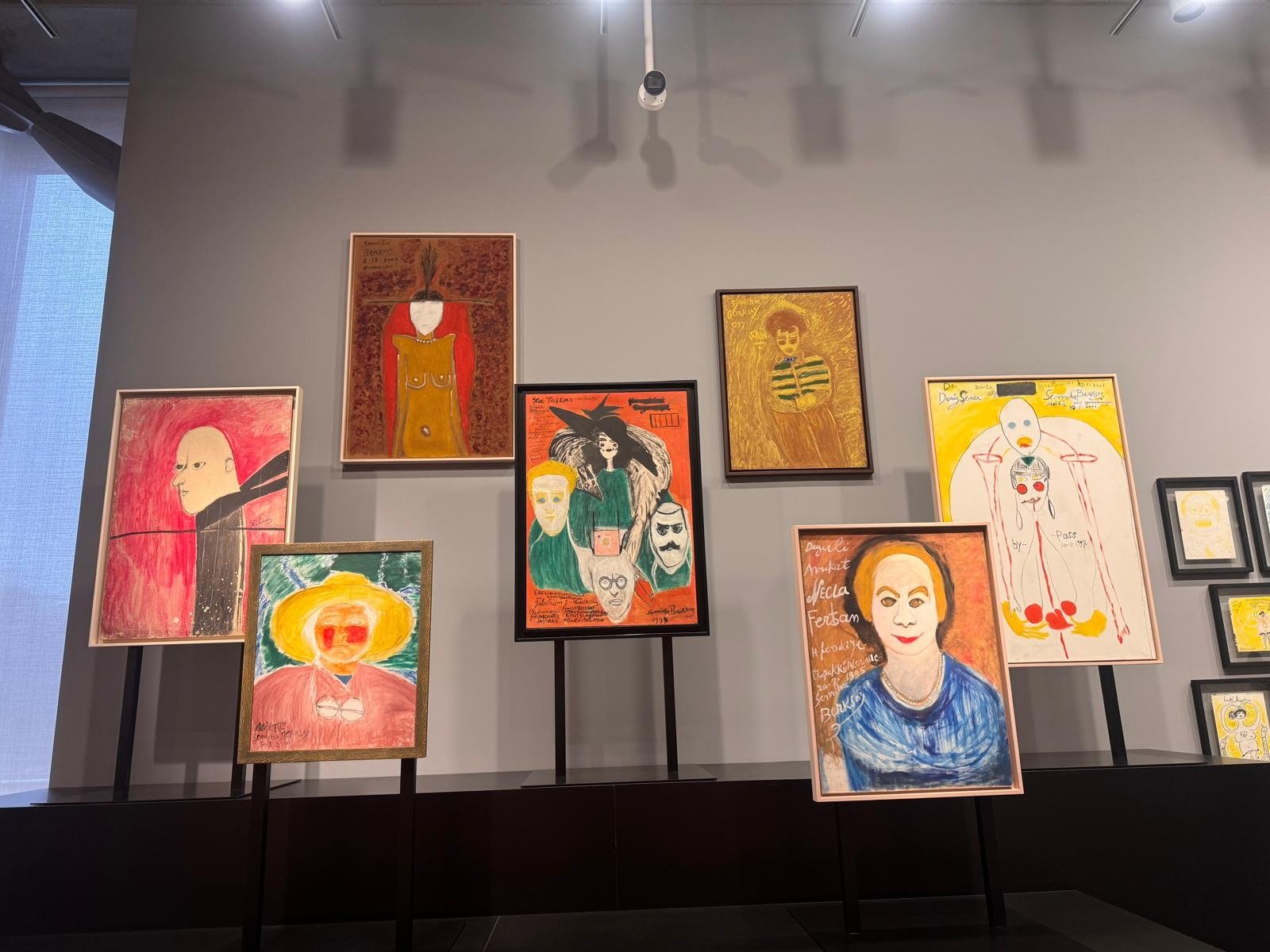
Yet to frame Berksoy primarily as an opera singer is to overlook the radical importance of her painting practice. Her paintings, often dismissed in earlier decades as “naïve” or “outsider” art, are now understood as a sophisticated, emotionally complex body of work that anticipates many concerns of contemporary art: autobiography, trauma, gender, performativity, and the body as archive. Berksoy painted herself obsessively, not out of narcissism, but out of necessity. In a world that repeatedly tried to define her, she insisted on defining herself, again and again, on her own terms.
Her self-portraits are confrontational. She stares back at the viewer with eyes that refuse submission. These are not flattering images; they are truthful ones. Berksoy painted illness, heartbreak, aging, and death with the same intensity as love and desire. She painted herself alongside historical figures, opera characters and mythical beings, collapsing time and identity into a single plane. In doing so, she rejected the linear narratives imposed on women’s lives, youth, marriage, motherhood, invisibility, and proposed an alternative: a life structured by emotional truth rather than social expectation.
To understand the radicalism of Berksoy’s work, one must consider the conditions under which she lived. Being a woman artist in early and mid-20th century Türkiye was not simply difficult; it was structurally hostile. Institutions were dominated by men; criticism was gendered; ambition in women was often read as arrogance or moral failing. Berksoy faced these obstacles not by adapting herself to them, but by refusing their authority altogether. She was not interested in being “acceptable.” She was interested in being inevitable. This refusal came at a cost. Berksoy experienced periods of isolation, financial precarity and emotional distress. She was often misunderstood, sometimes ridiculed, occasionally celebrated, but rarely supported consistently. Yet, she transformed even marginalization into material. Her later paintings, created in relative solitude, possess an extraordinary emotional density. They are works made not to please an audience, but to survive. In this sense, Berksoy belongs to a lineage of artists for whom art is not a profession but a lifeline.
What makes Berksoy particularly relevant today is not only her pioneering status, but her uncompromising authenticity. In an era increasingly obsessed with branding, visibility and marketability, Berksoy’s practice reminds us that true artistic power often emerges from refusal rather than compliance. She did not cultivate an image; she lived a truth. She did not seek validation; she sought expression. This is why she continues to function as what might be called an idol school, not an institution with walls and syllabi, but a living example that teaches by existence.
Generations of artists, particularly women, have looked to Berksoy not for stylistic imitation, but for permission. Permission to be excessive. Permission to be emotional. Permission to fail publicly. Permission to prioritize inner necessity over external approval. In this sense, Berksoy’s legacy is pedagogical in the deepest sense: she teaches not how to make art, but why.
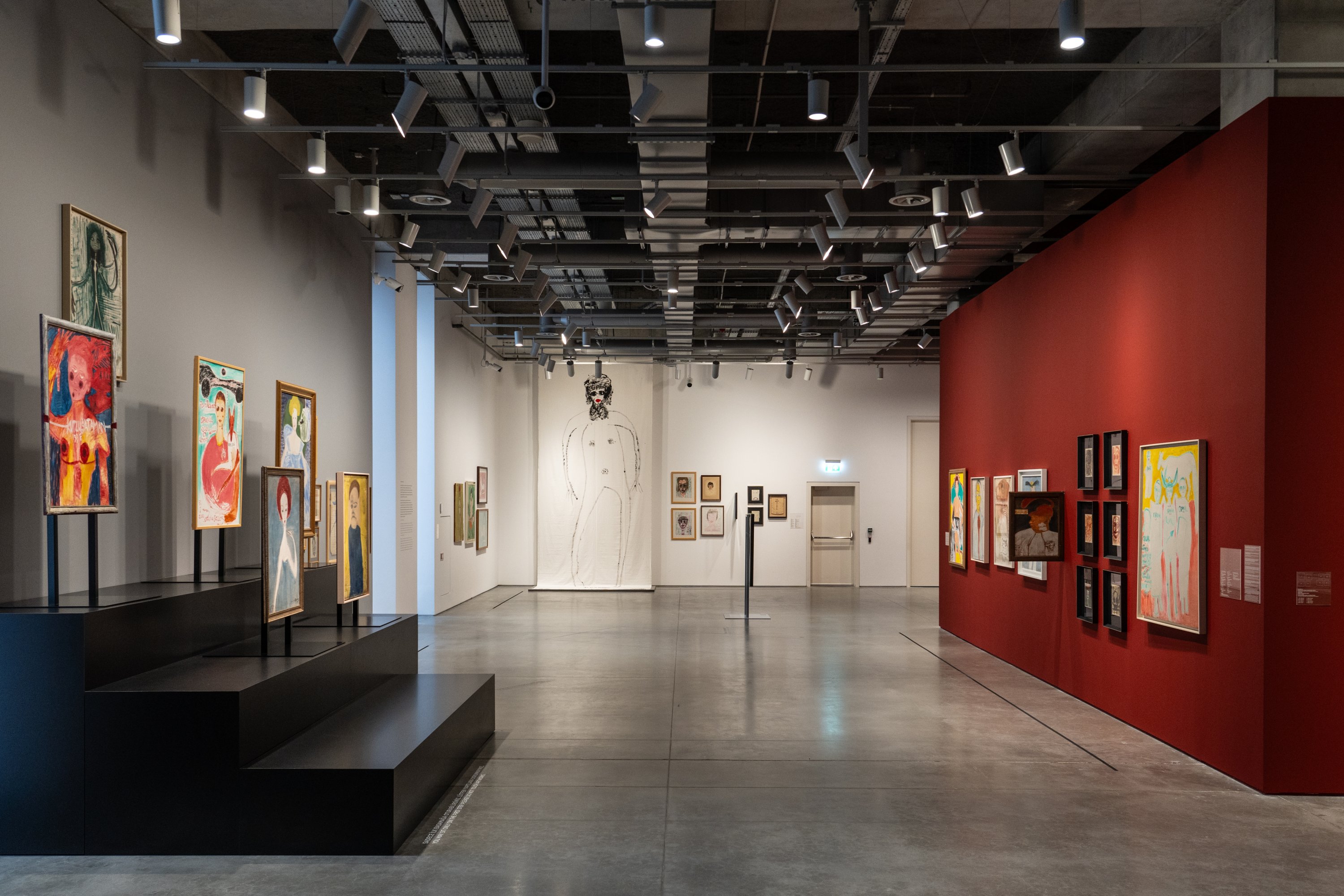
This legacy was powerfully reaffirmed through the landmark exhibition at Istanbul Modern, which brought Berksoy’s paintings, performances and archival materials into renewed conversation with contemporary audiences. The exhibition did not attempt to sanitize or canonize her. Instead, it embraced the contradictions, the excess, the vulnerability that defined her practice. Visitors were invited not merely to observe Berksoy, but to encounter her to feel the intensity of a life lived at full volume. Within the institutional space of Istanbul Modern, Berksoy’s work functioned almost as a disruption. Her raw, confessional paintings resisted the clean lines and neutral tones often associated with museum display. They demanded emotional engagement. They asked viewers to slow down, to sit with discomfort, to acknowledge the ways in which personal history and national history intertwine. In this context, Berksoy was not presented as a historical curiosity, but as a contemporary interlocutor, someone still asking questions we have not fully answered.
Perhaps the most moving aspect of Berksoy’s legacy lies in her insistence on visibility. She made visible the emotional labor of women, the cost of independence, the beauty of vulnerability. She refused to edit herself for comfort. In doing so, she offered future generations a radical model of artistic integrity.
Semiha Berksoy did not wait for permission to exist fully. She sang herself into being. She painted herself into history. She wrote herself into the emotional archive of a nation still learning how to listen to its women. And perhaps this is her greatest gift: not a body of work to be admired from a distance, but a life that continues to challenge us, to be braver, more honest, more alive.
In the end, Berksoy’s story is not simply about overcoming obstacles. It is about redefining the terrain altogether. She did not ask how to survive within the system; she asked how to live truthfully despite it. And in that question lies her enduring power.