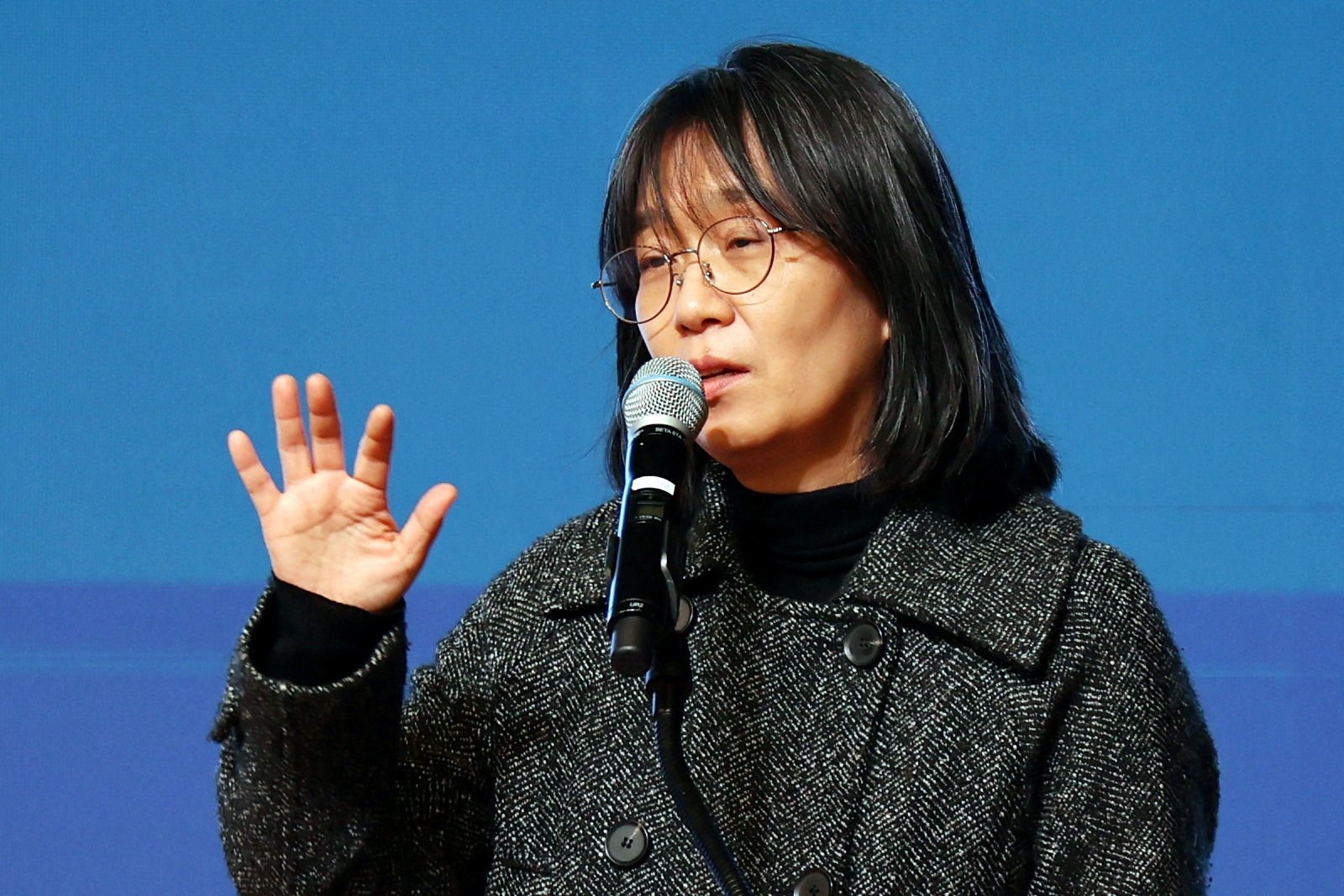
South Korean author Han Kang won the 2024 Nobel Prize in Literature for "her intense poetic prose that confronts historical traumas and exposes the fragility of human life," the award-giving body said on Thursday.
The prize is awarded by the Swedish Academy and is worth 11 million Swedish crowns ($1.1 million).
"She has a unique awareness of the connections between body and soul, the living and the dead and in her poetic and experimental style has become an innovator in contemporary prose," Anders Olsson, chairman of the academy's Nobel Committee, said in a statement.
Han Kang, the first South Korean to win the literature prize, began her career in 1993 with the publication of a number of poems in the magazine Literature and Society, while her prose debut came in 1995 with the short story collection "Love of Yeosu."
Born in 1970, she comes from a literary background, her father being a well-regarded novelist.
Han Kang won the Man Booker International Prize for fiction for her novel "The Vegetarian" in 2016, the first of her books to be translated into English and regarded as her major international breakthrough.
In "The Vegetarian," after struggling with gruesome recurring nightmares, Yeong-hye, a dutiful wife, rebels against societal norms, forsaking meat and stirring concern among her family that she is mentally ill.
Two of her books have been made into films; "The Vegetarian" in 2009, directed by Lim Woo-Seong, and 2011's "Scars," by the same director.
Her 2002 novel "Your Cold Hands," which bears obvious traces of Han Kang's interest in art, reproduces a manuscript left behind by a missing sculptor who is obsessed with making plaster casts of female bodies.
"There is a preoccupation with the human anatomy and the play between persona and experience, where a conflict arises in the work of the sculptor between what the body reveals and what it conceals," the Academy said in an official biography.
She is the second South Korean to win a Nobel prize ever, after 2000 Peace Prize winner and former South Korean President Kim Dae-jung.
Bookmaker favorites ahead of the announcement included Chinese writer Can Xue and many other perennial possible candidates, such as Kenya's Ngugi Wa Thiong'o, Australia's Gerald Murnane and Canada's Anne Carson.
"I was able to talk to Han Kang over the phone," Mats Malm, Permanent Secretary of the Swedish Academy, said at a news conference. "She was having an ordinary day, it seems; she had just finished supper with her son," he said.
The literature prize is the most accessible of the Nobels for many and, as such, the Academy's choices are met with praise and criticism, often in equal measure.
The Academy's omission of literary giants such as Russia's Leo Tolstoy, France's Emile Zola and Ireland's James Joyce has left many book-lovers scratching their heads over the last century.
The 2016 prize award to American singer-songwriter Bob Dylan was hailed as a radical rethink of what literature is, but it was also seen as a snub to authors in more traditional genres. The prizes for achievements in science, literature and peace were created through a bequest in the will of Swedish dynamite inventor and businessman Alfred Nobel. They have been awarded since 1901, with the final prize in the line-up – economics – being a later addition. After peace, the literature award tends to garner the most attention, thrusting authors into the global spotlight and yielding a spike in book sales that can, however, be relatively short-lived for authors who are not household names.
Even so, the prize money and a place on a list that includes luminaries such as Irish poet W.B. Yeats, who won in 1923, American novelist Ernest Hemingway, who took the award in 1954 and Colombia's Gabriel Garcia Marquez, winner in 1982, is an appealing proposition. Norwegian author and dramatist Jon Fosse won in 2023. The fourth award to be handed out every year, the literature prize follows those for medicine, physics and chemistry announced earlier this week.