Some things exist quietly amid the rush of everyday life; they do not raise their voices, but when touched by the eye or the skin, they suddenly transport us to a completely different time, a completely different feeling. Calling them “objects” falls short; they are narratives, invitations. Lumoths is such a narrative, an artistic endeavor aiming not to dress fashion but to clothe memory.
Lumoths transforms aesthetics into a language that appeals not only to the eye but also to the soul, bringing fashion, art and nature together on a common ground. Named after the Luna Moth, a creature that navigates the night solely by following the light, the brand offers an ode to intuition, memory and slowness in contrast to the speed and superficiality of contemporary life. Each piece is like a call to pause: look, feel, remember.
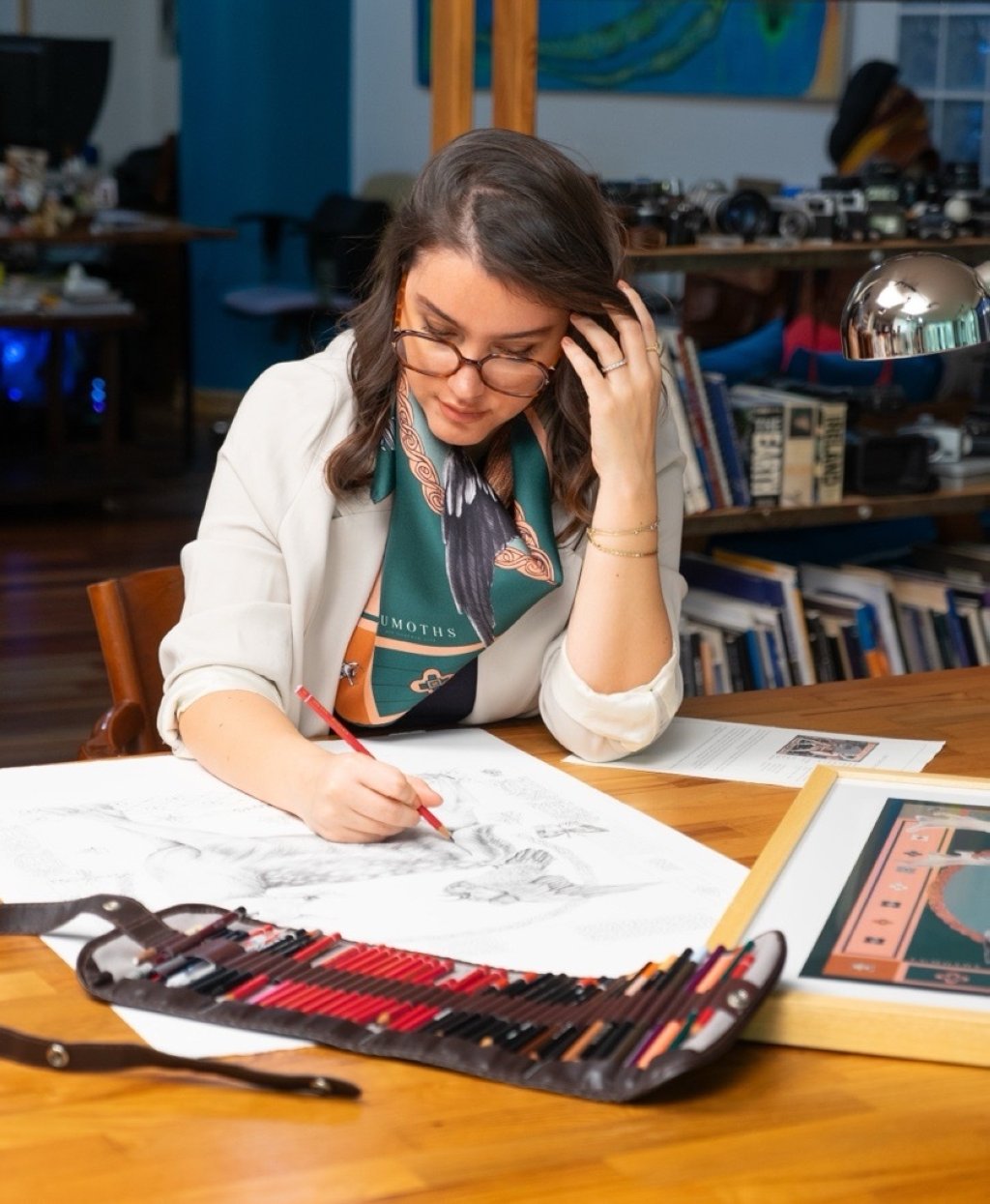
Every design emerging from the hands of Lumoths’ founder and artist, Funda Gülay Cengiz, is not merely a visual form but an expression of a memory, a feeling or perhaps a silence. Illustrations shaped with traditional charcoal techniques are directly applied onto natural silk. This tactile encounter between charcoal and silk creates a timeless and delicate aesthetic. Each design takes approximately six to eight weeks to materialize; the charcoal drawing and completion stages alone require four to eight weeks of meticulous work.
Cengiz’s journey with art began at a very young age. Her passion for drawing, which started around the age of 8 or 9, culminated in graduating top of her class from the Fine Arts Painting Department in high school. After completing an associate degree in Glass Design at Anadolu University, she graduated first in her class from Işık University’s Textile and Fashion Design Department. In 2011, she embarked on a professional career as a fashion designer, holding significant roles within the women’s design departments of prestigious brands.
However, her desire to create a unique space to reflect her inner world led her to establish her own personal brand, Lumoths. After an intense and demanding corporate career, she took a brief pause to patiently and carefully build the foundations of Lumoths in a calmer rhythm. “Sometimes you need silence to listen to your inner voice and take confident steps,” says Funda Gülay Cengiz, explaining how Lumoths was born from this inner tranquility, rising delicately on the fine line between design and art.
Her interdisciplinary education and unique perspective that merges art with fashion design add both technical mastery and emotional depth to every piece Lumoths produces. Her works are not mere surface beauty; they are time capsules woven with years of experience, patience and passion.
But here, the issue is not form but thought. Lumoths transforms wearable objects into fields of narrative. Each scarf functions less as a style suggestion and more as a map of an inner world. Sometimes shaped by a farewell, sometimes by a depiction of nature or a mythological reference, these pieces turn the wearer into a narrator rather than just a spectator. Fashion here is the language, but the story told is different: respect for nature, trust in intuition, attachment to the past and longing for timelessness.
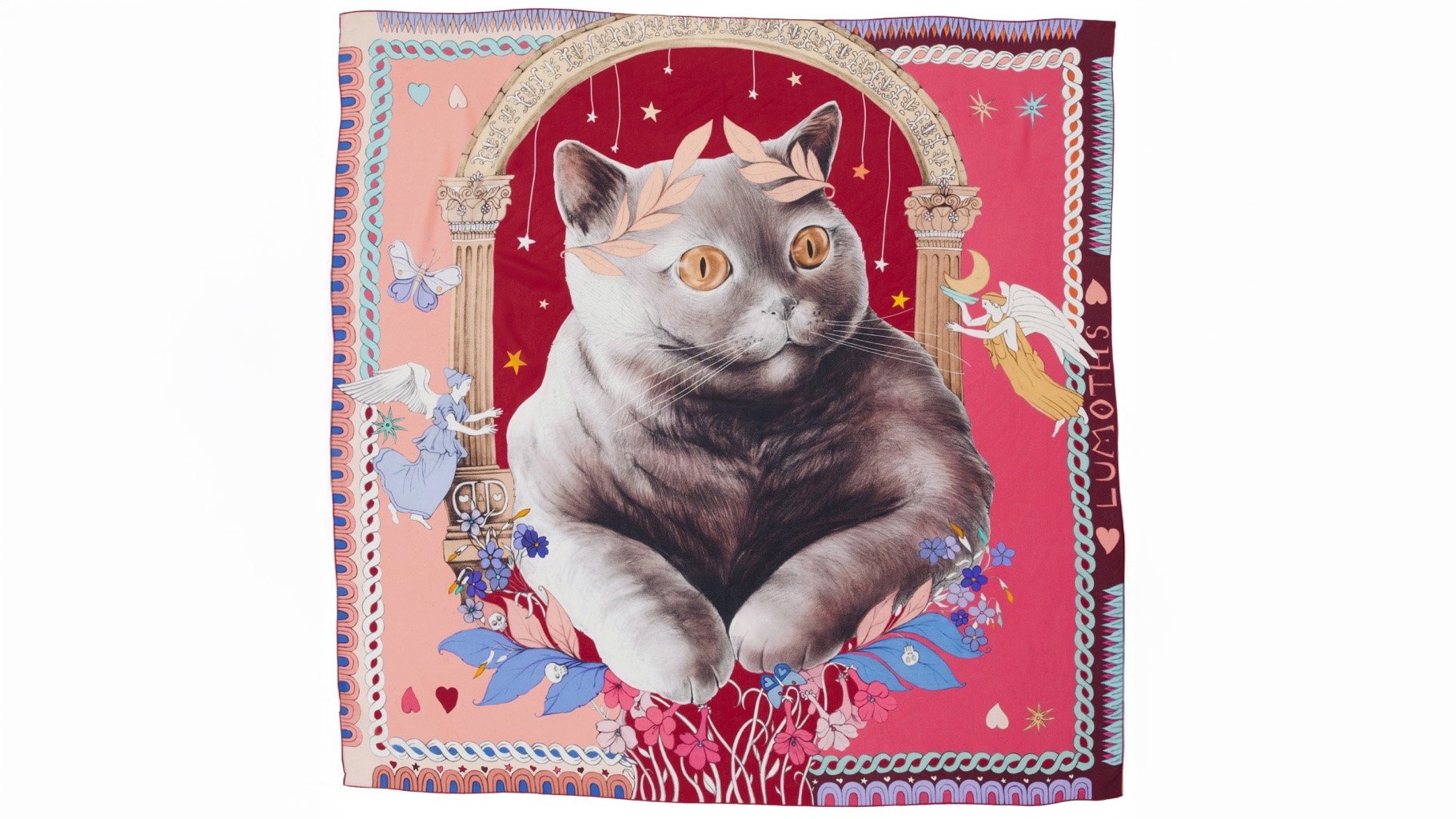
One of Lumoths’ most poignant collections, “With Love to Duchess,” reveals the emotional depth at the heart of the brand in all its rawness. Created in memory of the artist’s cat Duchess, who shared her life and bore witness to her days, this collection weaves not the emptiness felt after loss but the imprint left by presence itself.
The elegance of the British Shorthair merges with the dynamic and emotive lines of Roman aesthetics. Under a starry sky adorned with flowers in a dreamlike scene, the pieces quietly ask: What is love? How does loyalty appear? And how can a being leave an impact even after disappearing?
Drawn with charcoal, these illustrations speak not in words but through textures, spaces, and details. The scarves are not mere accessories; they are embodied memories, poems written in fabric.
Looking back through art history, fabric has been one of humanity’s oldest canvases. From ancient times to today, silk has symbolized not only luxury but also cultural transmission. Lumoths reinterprets this tradition for the contemporary era. But here, it’s not just silk being patterned; meanings embedded in time, space, and memory are woven in.
Cengiz’s multidisciplinary approach does not confine Lumoths’ aesthetic boundaries; rather, it continuously reconstructs them. From fashion design to painting, from glass art to illustration, her creative practice ensures that each piece is not only beautiful but also thoughtfully and emotionally realized.
In today’s fashion world dominated by speed and mass production, Lumoths stands apart as a form of resistance through slowness. Each piece, produced in limited quantities at local ateliers with synthetic-free, eco-friendly materials, emphasizes uniqueness. This approach carries not only environmental but also cultural sensitivity. Every design bears the imprint of a hand, every scarf reflects a soul. Therefore, each Lumoths product is far more than a fashion object: it is a narrative, a stance, an ethical position.
The “With Love to Duchess” collection invites us to reconsider the boundaries of visual art. Does art exist only in galleries, museum walls or within frames? If an illustration, a pattern, or a scarf can pose the same questions and evoke the same feelings, is there any reason not to call it art?
Here, the issue lies less in the object itself and more in the meaning it carries and the connection it creates. Every line appearing on fabric is not merely an aesthetic choice; it is a record of a feeling, a trace of a memory. Moreover, this trace is not meant only to be seen, but to be carried, worn, lived.
Wearable art interacts with time. It does not stay in a closet but moves through streets, cities and our lives. Thus, “With Love to Duchess” is not just a collection; it is a narrative embodied close to the body. It is a method to remember, tell and transmit.
Lumoths’ approach redefines fashion not merely as something to consume but as something to feel, contemplate and perhaps preserve. At this point, the brand itself becomes a vehicle of expression, but it speaks not with the voice of an advertisement, but with the whisper of a poem.
Because sometimes wearing something is telling a story. And the simpler, more sincere, and more heartfelt that story is, the more it touches people. Lumoths stands exactly at this point where it is not the worn object but the emotion carried together with the wearer that gains meaning. And it reveals its true power by hiding it beyond words, in the depths of silence and grace, just like most of the most compelling works of art.