From Nov. 11 last year until Jan. 30 of this one, the Afyonkarahisar Museum had a temporary exhibition on the Mevlevi tradition in Afyonkarahisar, the tradition that follows in the footsteps of the great 13th-century Sufi mystic and poet Jalaluddin Rumi, also known as Mevlana, and which is famed worldwide for its whirling dervishes. I only got to learn of and see this exhibition just before it came to an end, which is not ideal, as it means that by the time this piece comes out, it will be over. However, it had not too much to add to its permanent exhibition space dedicated to Rumi and the Mevlevi Order, and, what is more, all of the information on the panels which formed the bulk of the exhibition, was given solely in Turkish, whereas upstairs in the permanent exhibition, which can obviously be visited any time, everything is given in both Turkish and English.
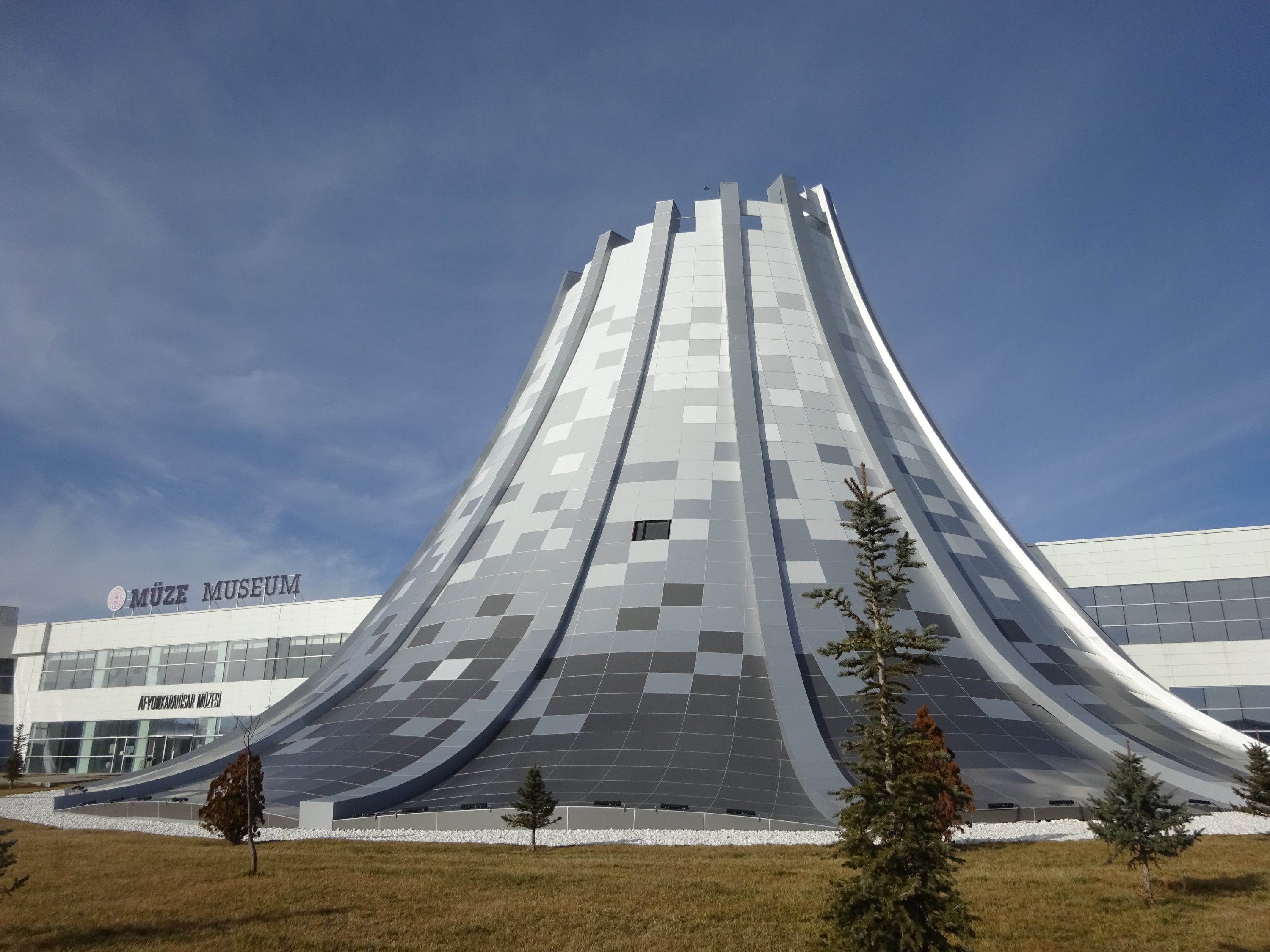
The museum, which is located some way to the west of the urban center of Afyonkarahisar, is easily recognizable by its huge concave grey cone that reaches up into the sky. This is not merely some distinctive form of roofing, but itself contains exhibit space in addition to that of the ground and basement levels. On the second floor, within this cone, there is a part of the Ethnography Section dedicated to Rumi and the Mevlevi Order. Yet, this cone may have even more of a connection with Rumi than that, for an official connected to the museum told me that the cone represents the rock-sited castle which dominates the city and from which Afyonkarahisar derives its name, in addition to representing the flared, flowing robe of a whirling dervish.
The temporary exhibition on the Mevlevis in the Afyonkarahisar Museum, as I have already mentioned, was mainly made up of information panels. One panel shows why Rumi, born in Balkh in what is now Afghanistan, was ever in Anatolia. For he was a refugee from a troubled region, and a large map showed the peregrinations taken by him and his father through the Middle East. Konya will forever be inextricably linked with the story of Rumi, for it is there, of course, where he finally settled, where he wrote his poetic masterpieces, most notably the Masnavi and where, following his death, a tomb was built over his grave, a tomb that nowadays attracts visitor numbers in the millions annually.
Yet, I have long wondered whether, having completed such an arduous journey to get to Konya, Rumi forever forsook the road, or whether he took occasion to visit relatively nearby cities, including Afyonkarahisar itself. Today, it is only a three-hour journey from Konya to Afyonkarahisar, indeed either city can be visited from the other on a day trip, but back in his time, such a journey would require a number of days, and, but for need, may well have seemed unnecessary to undertake.
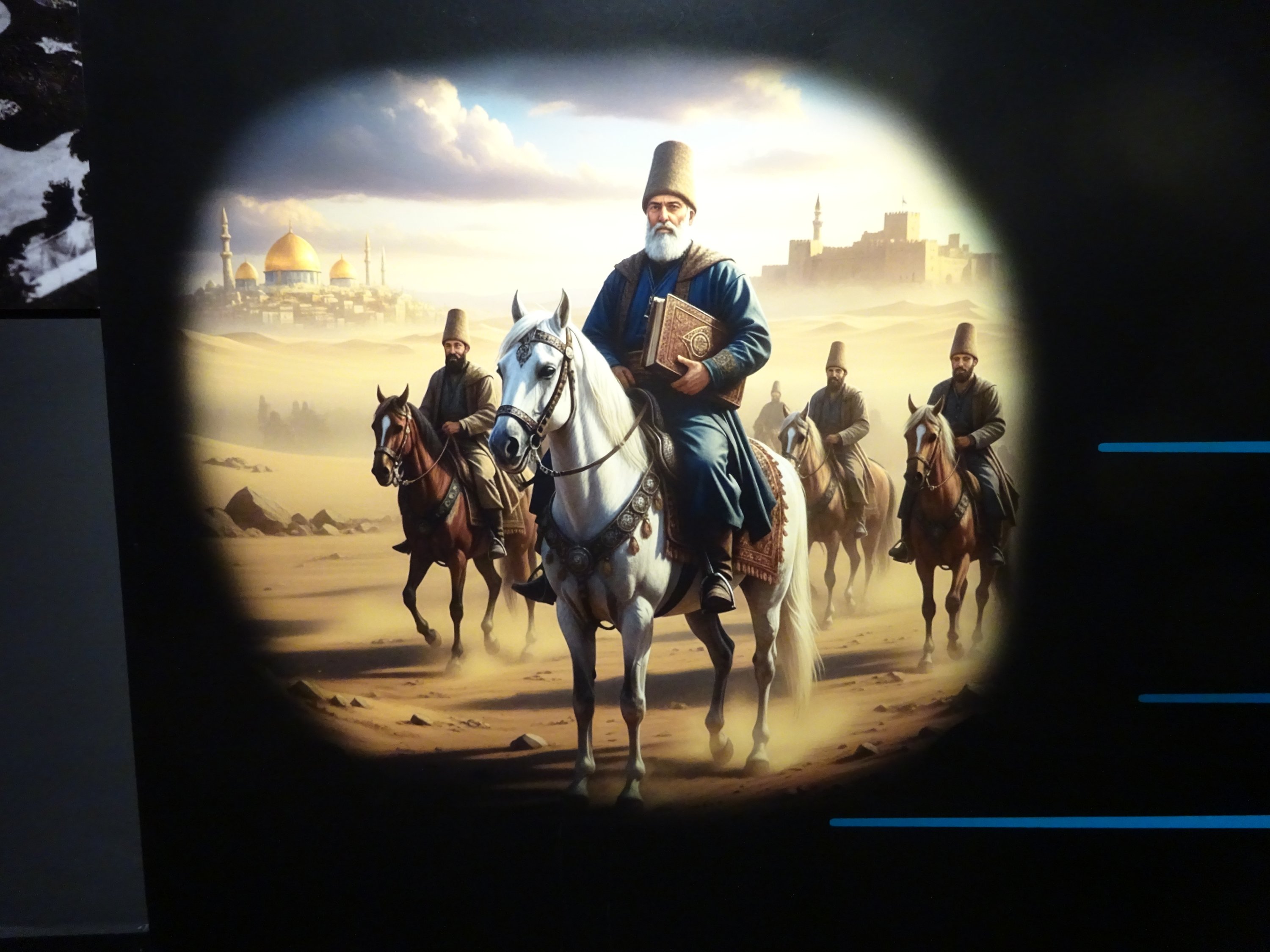
The temporary exhibition, however, reveals that Rumi may have actually visited Afyonkarahisar, and that at the invitation of the commander of the city’s iconic castle. Supposedly, Rumi was invited with his two sons, Sultan Walad and Alaadin Chelebi, who were around 6 or 7, and given the ceremony of circumcision there. Additionally, during this supposed visit to the city, Mevlana became well known to both the high dignitaries and the common people of Afyonkarahisar.
Nevertheless, this is information that is not provided on the information board in the permanent exhibition upstairs. There, it merely states that “Rumi had relations in this region while he was alive,” although to be fair, what the temporary exhibition mentions about his visit is not stated as a certain historical fact. Whatever the truth of the matter, the permanent exhibition makes the closest personal connection between the person of Rumi and the city of Afyonkarahisar, as Rumi’s son, the aforementioned Sultan Walad, who, as “the real founder and master of the Mevlevi Order,” is revealed to have made a visit to Afyonkarahisar and whose daughter married into the ruling family there. Whether or not Sultan Walad was returning to the place of his circumcision will have to remain purely speculative. Another issue that is unclear is whether, on the visit of Sultan Walad, an actual Mevlevihane, that is a lodge dedicated to the Mevlevi rites, was established in Afyonkarahisar at the time.
The Mevlevi lodge of today in Afyonkarahisar is thought to have been established in 1316, a few years after Sultan Walad’s death. This lodge was the first such purpose-built place for Mevlevi ritual outside of Konya itself. The claim is made in the temporary exhibition that due to the standard of the Afyonkarahisar Mevlevihane in terms of knowledge, education, literature and art, it was second only to Konya in significance for the Mevlevi Order. The permanent exhibition also reveals that the "postnişin," which is the highest rank in a Mevlevihane, of many other lodges were educated at the one in Afyonkarahisar.
Unfortunately, from the information provided, I was unable to ascertain when the original wooden building was transformed into the stone one that exists today. It was almost certainly in the late Ottoman period, though. The Mevlevihane is revealed to have suffered from one of the intermittent plagues of urban life in the Ottoman Empire, that of urban fire, which damaged it on several occasions. It is thought that it was while it was being repaired, the building was enlarged, and changes were made to it.
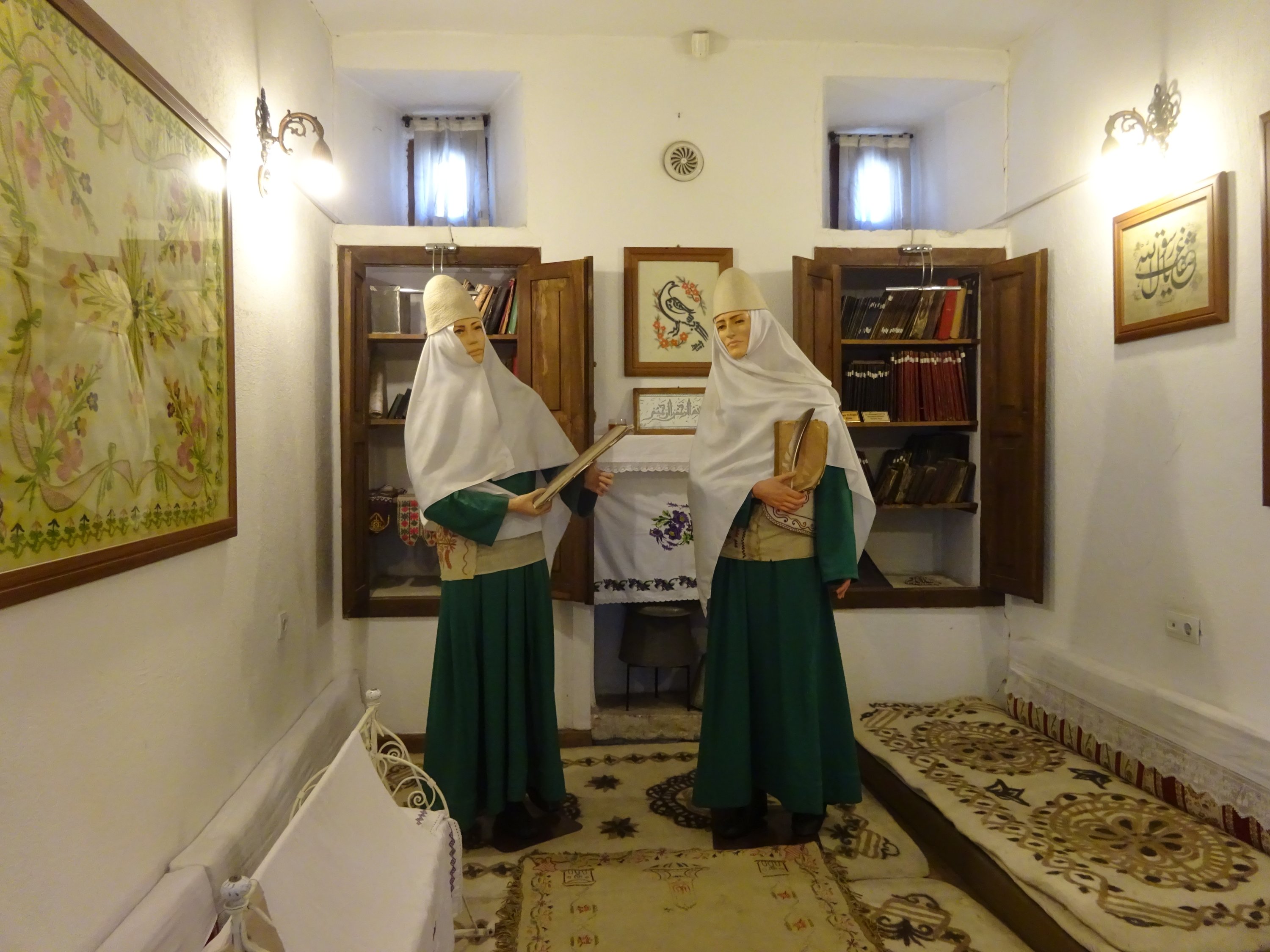
For instance, repairs were made by the ladies Destina and Güneş, who themselves held the post of postnişin, one that was not reserved exclusively for men. Then, in the time of Sheikh Mehmed Rashid Chelebi, the building was renewed. In 1844, so the Mevlevihane could also be used as a mosque, the addition of a brick minaret and a mimbar was planned. A rebuilding of the Mevlevihane was also commenced in 1903 and completed in 1908. However, the new Republican law that banned the use of dervish lodges put the building out of operation as a Mevlevihane in 1925. Today, it is used as a mosque.
As for the permanent exhibition on Rumi and the Mevlevi Order, the information available there includes two engaging tales connected with Mevlana and his father, to which enlarged reproductions of Turkish miniatures have been appended. As for the Mevlevi order itself, the visitor learns how serious a process of initiation into it was. The applicant would be subjected to a training period of 1,001 days during which they were responsible for the humble tasks of carrying firewood, keeping the floors swept and the toilets clean, as well as the lighting of the lamps. Only after having completed this 1,001-day initiation, would the novice then become a "hücrenişin," a devoted member of the lodge.
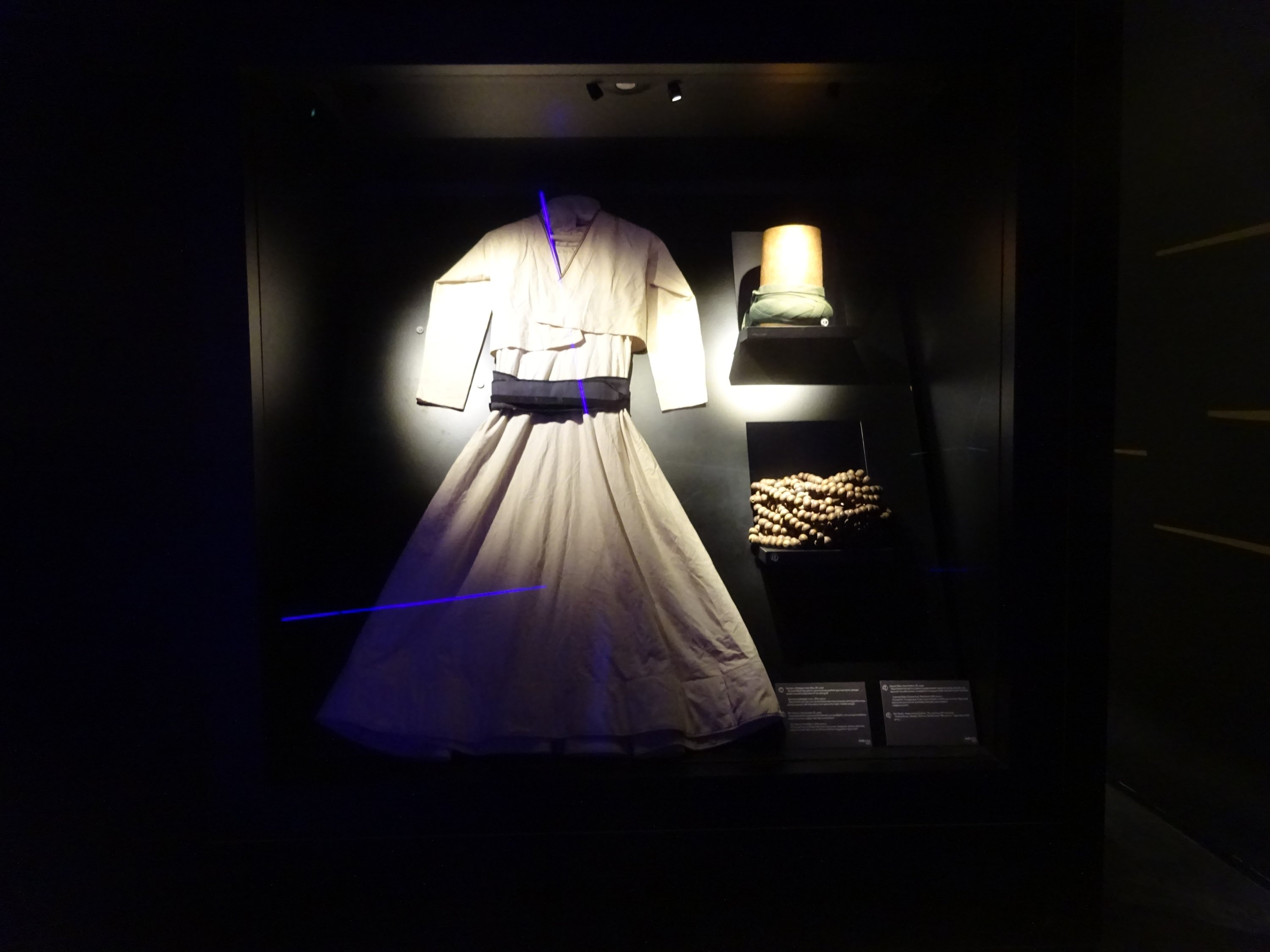
In terms of Mevlevi items, the most impressive in the permanent exhibition is the large display case in which one can see the full white robe of the Mevlevi dervish fully laid out, along with the famed slightly elongated beige felt hat and an enormous tesbih, or string of prayer beads. In other display cases, there are, among other items, gigantic ladles, one of whose ends is perforated like a colander, which the dervishes used in their kitchen, an elegant censor for the burning of incense, and the musical instruments, namely the kundum drums, the halile cymbals and the ney flute that the dervishes used in their rituals.
The Afyonkarahisar Museum is not the only place in the city in which Mevlevi items can be seen, however. And the museum, for a visitor without their own transport, may be a little difficult to get to, though it is served by public transport. In the heart of Afyonkarahisar itself, though, the Mevlevihane celebrated in the museum still stands today. Its official name is the Sultan Divanı Tomb Mevlevi Mosque and as this name suggests its central building is both a tomb and a mosque, yet its surrounding buildings, similarly to those at the Tomb of Rumi in Konya, are used as a museum on the Mevlevi Order, a museum which opened in 2008, under the name of the Sultan Divanı Mevlevihane Museum Afyon.
Through the entrance to the mosque courtyard, the first part of the museum is to the left. This is a large room, but the least adorned in the museum. Indeed, it has the air of a storeroom, which is suitable in that it literally stores while displaying items of interest concerning the Mevlevi Order in Afyonkarahisar. For instance, in this room, there is a handwritten copy of the "Masnavi." In addition, hung on its walls are old black-and-white photographs that enable us to see actual dervishes of the late Ottoman period, in their traditional garb, with actual examples of this clothing in the display case below.
There is also a framed piece of calligraphy that reads “Ya Hazreti Mevalana” – meaning “O Your Holiness Mevlana” – and which is dated to 1324 of the hijri Islamic calendar, corresponding to 1906-7. This is a tasteful and apt piece of calligraphy, it being simple golden writing offset against a background of dark blue, yet the calligraphy itself seems to have a grace of movement to its letters, which can be thought to reflect that of the swirl of a dervish in their revolution.
As for the main building, the two pyramid domes over the entrance indicate its role as a tomb as well as a mosque. For it contains the graves of important dervishes, the most prominent of them being that of the seventh-generation descendant of Mevlana, Mehmed Semai, the sultan divanı of the name of the mosque and the museum. The graves, like the ones in the Tomb of Rumi at Konya, are surmounted by headstones with the felt Mevlevi caps and, in some cases, a slightly tight turban, though the one for Mehmed Semai has a turban of enwrapped splendour. The graves are also covered in cloth embroidered with religious writings.
Back over on the side of the museum, there is a map on the wall that shows Mevlevihanes across the whole of the Ottoman Empire, from Hungary in the north, to the Hijaz in the south and one in Cairo in Egypt, demonstrating that the movement spanned three continents, although the greatest concentration of the lodges seems to have been in western and central Anatolia.
Then the first of the rooms of cells is that of the postnişin. This is a very tastefully decorated light room with white felt carpets embroidered with brown and gold geometric patterns on the floor and on two raised divan structures. The postnişin mannequin is suitably dressed in the Mevlevi garb, and his seniority, wisdom and gravitas are conveyed not only by his full grey beard, but also that he is lost in contemplation whilst telling his tesbih.
The next cell, though narrower, is similarly decorated. Indeed, all the cells are decorated much like the first one. This is the cell of a hücrenişin. His mannequin is suitably dressed in the Mevlevi garb and sits in front of rahle – a foldable wooden support upon which to place holy books – from which he seems to have briefly turned aside from the text to gather his thoughts.
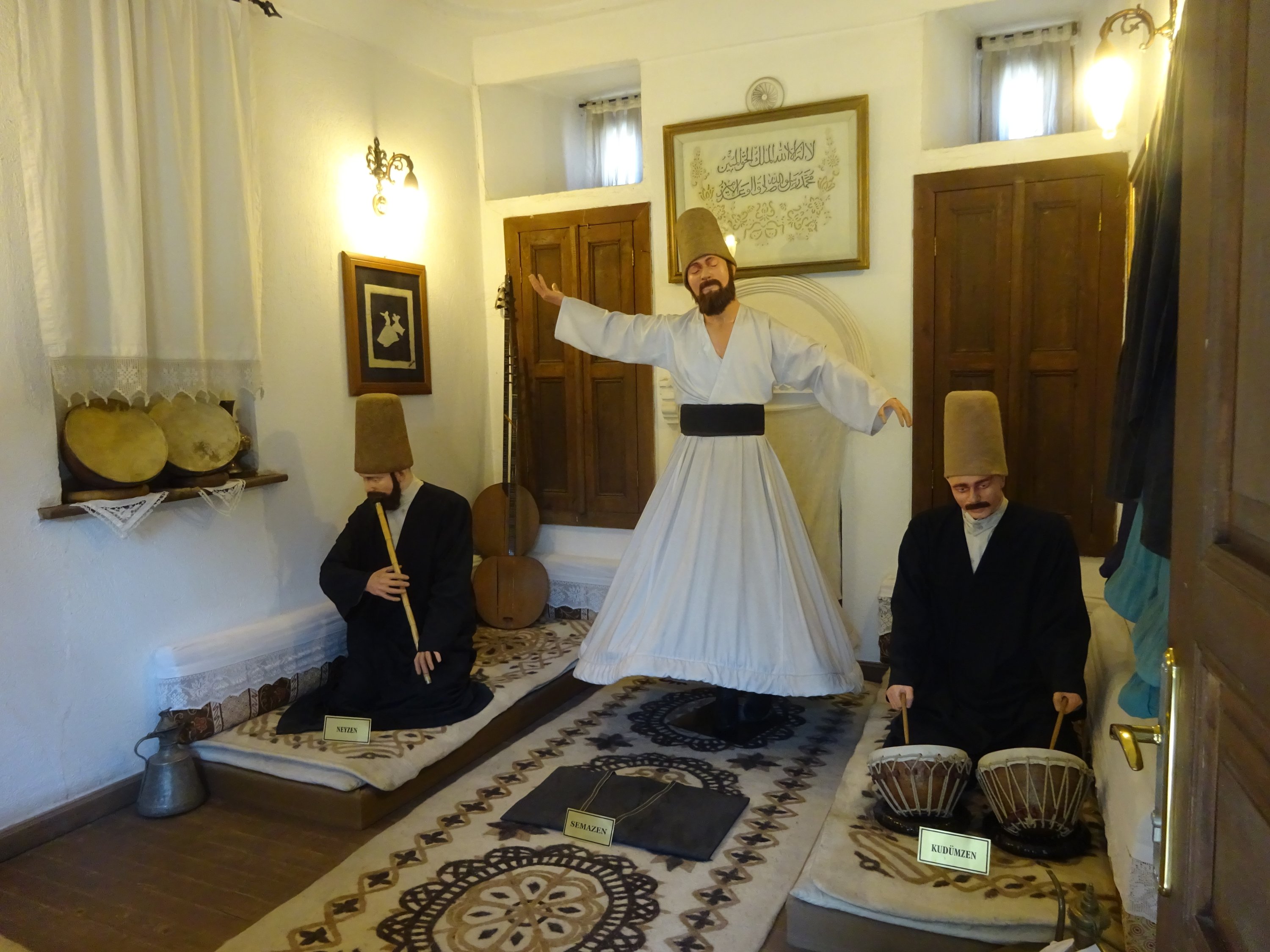
The next cell has a collection of mannequins, including one that the visitor would surely be expecting to see. Between two dark-robed dervishes playing the ney and the kundum is a whirling dervish in white, hands outstretched, one palm up and one down, and lost in reverence.
In the next cell, there are two dervish mannequins, one is engrossed in reading the Masnevi on the rahle in front of him, and the other is practicing "hattat," or the art of calligraphy. It is also to be noted that over the door of this room, there is a beautifully rendered Bismillah Al-Rahman Al-Rahim, the invocation Muslims make to Allah, in black on a sheep-fleece white carpet flanked by two red roses.
Then, in the next cell, there are mannequins representing the ladies Destina and Güneş mentioned above. They are modestly dressed in long skirts and with the expansive white headscarf that covers not only the head but also the shoulders. What sets them out as dervishes, though, is that atop this, they too have a light beige conical felt dervish cap. Their administrative status is represented by their holding a document and a quill pen.
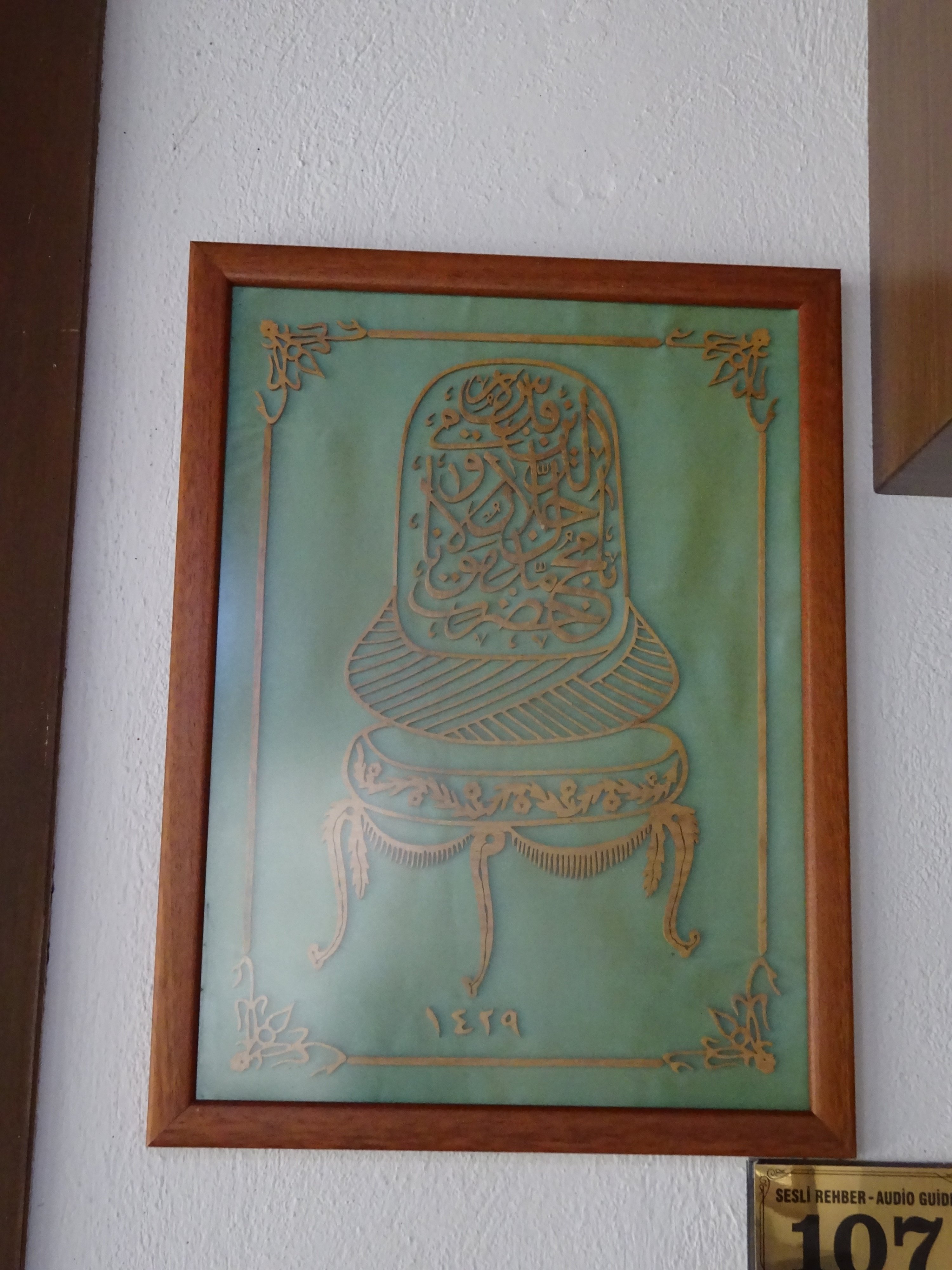
For this room, it is also worthy of note that on the wall outside the door is a lovely framed piece of embroidery, having that pleasing mixture of the simple and the ornate. As with the earlier calligraphic piece, it is also duochrome blue and gold. The design though, is of a Mevlevi cap and turban inside which is complexly woven a prayer of benediction for Mevlana.
Lastly, in the corridor, there is a collection of musical instruments similar to those in the Afyonkarahisar Museum, with the addition of the three-stringed rebab, and there are also two books, one of which is a Quran.
However, the museum is not quite complete. On the other side of the courtyard entrance, there is one extra building. On its wall, there is a plaque in English. As is sometimes found in museums in Türkiye, this English reads slightly oddly to a fluent speaker, but it adds to the information on the initiation of a novice for the Mevlevihane by stressing how they are to behave righteously to others and that “bad mouth and profanity does not come out.”
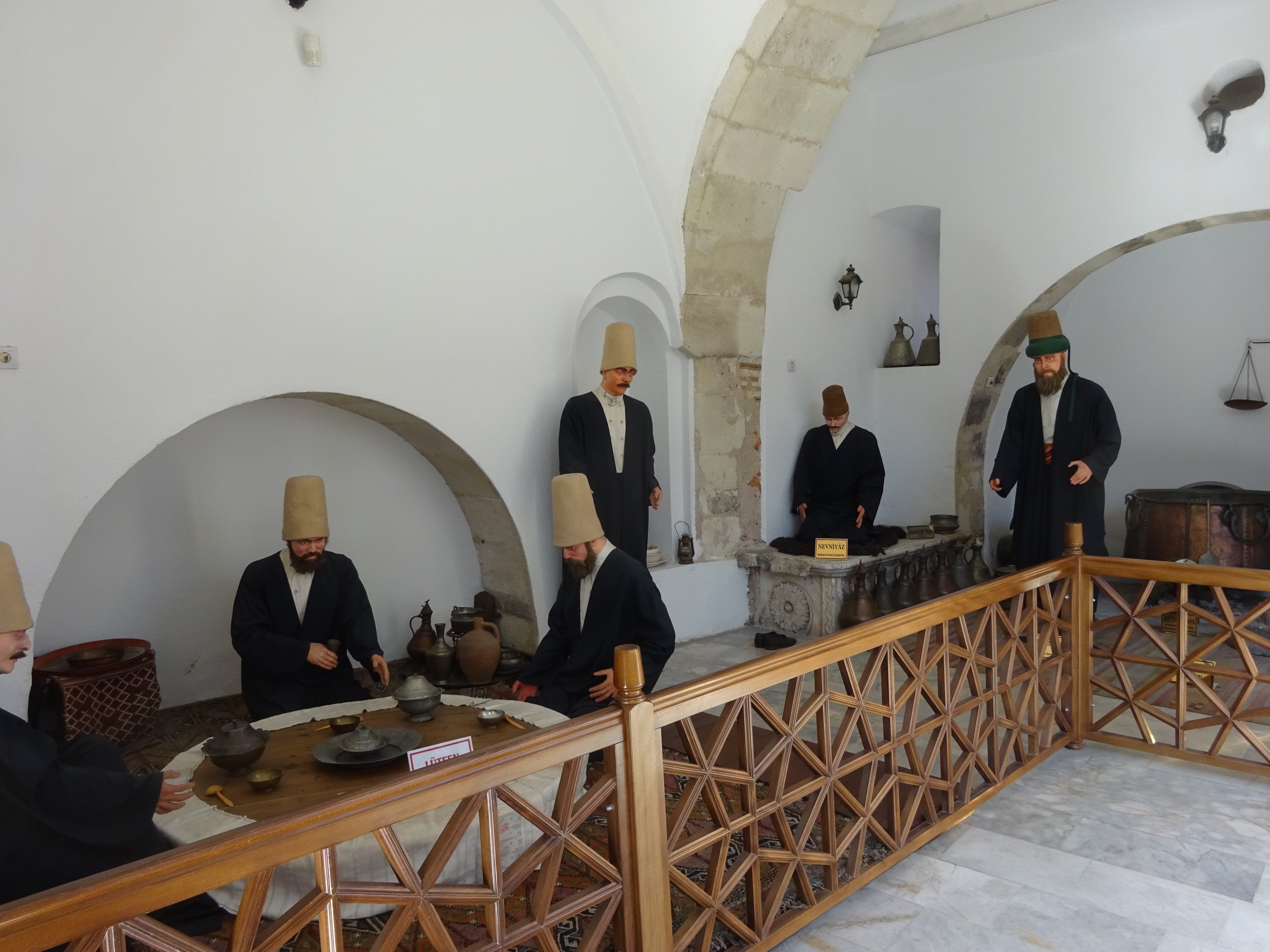
A separate sign also reveals that this room is the most important section of the Mevlevihane, and it is the kitchen. At first, this might seem odd for an order that is dedicated to at least some degree of worldly renunciation. However, the sign makes clear that the importance of the kitchen is not food-related but rather educational. It is in the kitchen that the continual education of the dervish, which lasts all their life, is undertaken. And, in this light, airy space, there are numerous mannequins of dervishes, each devoted to his own particular task.
Taken together, the exhibits in both museums provide some information and some sense of what the life of a Mevlevi dervish was like in Afyonkarahisar, and by extension, how the day-to-day life of the Mevlevi Order functioned in other places of less significance. As such, they are well worth visiting.