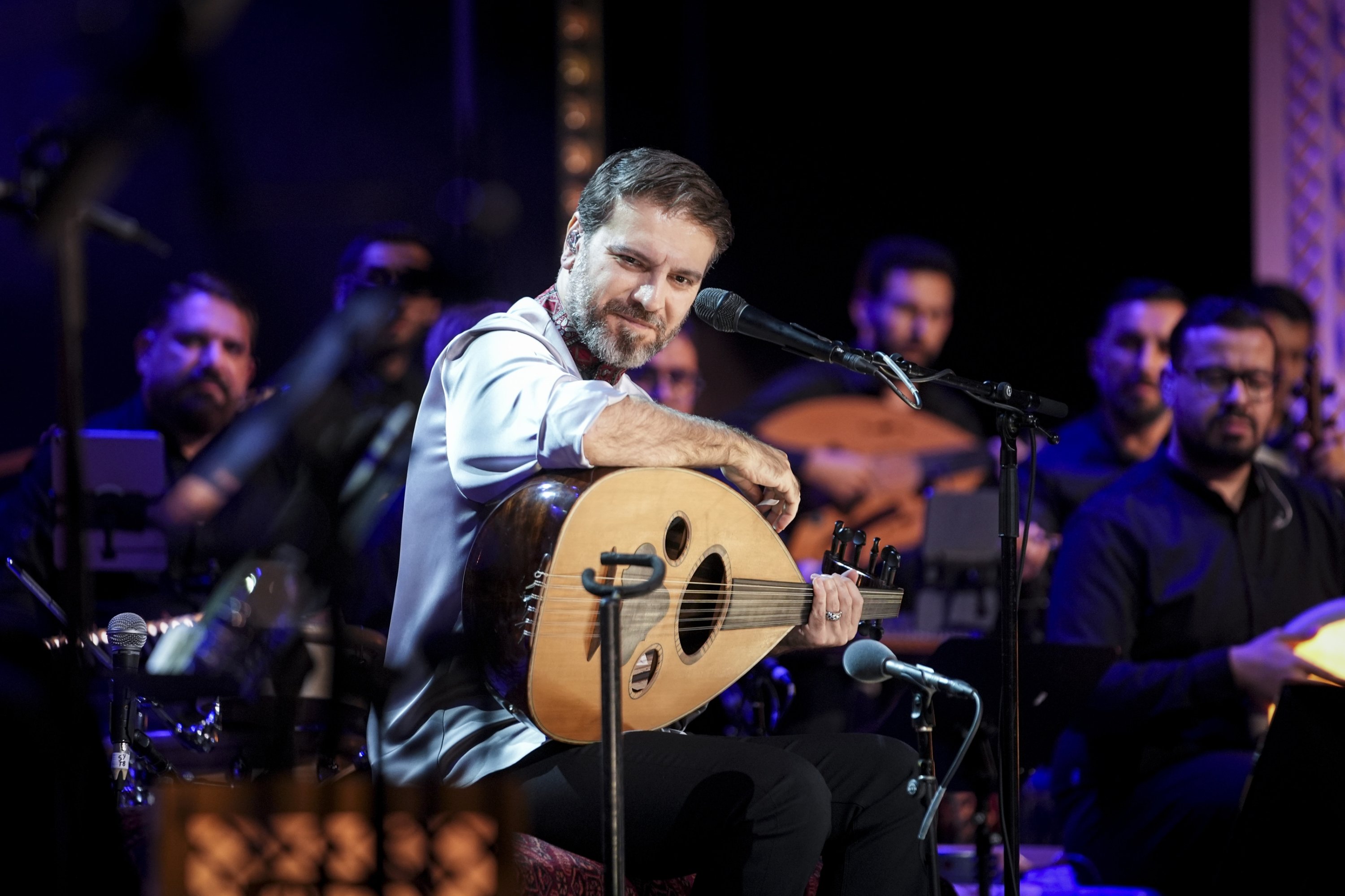
Musician and composer Sami Yusuf, known for albums including “Hasbi Rabbi,” “Barakah,” “Al-Mu’allim” and “My Ummah,” said music should not be used as a means to an end but is instead “a divine gift from the heavens that reminds us who we are and who we are meant to be.”
Meeting with artists, academics and musicians at Sufi Corner in Istanbul, Yusuf spoke about the turning points in his career, his shift toward traditional music, his break with the Islamic pop world and the Sufi inspiration behind his work.
The artist said he grew up in a family of musicians and has always preferred to keep his private life away from the public eye.
Yusuf noted that he spent his childhood and teenage years in London, where, while his peers listened to pop and rock music, he gravitated toward Bach and makam music during his school years.
Yusuf said he was at the heart of the Islamic pop genre, which reached a huge audience during the early years of his career, and was effectively carrying the torch for the movement. However, he said he completely lost his faith in and affection for that world during the period of his second album, “Hasbi Rabbi.”
He recalled the moment he experienced an internal turning point while backstage at a concert in Utrecht, the Netherlands. Just before going onstage, he was asked to recite “As-salatu wa’s-salam,” when he heard the screams of 6,000 women rising from behind the curtain.
“I remember thinking, ‘Something is wrong here. This isn’t right,’” Yusuf said, describing the moment he began questioning the world he had become part of. He said the Islamic pop scene had become “entirely ideological and political,” with little connection to tradition or genuine art.
Even while working on his first album, “Al-Mu’allim,” Yusuf said, he faced restrictions on the use of instruments and was asked to avoid polyphony. He came to feel that music had been reduced to a tool of propaganda.
“But music is not a tool or a means to an end,” he said. “It is a divine gift from the heavens that reminds us who we are and who we are meant to be.”
Following a major disagreement with his record company, Yusuf said he left everything behind and took a five-year break from music, during which he began exploring his faith and the inner dimensions of traditional music.
Yusuf said a single truth and the sacred lie at the heart of traditional world music, arguing that modern notions of art and the music industry have fallen into the trap of formalism.
He stressed that artists are always faced with a fundamental choice between fame and the Divine, criticizing the way popular culture has turned art into a commodity:
Yusuf said artists are often forced to choose between fame and staying true to tradition, arguing that pursuing popularity requires them to “be modern, look cool and keep up with the times.” Tradition, however, cannot simply be adapted to fit contemporary tastes, he said.
“Tradition cannot be simplified or emptied of its meaning,” Yusuf said, adding that artists must instead “elevate” themselves to the level of truth.
He also criticized the evolution of Western classical music, arguing that it “lost its soul with the Renaissance” by replacing the universal with the ego. As a result, he said, it became increasingly technical and focused on form before eventually “drift(ing) into meaninglessness – into noise.”
Yusuf also criticized the way music is taught in schools, saying improvisation is difficult to teach when students are not encouraged to “set the spirit free” and are instead taught to obey “almost like a soldier.”
“The great masters of the past were not seeking perfection,” he said. “They were seeking the spirit, divine bliss.”
Yusuf also spoke about the stories behind “Nasimi” and “Being,” two works that have been widely acclaimed by listeners, saying both were inspired by the dhikr gatherings, or hadra, of Shadhili dervishes in Morocco.
He said the melody that emerged from this spiritual atmosphere came together almost perfectly with the poetry of Imadaddin Nasimi at the request of Azerbaijan’s Ministry of Culture, resulting in “Nasimi” – a union he likened to a marriage solemnized in heaven.
Yusuf said the musical structure of Moroccan dhikr gatherings, in which voices and movements overlap rather than forming a single unified voice, was a key inspiration for “Being.” The multiplicity heard in the piece, he explained, is ultimately an illusion, with its different voices and colors all leading back to tawhid and the remembrance of “La ilaha illallah.”
He drew on a story recounted by Seyyed Hossein Nasr about a young fish asking its mother where the water is. “Show me a place where there is no water,” the mother replies. Yusuf said that idea – that we are immersed in something we may not even recognize – was “the greatest inspiration at the heart of this work.”
Yusuf also described traditional art as a path built on hierarchy, respect and discipline. “A teacher has a teacher and that teacher has a teacher,” he said, describing it as a chain of transmission in which respect and love for one’s master eventually allow a student to become a master themselves.
He argued that while the technical form of traditional music can be learned by anyone – “A Japanese musician can come and perform the makams beautifully” – creating a genuine and profound impact requires living by the ethos behind the tradition.
“You cannot speak about Rumi or Yunus Emre while living a life that contradicts the truth they taught,” Yusuf said.
Yusuf also spoke about the ilahi “Zahid Bizi Tan Eyleme,” which he performed during his concert in Türkiye, saying the country is home to a unique musical richness at the crossroads of East and West.
Yusuf said they opted for a stripped-down, monophonic arrangement of the piece, deliberately setting aside their own egos in the process. He argued that traditional music does not need to be embellished to be beautiful.
“Tradition is already beautiful in itself,” he said. “The less of your own ego you impose on it, the more beautiful it becomes.”
Onstage, the oud player, percussionist and other musicians joined in with the ilahi, Yusuf said. He recalled an Armenian listener telling him, “This is just like our music,” saying the reaction reflected a deeper connection shared by traditional musical forms.
“The baraka and sacredness at the heart of traditional music – whether it is a Gregorian chant or an ancient makam – whispers the same deep familiarity to all of humanity,” he said.