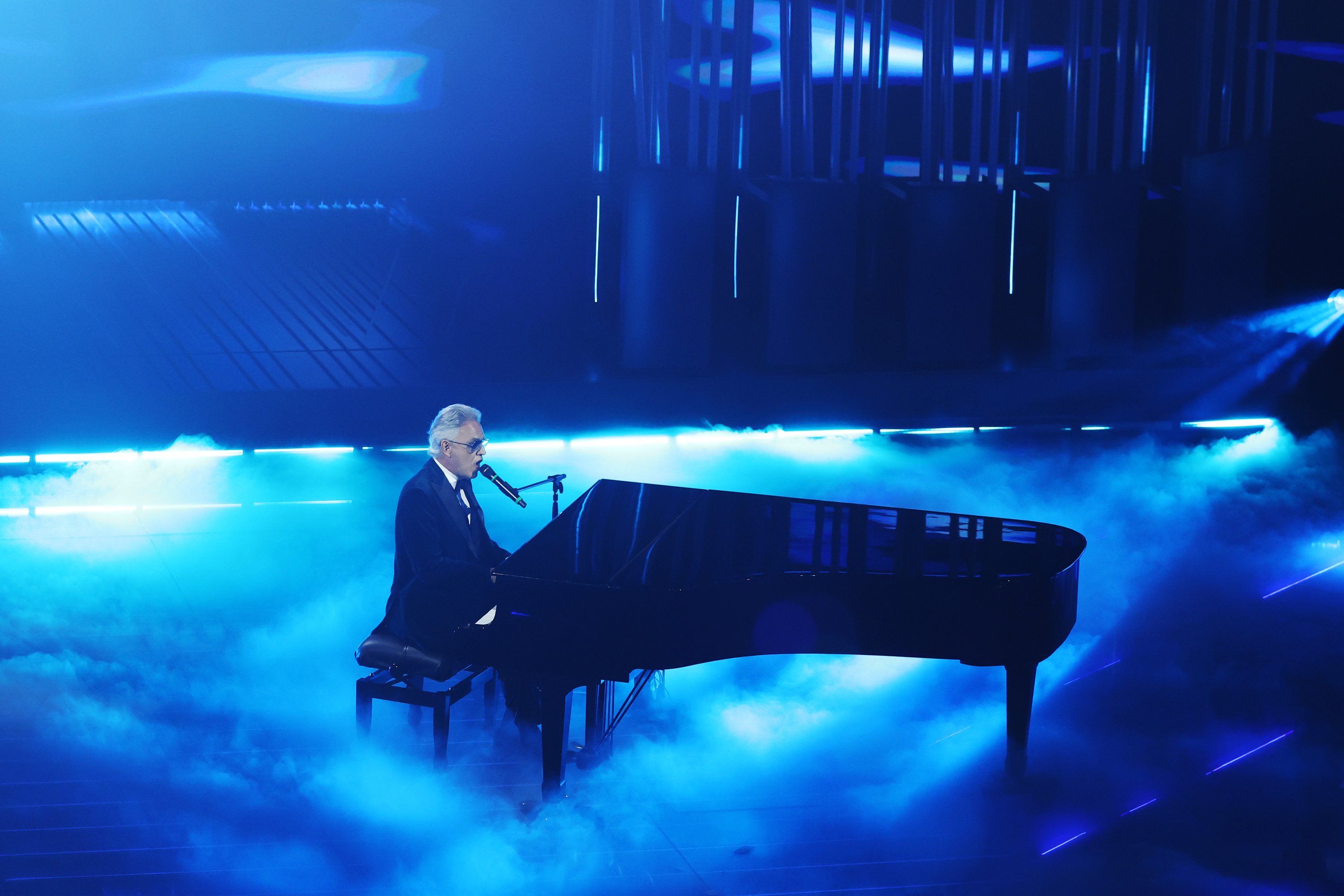
On Jan. 29, 1951, the first step was taken toward what would later become a cultural phenomenon uniting the Italian people: a music competition held in the Italian city of Sanremo, now known as the Sanremo Music Festival (Festival di Sanremo).
“You are far more than just a Festival; I have always considered you a collective rite. When your curtain rises, Italy comes to a halt, listens, and rediscovers itself. You are a mirror of our society, reflecting its joys and sorrows in all their forms and evolutions.”
These words were written by Pippo Baudo in a letter addressed to the festival in 2025. One of Italy’s most iconic television showmen and a figure long associated with the festival, Baudo revealed Sanremo’s central role in Italian culture, portraying it as a shared national ritual rather than merely a music competition.
As Italy’s first television broadcast would not begin until 1954, the event, then referred to as the “Italian Song Festival,” was initially transmitted via radio and the competition featured only three songs.
Following its first television broadcast in 1955, the festival’s success proved lasting. From that moment on, each annual edition would continue to captivate the entire nation, bringing vast audiences across Italy together in front of their screens.
Today, numerous songs that achieved worldwide fame first emerged from the Sanremo stage. Among the most iconic is “Nel Blu Dipinto di Blu (Volare)” ("In the Blue Painted Blue (Flying)"), which won the festival performed by Domenico Modugno and Johnny Dorelli in 1958.
Other internationally recognized songs did not win the competition but were first introduced there. These include “Felicita,” performed by Al Bano and Romina Power, which placed second in 1982, and “L’Italiano,” which finished fifth in 1983, performed by Toto Cutugno. Despite their rankings, both songs went on to achieve lasting international success.
The Sanremo Music Festival has not only hosted Italian performers but has also welcomed global stars as guest artists outside the competition. Among them are Queen, Elton John, Madonna, Whitney Houston, David Bowie and Britney Spears.
One of the most memorable moments in Italian television history dates back to 1968, when Louis Armstrong competed at the Sanremo Music Festival alongside Lara Saint Paul with the song "Mi va di cantare" ("I Feel Like Singing"). Unaware of the program’s strict time constraints, Armstrong continued performing after finishing the competition song, clearly intending to move on to additional numbers.
He was gently interrupted live on air by Pippo Baudo, who was hosting the Sanremo Festival for the first time that year and would go on to present it 12 more times, a record in the festival’s history. His interruption of Armstrong entered Italian television history as an iconic moment. Baudo passed away on Aug. 16, 2025, leaving behind a legacy inseparable from the Sanremo Music Festival.
Today, the festival is inseparably linked to the city of Sanremo, as its very name suggests. The event has been held at the Teatro Ariston since 1977. In recent years, however, proposals have emerged to relocate the event due to a range of technical, logistical and economic challenges.
Despite these discussions, the idea of moving the Sanremo Music Festival away from the city has sparked strong public backlash. As a result, the festival remains in its historic home at least through 2026.
Since 2015, the winning song of the Sanremo Music Festival has been granted the right to represent Italy at the Eurovision Song Contest. Participation, however, is not mandatory: the winning artist may choose to withdraw, in which case the opportunity passes to the runner-up of the festival.
Over the years, Sanremo has proven capable of launching songs to international success. A striking example is “Zitti e Buoni” ("Quiet and Good") by Måneskin, which not only won Sanremo in 2021 but went on to achieve global recognition by winning Eurovision as well.
Since it began to be broadcast on television in 1955, the Sanremo Music Festival has captivated millions, drawing viewers to their screens year after year as a shared national ritual. What began as a simple music competition has grown into a cultural institution, a shared experience that unites generations. From the living room to the piazza, Sanremo has become more than a festival; it is a part of Italian culture, celebrated and cherished by the nation year after year.